
Best Filling Machine for Essential Oil Bottles: A Practical Buyer’s Guide
Quick Answer: What Is the Best Filling Machine for Essential Oil Bottles?
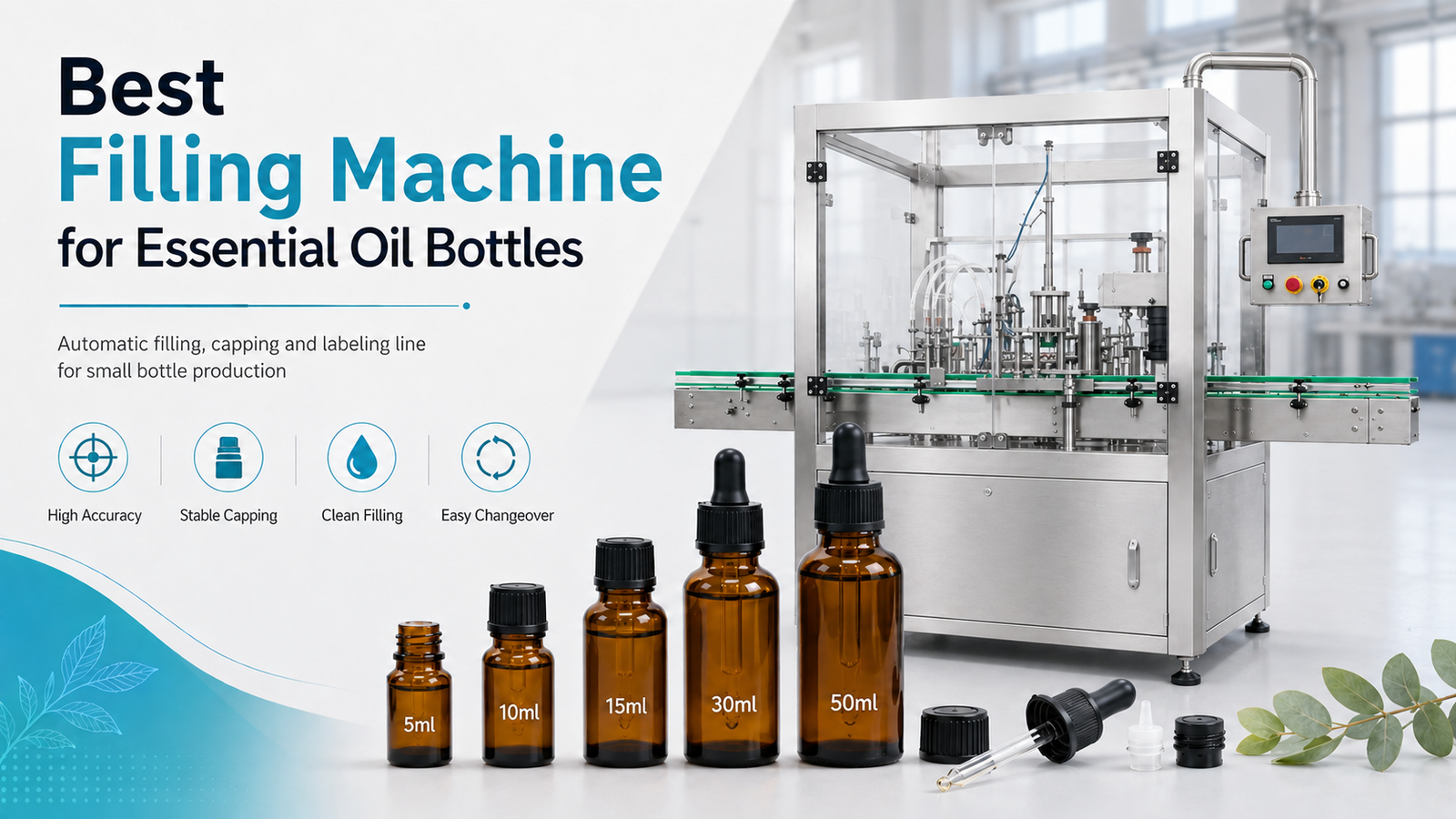
The best filling machine for essential oil bottles is usually an automatic small bottle filling, plugging, capping, and labeling line with a peristaltic pump or ceramic pump filling system. For most 5ml, 10ml, 15ml, 30ml, and 50ml glass essential oil bottles, this type of machine offers the best balance of filling accuracy, clean operation, easy changeover, and stable capping performance.
If you are filling pure essential oils, fragrance oils, CBD oil, tinctures, aromatherapy oils, or other low-viscosity liquids in small glass bottles, your machine should not only “fill liquid.” It should also control dripping, protect the bottle mouth, insert plugs or droppers smoothly, tighten caps consistently, and apply labels without bubbles or misalignment.
For buyers, the right question is not simply “Which machine is cheapest?” A better question is: “Which machine can fill my actual oil, bottle, plug, cap, and label with stable accuracy during daily production?” This guide will help you choose the right essential oil filling machine based on bottle size, oil characteristics, output requirement, automation level, and long-term production cost.
Why Essential Oil Bottles Need a Specialized Filling Machine

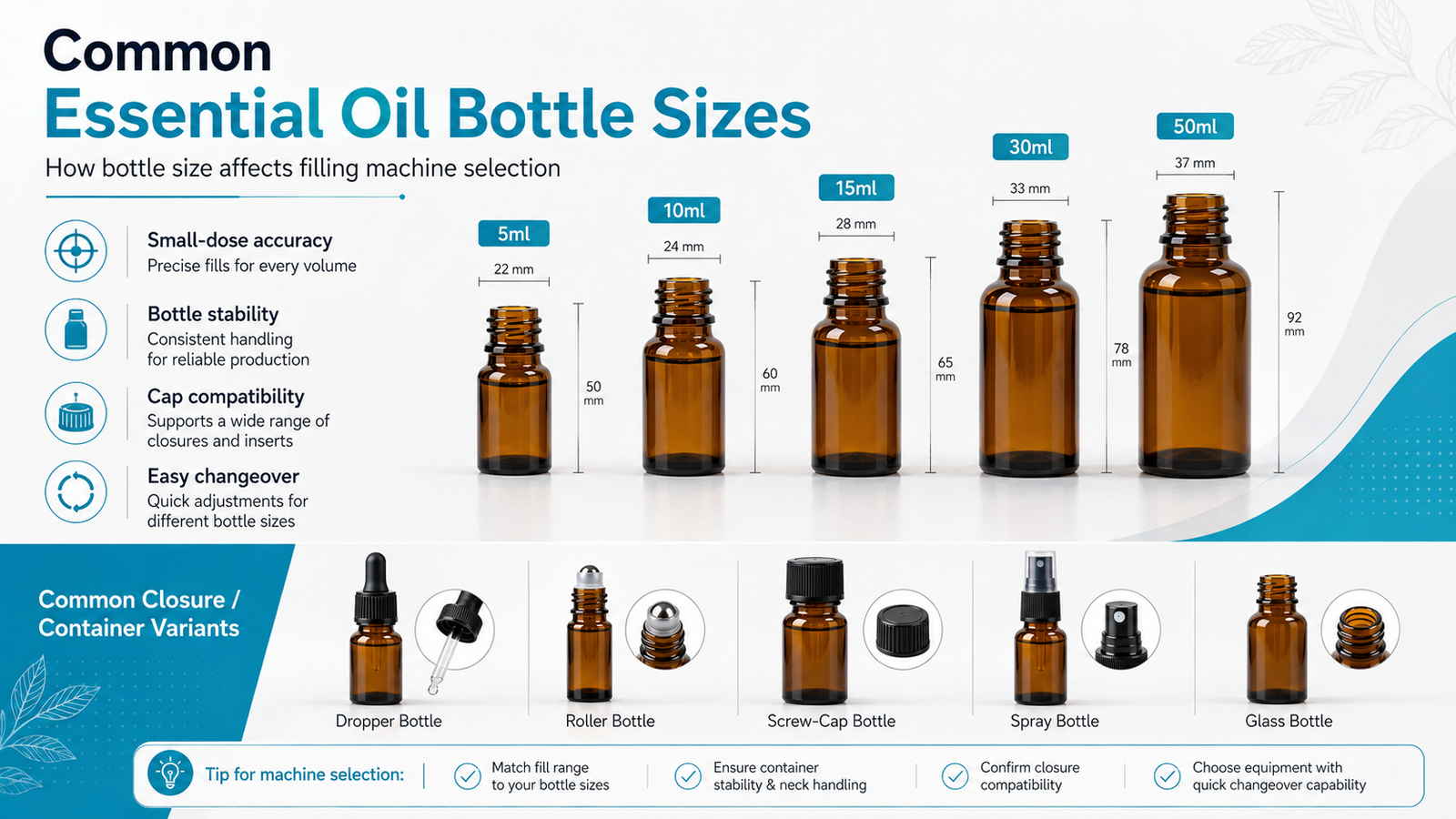
Essential oil packaging looks simple from the outside, but it is more demanding than many standard liquid filling applications. Most essential oils are packed in small glass bottles, often between 5ml and 30ml. A small filling error may look minor in milliliters, but it can become a serious cost issue when the product value is high.
Essential oils also have several production challenges:
- They are often low-viscosity and easy to drip after filling.
- Some oils are volatile and require clean, controlled handling.
- Small glass bottles can be unstable on the conveyor.
- Dropper plugs, inner stoppers, roller balls, spray pumps, and screw caps require accurate placement.
- Labels are small, so even a slight label deviation is easy to notice.
- Different bottle sizes may be used for the same product line.
This is why a good essential oil bottle filling machine should be designed around the complete packaging process, not only the filling station.
Best Machine Type by Production Scale
Different buyers need different machines. A startup brand filling 10ml bottles for online sales does not need the same system as a contract manufacturer producing thousands of bottles per hour. The table below gives a practical selection guide.
| Production Need | Recommended Machine | Best For | Main Advantage |
|---|---|---|---|
| Small batch testing | Semi-automatic peristaltic pump filler | New brands, lab samples, short runs | Low investment and simple operation |
| Growing daily production | Automatic filling and capping machine | 5ml–50ml essential oil bottles | Stable filling and lower labor cost |
| Complete retail packaging | Automatic filling capping labeling machine | Branded essential oil products | One-stop bottle packaging process |
| Multi-size bottle production | Linear automatic filling line | 5ml, 10ml, 15ml, 30ml, 50ml bottles | Easier changeover and customization |
| High-value small-dose filling | Ceramic pump or peristaltic pump system | Pure essential oils, tinctures, CBD oil | High accuracy and clean liquid path |
For most essential oil bottle manufacturers, the most practical choice is a linear automatic essential oil filling machine. It is easier to customize, easier to maintain, and more flexible when bottle sizes change. A rotary monoblock machine can save space and increase speed, but it may require more precise bottle and cap consistency.
Peristaltic Pump, Piston Pump, Ceramic Pump, or Gear Pump?
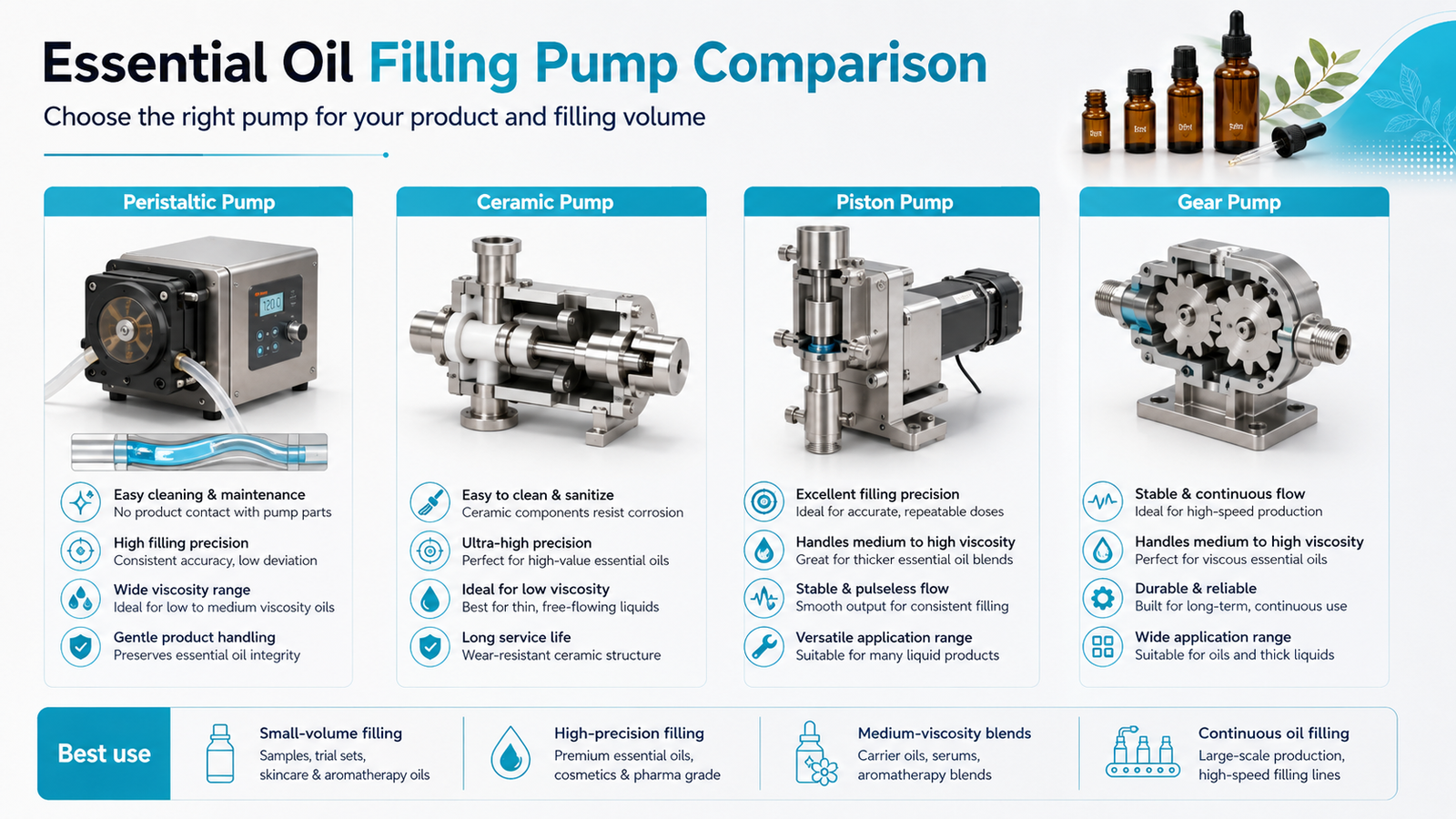
The pump system is one of the most important parts of an essential oil filling machine. It affects accuracy, cleaning, product contact, maintenance, and long-term stability.
Peristaltic Pump Filling Machine
A peristaltic pump is often a strong choice for essential oils because the liquid only contacts the tube. This makes cleaning easier and reduces cross-contamination risk when switching between different oils such as lavender, peppermint, tea tree, lemon, eucalyptus, or fragrance blends.
It is suitable for low-viscosity liquids and small filling volumes. For buyers who fill many formulas in small batches, peristaltic filling is usually very convenient.
Ceramic Pump Filling Machine
A ceramic pump is suitable for high-precision small-volume filling. It is often used when the buyer needs better wear resistance, stable dosing, and clean operation. For premium essential oils or pharmaceutical-style small bottles, a ceramic pump can be a good option.
Piston Pump Filling Machine
A piston pump is commonly used for medium to higher viscosity liquids. If your product is not pure essential oil but a thicker oil blend, serum, lotion-like oil, or carrier-oil mixture, a piston pump may be more suitable. However, for very small 5ml or 10ml bottles, the filling system must be carefully configured for accuracy.
Gear Pump Filling Machine
A gear pump can handle stable flow and repeatable filling for certain oils. It may be suitable for some fragrance oils, carrier oils, or slightly thicker liquid products. The final choice depends on viscosity, filling volume, speed requirement, and cleaning method.
In simple terms: choose a peristaltic pump for easy cleaning and small-batch formula changes, a ceramic pump for high-precision small-volume filling, a piston pump for thicker liquid blends, and a gear pump for stable continuous oil filling.
Key Features to Check Before Buying
1. Filling Accuracy
For 10ml essential oil bottles, filling accuracy is not just a technical number. It directly affects product cost, customer trust, and label compliance. Ask the supplier to test your actual oil and bottle. Do not rely only on general machine specifications.
A good supplier should be able to provide a test video, sample filling result, and recommended pump type based on your liquid.
2. Anti-Drip Nozzle Design
Essential oils are easy to drip because many formulas are thin and have strong flow. Dripping can stain the bottle, affect label adhesion, and make the finished product look unprofessional. A good essential oil filling machine should use anti-drip nozzles, accurate suck-back control, or customized filling heads.
3. Bottle Stability on Conveyor
Small glass bottles are narrow and easy to fall during movement. The conveyor should include proper bottle guiding, star wheel or positioning device, and adjustable rails. If you use round bottles, square bottles, amber glass bottles, or roller bottles, the machine layout should be tested accordingly.
4. Plugging and Capping Performance
Many essential oil bottles use inner plugs, dropper inserts, roller balls, or child-resistant caps. The machine must place these parts correctly before capping. Poor plug insertion can cause leakage. Poor capping torque can cause loose caps, broken caps, or customer complaints.
For this reason, buyers should check whether the machine can handle their exact plug and cap type, not just the bottle size.
5. Labeling Accuracy
Essential oil labels are often small, premium-looking, and brand-sensitive. A label that is slightly tilted may reduce the perceived quality of the product. If your line includes labeling, check whether the labeling machine supports round bottle labeling, wrap-around labeling, transparent labels, and date coding.
6. Material and Cleanability
For essential oil filling, product-contact parts should be clean, corrosion-resistant, and suitable for the oil formula. Stainless steel contact parts and food/cosmetic-grade tubing are commonly preferred. If you fill different formulas, easy disassembly and cleaning are important.
Recommended Complete Line for Essential Oil Bottles
A practical syandard automatic essential oil filling line may include:
- Bottle unscrambler or bottle feeding table
- Peristaltic pump or ceramic pump filling station
- Inner plug or dropper insertion station
- Cap feeding and capping station
- Round bottle labeling machine
- Inkjet printer or laser marking system
- Cartoning packing machine
- Finished bottle collecting table
For a 10ml essential oil filling machine, the line should be compact but stable. For 30ml or 50ml bottles, the machine may need wider guiding rails and adjusted conveyor settings. If you plan to fill several bottle sizes, ask the supplier about changeover time, required tools, and whether bottle molds are needed.
How to Choose the Right Machine: Buyer Checklist

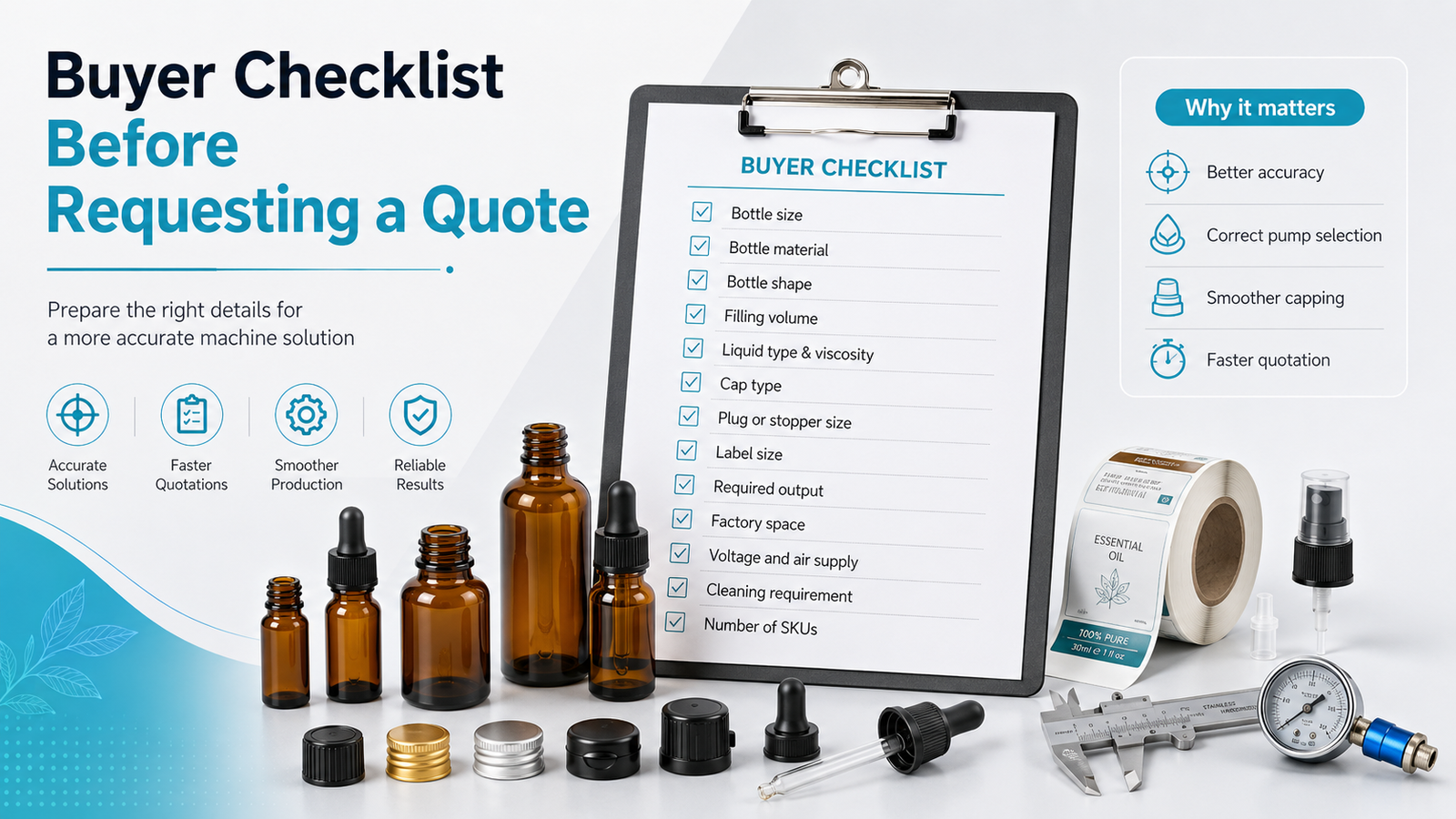
Before requesting a quotation, prepare the following details:
- Bottle size: 5ml, 10ml, 15ml, 30ml, 50ml, or custom size
- Bottle material: glass, PET, amber glass, clear glass, or plastic
- Bottle shape: round, square, flat, roller bottle, dropper bottle
- Filling volume and target accuracy
- Liquid type and viscosity
- Cap type: screw cap, dropper cap, child-resistant cap, spray pump, roller ball
- Inner plug or stopper size
- Label size and label roll direction
- Required output per hour
- Available factory space
- Voltage and air supply
- Cleaning requirement
- Number of SKUs and daily changeover frequency
The more accurate your information is, the more accurate the machine solution will be. A reliable supplier should not only quote a price. They should confirm your bottle, cap, plug, label, filling volume, and production target before recommending the final configuration.
Common Mistakes When Buying an Essential Oil Filling Machine
Mistake 1: Only Comparing Machine Price
A cheaper machine may become expensive if it wastes oil, causes leaking caps, needs frequent adjustment, or cannot handle your future bottle sizes. Always compare total cost of ownership, not only purchase price.
Mistake 2: Ignoring the Cap and Plug
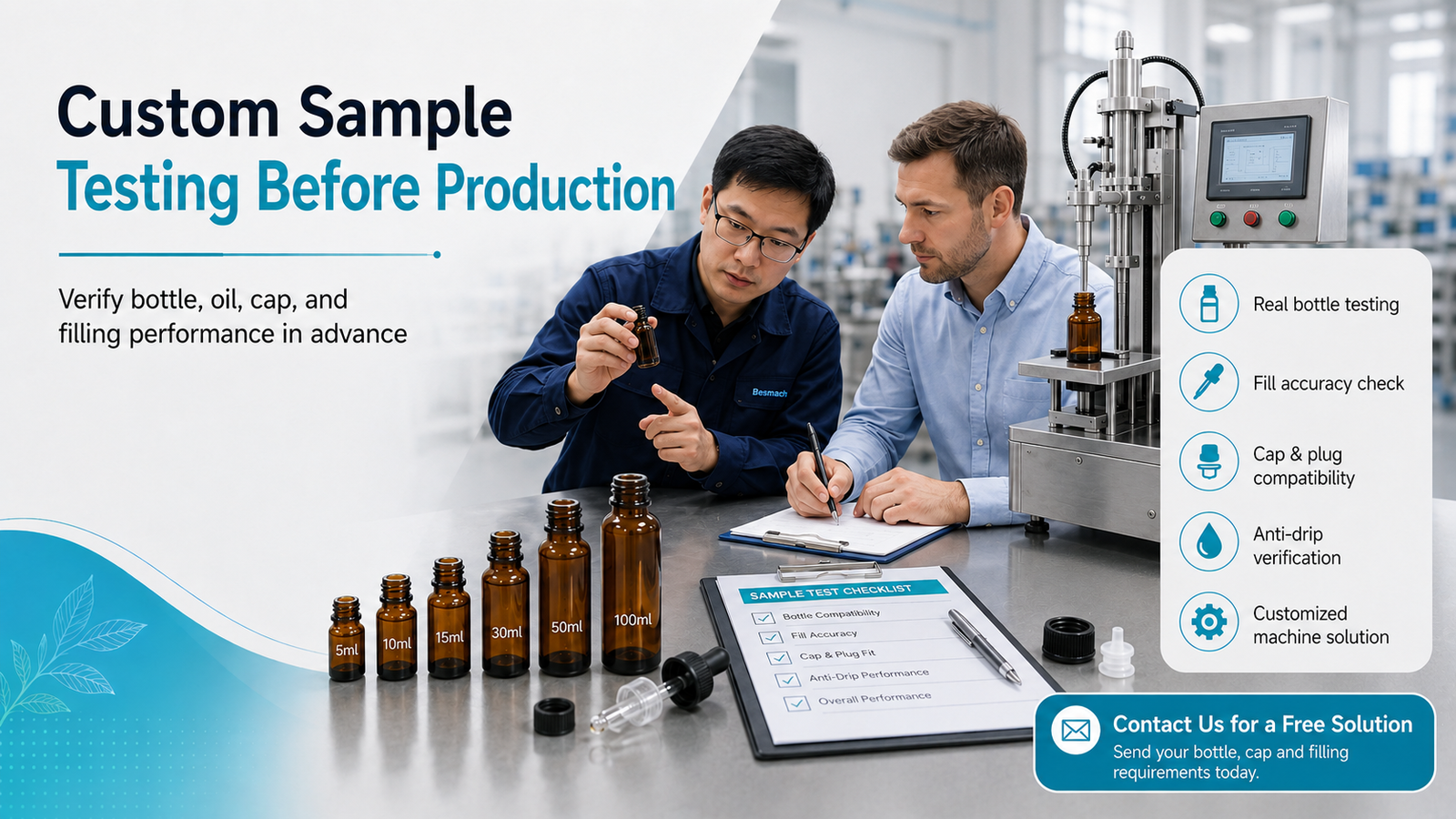
Many buyers focus on filling accuracy but forget plugging and capping. In real production, capping problems often cause more downtime than filling problems. Always send real samples of your bottle, plug, and cap for testing.
Mistake 3: Buying a Machine Without Testing Actual Samples
Essential oil formulas can behave differently. Some are very thin. Some are slightly sticky. Some may react with certain tubing materials. Sample testing is the safest way to confirm the machine.
Mistake 4: Not Planning for Future Bottle Sizes
If you currently fill 10ml bottles but plan to add 15ml, 30ml, or 50ml bottles later, tell your supplier in advance. A flexible machine design can save future modification cost.
Mistake 5: Forgetting Labeling and Coding
A bottle is not ready for sale after filling and capping only. Retail essential oil products usually need labels, batch numbers, production dates, or expiration dates. Adding labeling and coding into the line from the beginning can improve production efficiency.
What Makes a Good Supplier?
A good essential oil filling machine supplier should understand both machinery and packaging details. Look for a supplier who can:
- Review your bottle, cap, plug, and label before quoting
- Recommend the correct pump type
- Provide sample testing before production
- Customize bottle guiding and capping parts
- Offer filling, capping, labeling, and coding as a complete line
- Provide operation videos and training
- Support spare parts and after-sales service
- Explain changeover and maintenance clearly
For international buyers, communication is also important. The supplier should help you confirm technical details before production, not after the machine is finished.
People Also Ask / FAQ:
For 10ml essential oil bottles, an automatic peristaltic pump filling capping machine is usually a good choice. It offers clean filling, good accuracy, and easy changeover for small glass bottles. If higher precision is required, a ceramic pump can also be considered.
Yes, one machine can often fill multiple bottle sizes if the bottle shape, cap type, and line design are considered in advance. Some parts may need adjustment or replacement, such as bottle guides, filling height, capping heads, or positioning parts.
Yes. A peristaltic pump is commonly used for low-viscosity liquids and small-volume filling. It is especially useful when the buyer fills different essential oil formulas and wants easier cleaning.
If you are producing retail-ready essential oil bottles, a full filling capping labeling line is usually better than buying separate machines. It reduces labor, improves consistency, and makes the packaging process easier to control.
The speed depends on filling volume, number of nozzles, bottle stability, cap type, plug insertion, and labeling requirement. A small automatic line may produce hundreds to several thousand bottles per hour depending on configuration.
You should send bottle samples, caps, plugs, labels, filling volume, liquid information, target speed, and photos or videos of your current packaging process. This helps the supplier design the right machine and avoid unnecessary mistakes.
Final Recommendation
The best filling machine for essential oil bottles is not always the most expensive machine. It is the machine that matches your real bottle, oil, plug, cap, label, and production plan.
For most essential oil brands and manufacturers, a customized automatic essential oil filling capping labeling machine with peristaltic or ceramic pump filling is the most practical solution. It gives you better filling accuracy, cleaner bottles, more stable capping, and a more professional finished product.
If you are planning to package 5ml, 10ml, 15ml, 30ml, or 50ml essential oil bottles, the best next step is to test your actual samples before finalizing the machine.
Need a Custom Essential Oil Filling Solution?
Send us your bottle size, filling volume, cap type, plug type, label size, and target production speed. Our team can help you design a suitable automatic essential oil filling machine or complete filling capping labeling line for your production needs.
Request a free solution and machine quotation today.

Great content! Keep up the good work!