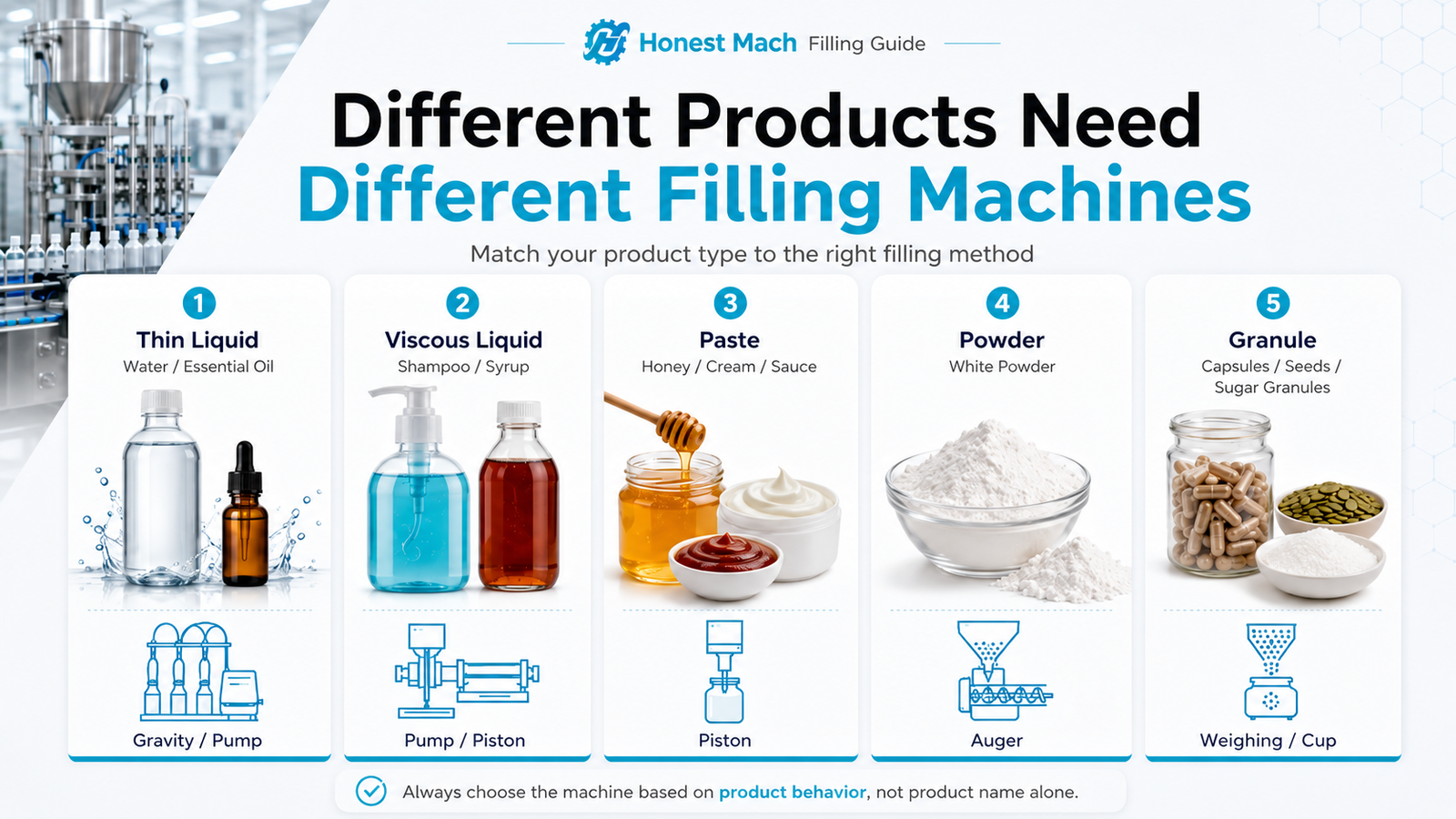
 Before asking for a quotation, you should first understand your product clearly. A professional filling machine supplier cannot give an accurate solution only based on the product name. “Liquid filling machine” is too general. Water, oil, syrup, nail polish, eye drops, and detergent are all liquids, but they require different filling structures.
Liquid, Paste, Powder, or Granule?
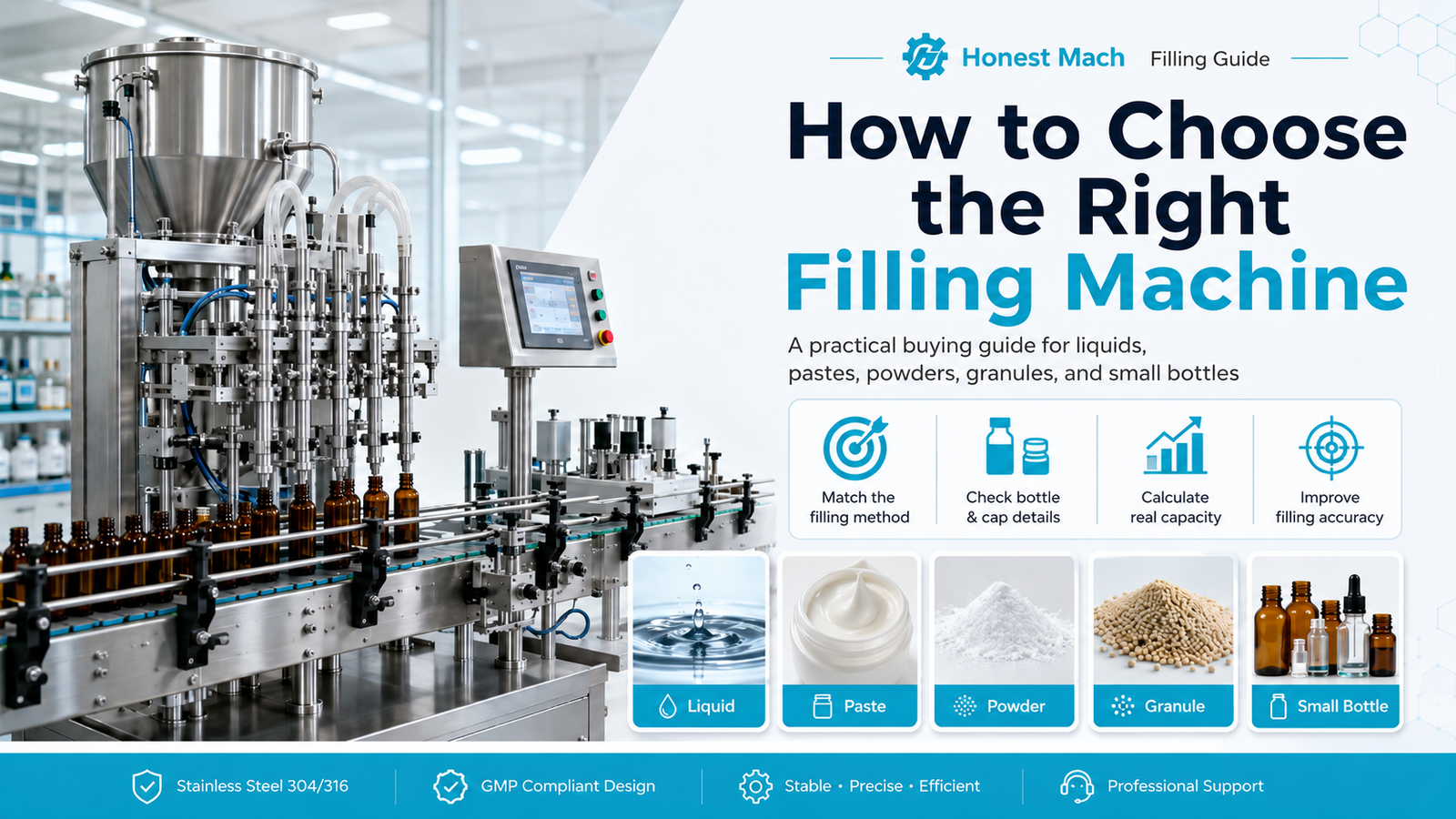
Start by classifying your product:
| Product Type | Common Examples | Suitable Filling Machine |
|---|---|---|
| Thin liquid | water, alcohol, essential oil, perfume | gravity filler, overflow filler, pump filler |
| Viscous liquid | syrup, shampoo, lotion, detergent | piston filler, gear pump filler, rotor pump filler |
| Paste | sauce, honey, cream, gel, balm | piston filling machine, servo piston filler |
| Powder | flour, milk powder, spice powder, protein powder | auger filling machine |
| Granule | seeds, sugar, salt, capsules, small particles | weighing filler, cup filler, counting filler |
| Small dose liquid | eye drops, e-liquid, reagent, vial products | peristaltic pump filler, ceramic pump filler, micro-dose filling machine |
This first step is important because different filling machines measure and move the product in different ways.
Viscosity, Foam, Particles, and Temperature
The second step is to check product behavior during filling.
Ask yourself:
- Is the product thin or thick?
- Does it foam easily?
- Does it contain particles, pulp, seeds, herbs, or fibers?
- Is it corrosive?
- Is it flammable?
- Does viscosity change when temperature changes?
- Does the product need heating or mixing before filling?
- Is it easy to crystallize, dry, or block the nozzle?
For example, a foaming liquid needs anti-foam filling methods, diving nozzles, or overflow filling technology. A sauce with particles needs larger valves and suitable nozzles to prevent clogging. A cosmetic cream may need a hopper with heating and stirring. A corrosive chemical may require special contact materials instead of standard stainless steel.
Many buyers only send a bottle photo and ask for the best price. A better approach is to send product viscosity, filling volume, bottle size, cap type, target speed, and product video. This helps the supplier recommend a machine that fits your real production condition.
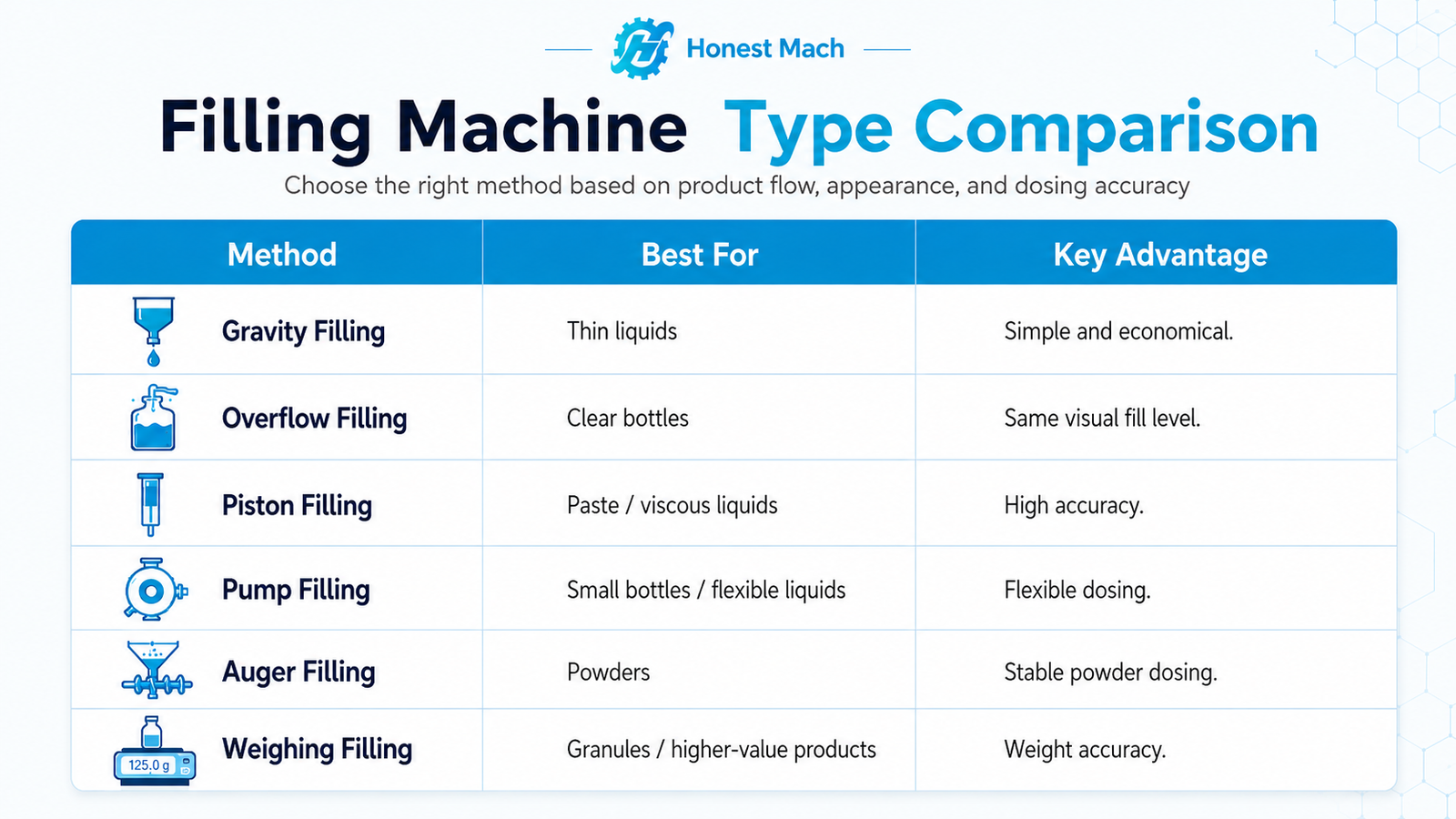 Different filling methods are designed for different products and accuracy requirements. Below is a practical comparison.
| Filling Method | Best For | Advantages | Limitations |
| Gravity filling | thin, free-flowing liquids | simple, economical, easy to operate | not ideal for thick products |
| Overflow filling | thin liquids requiring same visual fill level | excellent bottle appearance | not always best for exact volume |
| Piston filling | viscous liquids and pastes | accurate, strong, widely used | cleaning may take longer |
| Pump filling | small to medium liquid volumes | flexible, good for many liquids | pump type must match product |
| Peristaltic pump filling | small-dose liquid, sterile or clean products | product only contacts tube | not ideal for all high-speed lines |
| Auger filling | powders | good dosing control | powder dust control is needed |
| Weighing filling | granules, expensive products, large volume | high accuracy by weight | speed may be slower |
| Net weight filling | high-value liquid or large containers | accurate by weight | higher cost and more complex control |
If you are filling clear bottles where shelf appearance is important, level consistency may matter more. That is why overflow filling is often used when the visual fill line should look the same across bottles.
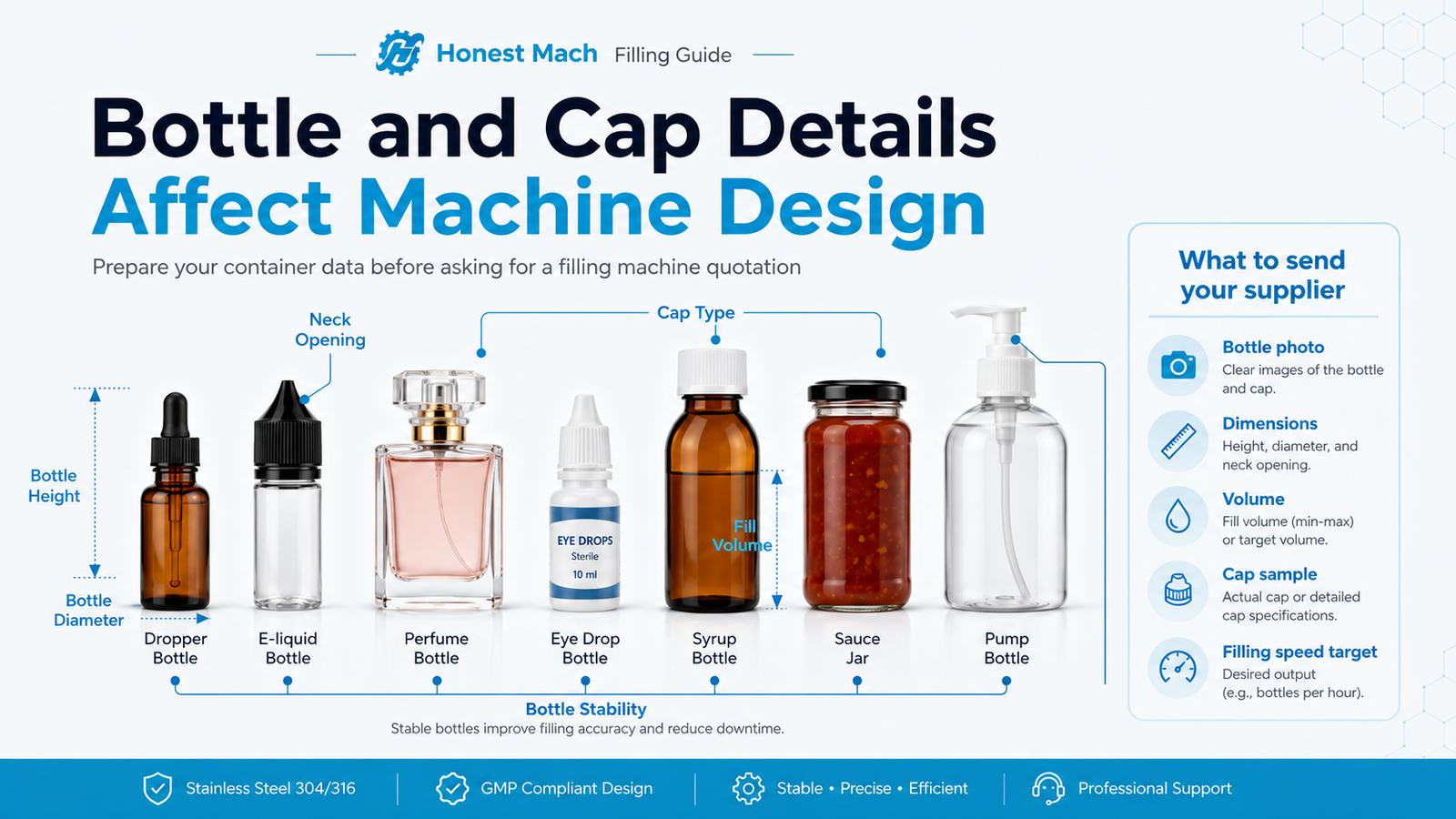 A filling machine must work with your product, but it must also work with your container. Many machine problems come from bottle instability, narrow openings, irregular shapes, soft plastic bottles, or poor cap feeding.
Prepare these details before buying:
- bottle material: glass, PET, HDPE, aluminum, tin, pouch, jar
- bottle shape: round, square, flat, irregular
- bottle size and height
- neck diameter and opening size
- filling volume range
- cap type: screw cap, dropper cap, pump cap, press cap, trigger, cork, plug
- label position and packaging style
- whether you have multiple bottle sizes
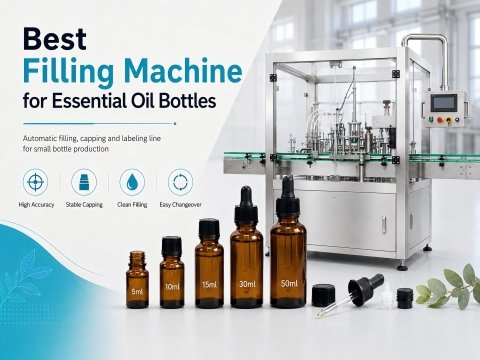
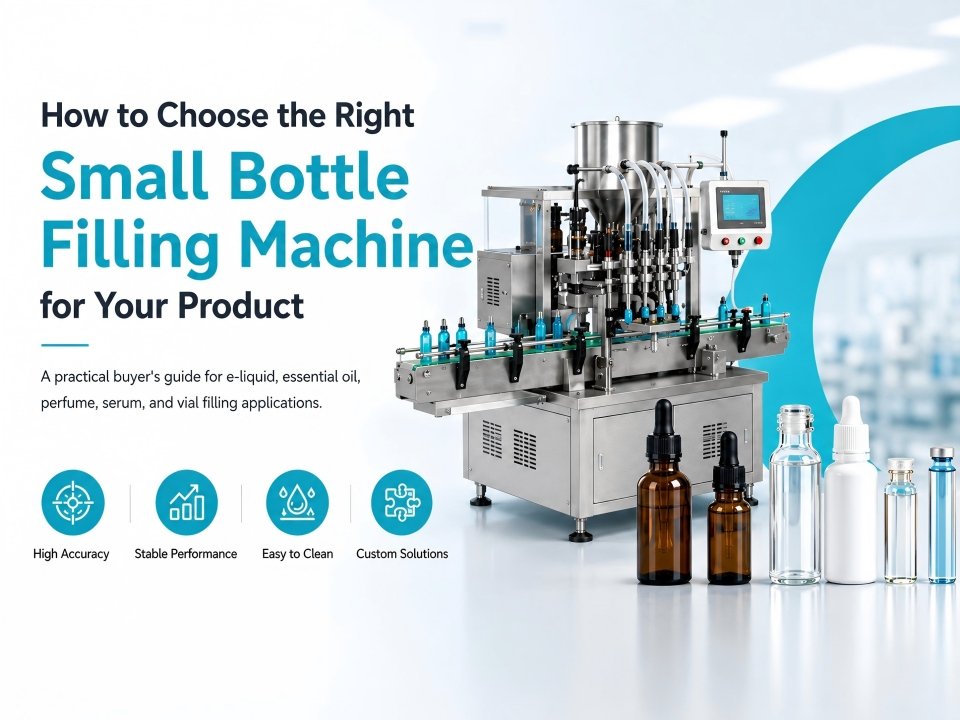
Small bottles such as 5ml, 10ml, 15ml, 30ml, and 60ml often require more precise positioning than large bottles. For eye drops, e-liquid, essential oil, perfume, and vial products, the machine may also need bottle unscrambling, precise filling, plug inserting, cap placing, capping, labeling, and collecting table.
If you plan to use different bottles on the same machine, ask the supplier how long changeover takes and which parts need to be changed. A cheaper machine with slow changeover may cost more in daily production.
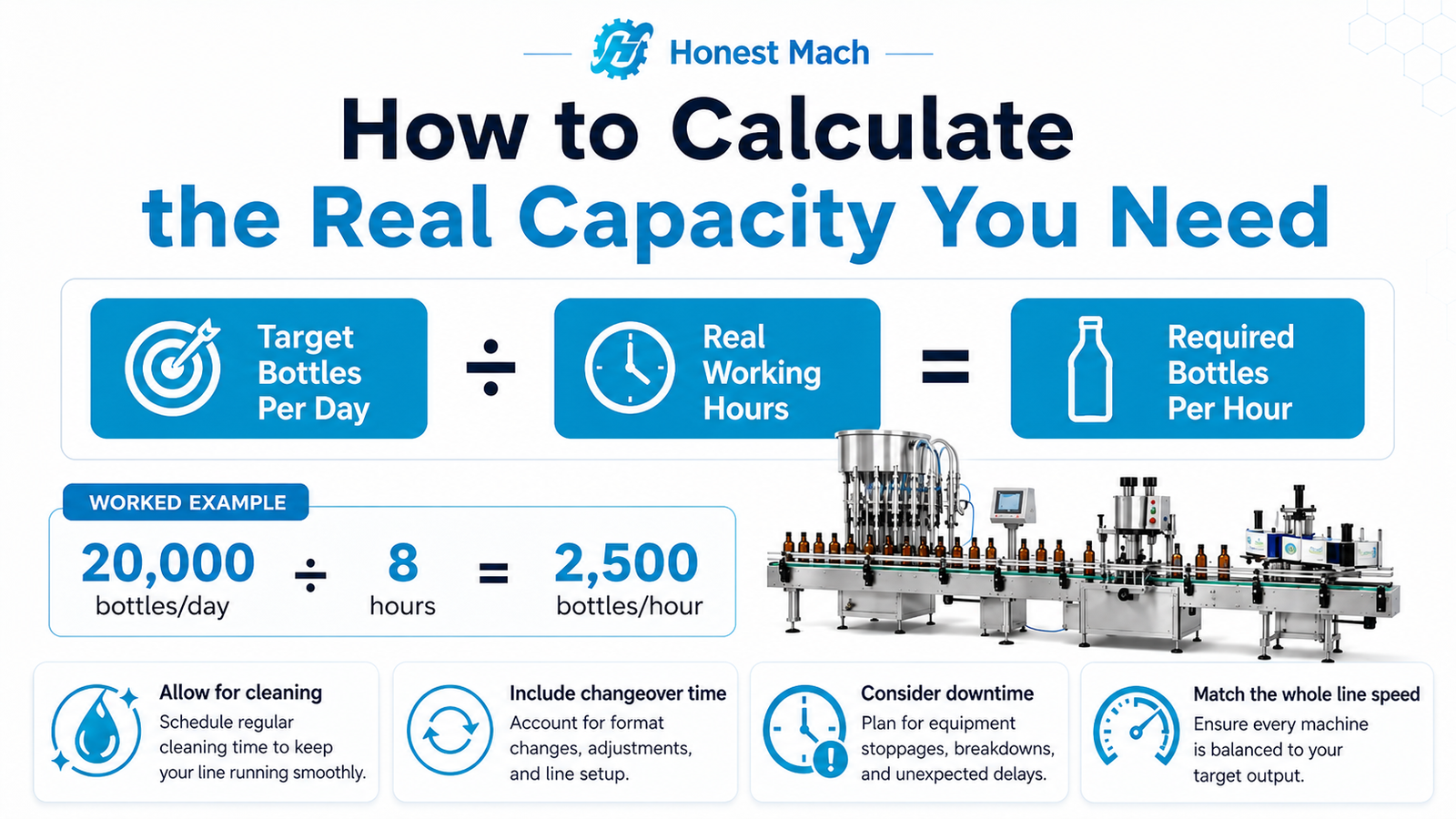
Do not choose a filling machine only by “bottles per hour” shown in a catalog. The real speed depends on filling volume, viscosity, number of filling heads, bottle handling, capping speed, labeling speed, operator skill, and changeover time.
A simple calculation is:
Target bottles per day ÷ real working hours = required bottles per hour
For example, if you need 20,000 bottles per day and your real production time is 8 hours, you need at least 2,500 bottles per hour. But you should also consider cleaning, lunch break, bottle changeover, cap refilling, label roll change, and possible downtime. In this case, choosing a line designed for 3,000 to 3,500 bottles per hour may be safer.
Also ask whether the quoted speed is based on water testing or your real product. Thick liquid, foam, particles, and small neck bottles can reduce speed. A stable machine running at 2,000 bottles per hour may be better than a machine that claims 4,000 bottles per hour but stops frequently.
When buying a filling machine, many buyers focus on speed first. In real production, accuracy and stability are often more important.
You should ask:
- What is the expected filling accuracy?
- Is the accuracy tested with water or with my product?
- How many bottles were tested continuously?
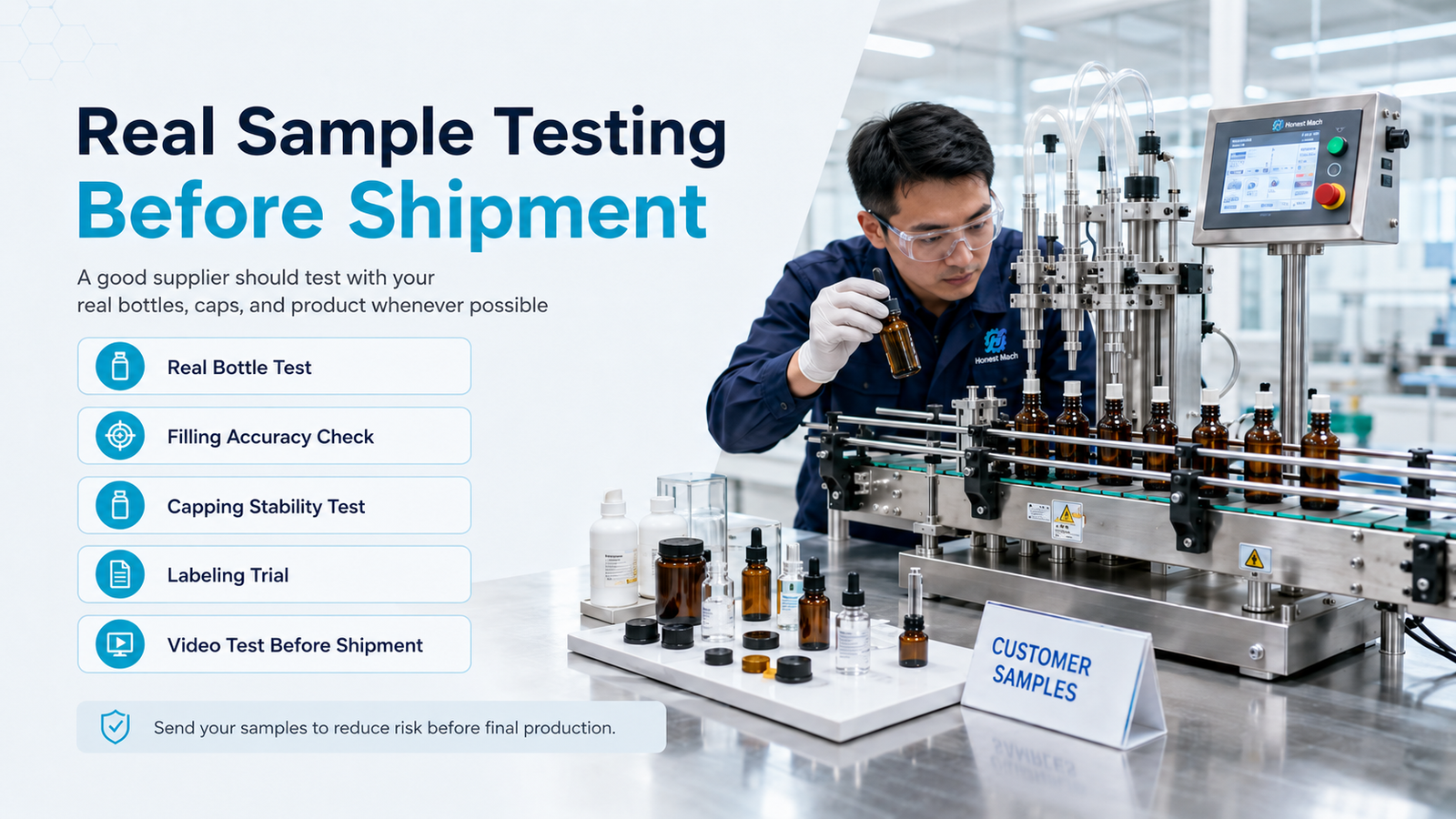
- Can I see a test video with my real samples?
- Does the machine drip after filling?
- Is there foam control?
- Can the machine save recipes for different products?
- Does it use servo control, PLC, touch screen, or manual adjustment?
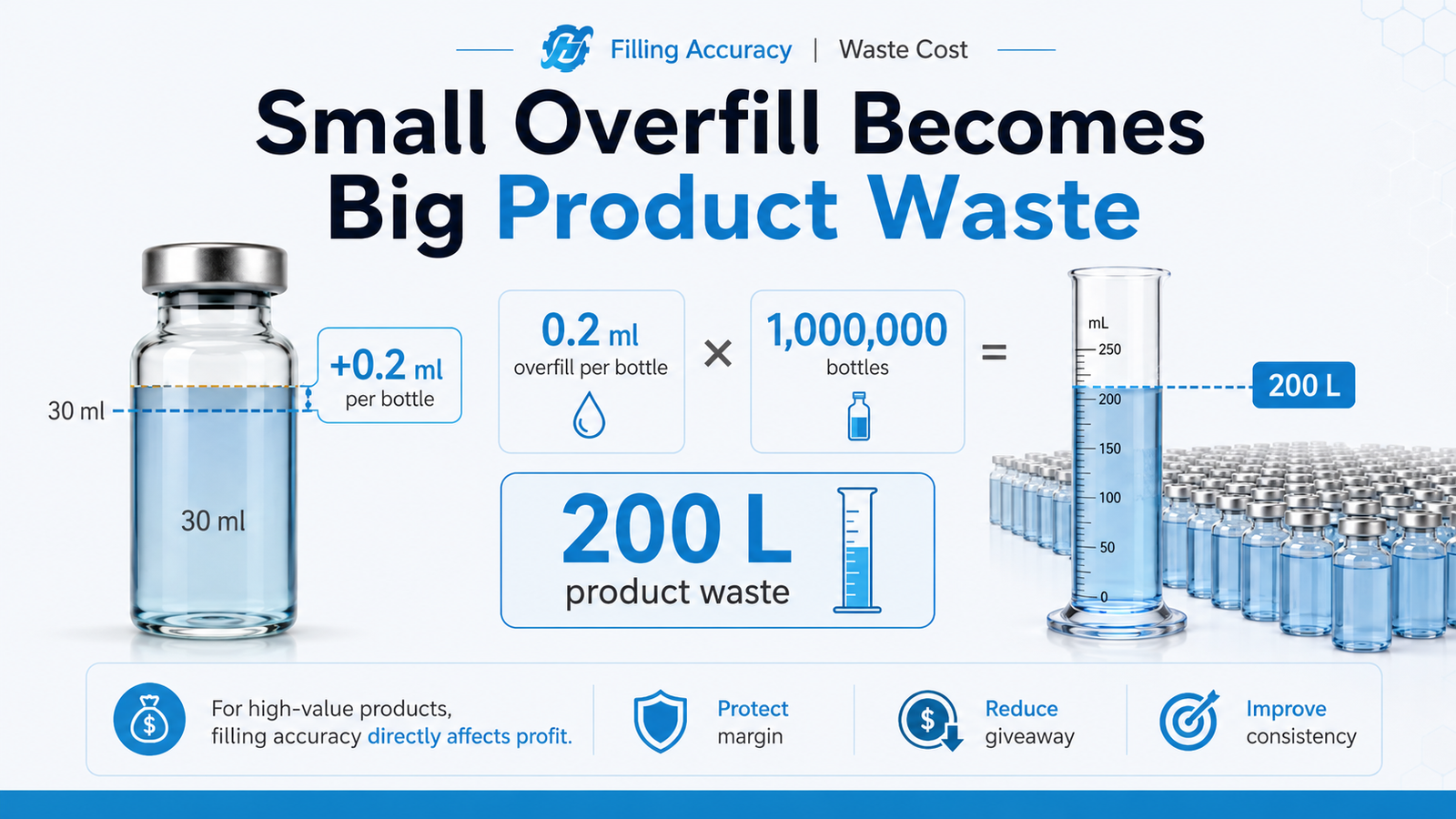
For high-value small bottle products, a small error can create big losses. For example, overfilling 0.2ml per bottle may look small, but it becomes 200 liters of product waste after one million bottles.
A good supplier should be able to explain how the machine controls accuracy, how it prevents dripping, and how it handles product changes.
The best filling machine is not the most expensive one or the fastest one. It is the machine that matches your product, bottle, production target, cleaning needs, compliance requirements, and future growth plan.
Before buying, prepare your product sample, bottle drawings, cap type, filling volume, target speed, and packaging process. A professional supplier can use this information to recommend the right liquid filling machine, bottle filling machine, or complete automatic filling line.
If you are planning a new filling project, send us your bottle size, product type, filling volume, and target capacity. Our team can help you evaluate the right filling solution and provide a customized recommendation for your production line.