
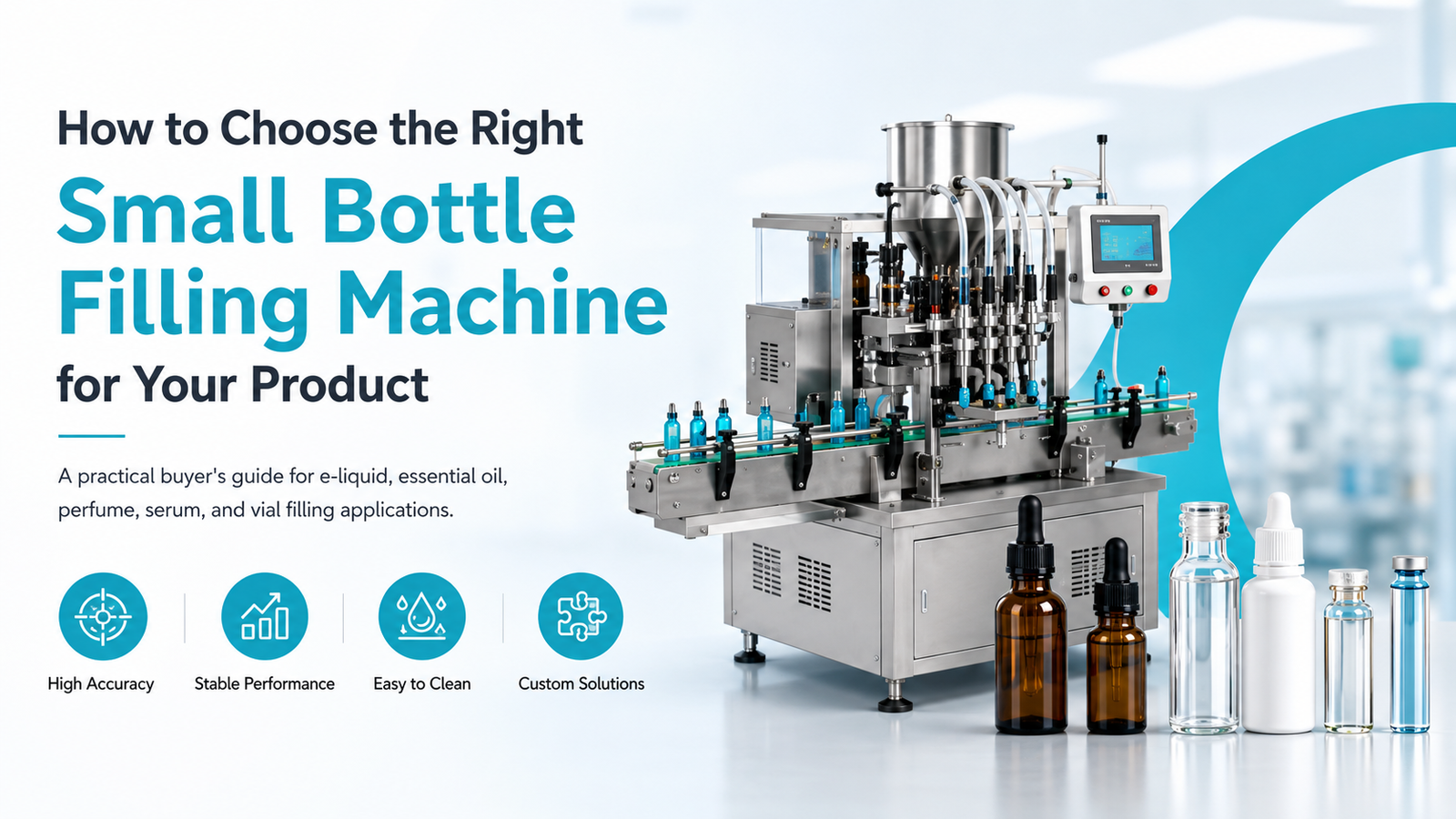
How to Choose the Right Small Bottle Filling Machine for Your Product

small-bottle-filling-machine-selection-guide

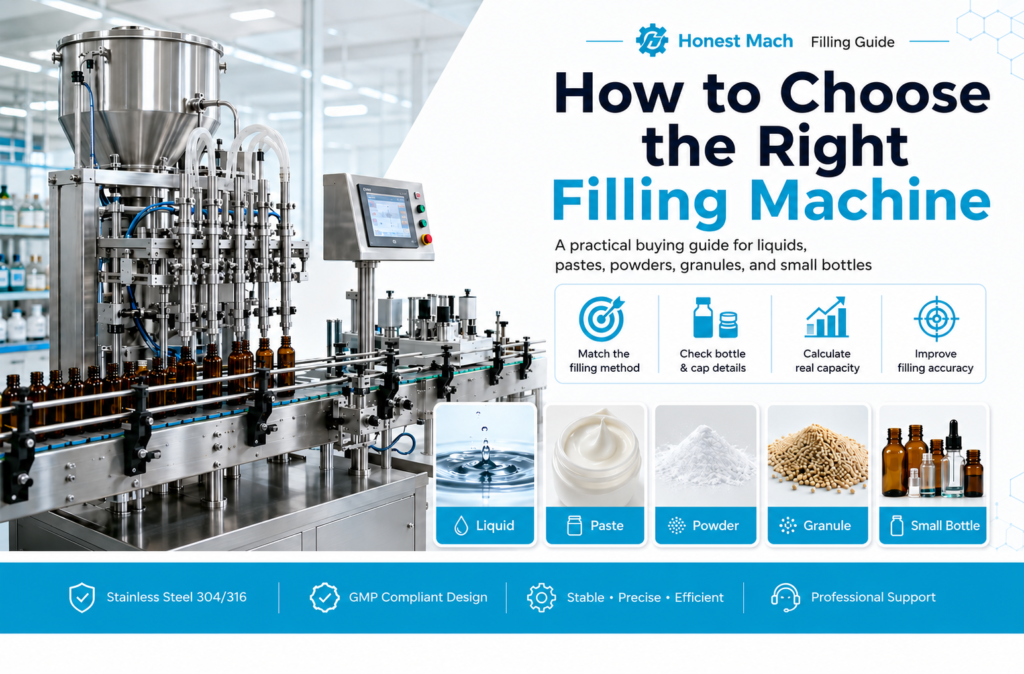
Choosing a small bottle filling machine is not only about finding a machine that can “fill liquid into bottles.” For most buyers, the real question is: Which filling solution can handle my product accurately, cleanly, and efficiently without creating problems after installation?

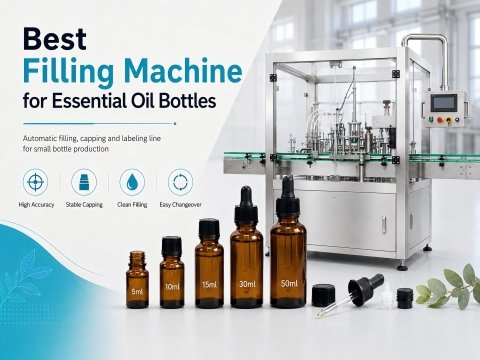
If you are filling e-liquid, essential oil, perfume, oral liquid, cosmetic serum, eye drops, reagent, CBD oil, or small-volume pharmaceutical-style products, the details matter. A small bottle usually has a narrow opening, a low filling volume, and a higher requirement for dosing accuracy. A small mistake in machine selection can lead to dripping, foaming, unstable filling volume, difficult cleaning, slow output, or poor bottle handling.

This guide explains how to choose the right small bottle filling machine from a buyer’s point of view. It will help you understand the key technical factors, compare machine types, prepare your inquiry information, and avoid common mistakes before you place an order.

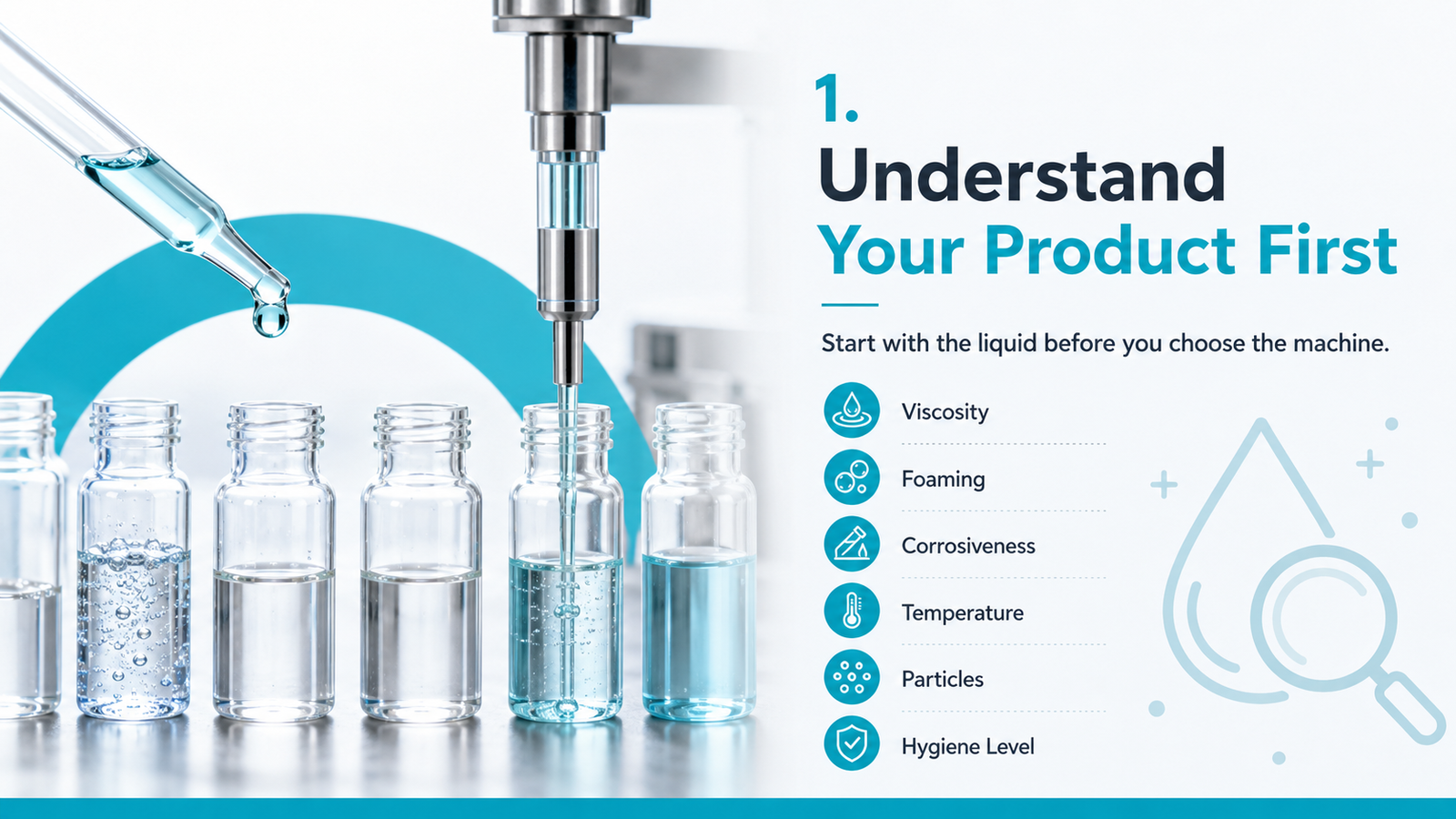
1. Understand Your Product First

Liquid Characteristics for Filling Machine Selection
Liquid characteristics for small bottle filling machine selection including viscosity, foaming, particles and hygiene level

The best filling machine is always selected around the product, not the machine catalog.before asking for a quotation, you should clearly define your liquid characteristics. A supplier cannot recommend the right filling system if they only know the bottle volume. The same 30ml bottle may require different filling technology depending on whether the product is thin, oily, foamy, corrosive, or highly viscous.

Key product details to confirm:

  • Product name and application
  • Liquid viscosity: thin, medium, or thick
  • Product behavior: foaming, dripping, crystallizing, sticky, or volatile
  • Filling temperature: room temperature, heated, or hot fill
  • Product compatibility with stainless steel, silicone, PTFE, or other contact materials
  • Hygiene level required: cosmetic, food, pharmaceutical, chemical, or laboratory use
  • Whether the product contains particles or suspended ingredients

For example, perfume and alcohol-based products are usually thin and volatile, so anti-drip nozzles and explosion-safe considerations may be important. Essential oil is also thin, but it may require high accuracy and strong sealing because the product value is high. E-liquid may have different VG/PG ratios, meaning the viscosity can change from batch to batch. Cosmetic serum may need a piston or servo pump system if it is thicker and sticky.

The more specific your product data is, the more accurate the machine recommendation will be.
2. Match the Filling Method to Your Liquid

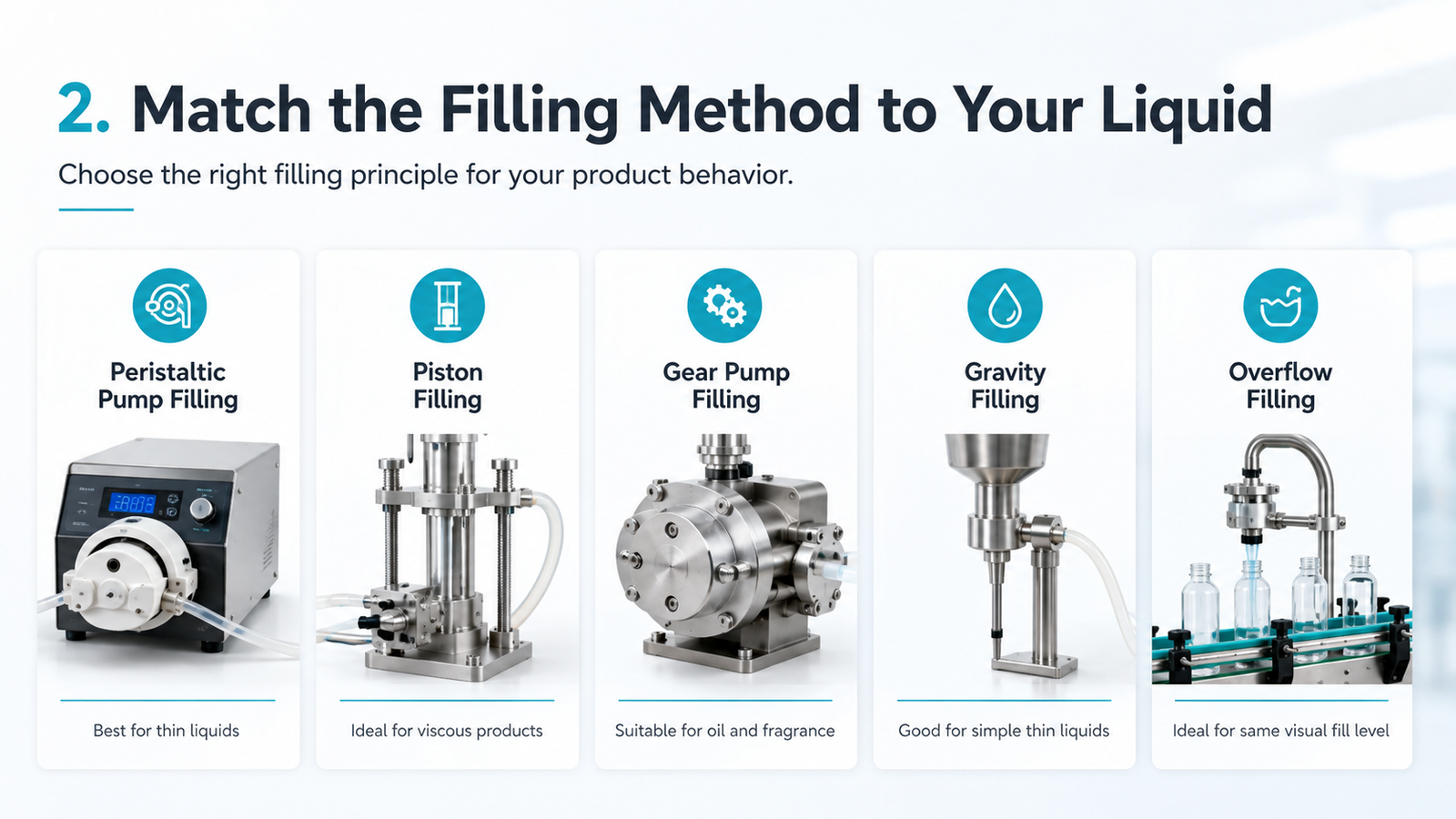
Small Bottle Filling Method Comparison
Comparison of peristaltic pump, piston, gear pump, gravity and overflow filling methods for small bottles

Small bottle filling machines commonly use several filling principles. Each one has advantages and limitations. Do not choose only based on price. Choose based on your product, accuracy requirement, and production plan.

Filling MethodBest ForAdvantagesLimitations
Peristaltic Pump FillingEssential oil, e-liquid, reagent, oral liquid, sterile-style small bottlesClean, easy tube replacement, liquid only contacts tubingNot ideal for very thick products or high-speed large output
Piston FillingCream, gel, serum, sauce, thicker liquidStrong filling force, good for viscous products, stable volumeMore contact parts to clean
Gear Pump FillingOil, fragrance, cosmetic liquid, medium-viscosity productsAccurate, good flow control, suitable for automatic linesRequires proper material selection and cleaning
Gravity FillingThin, free-flowing liquidSimple structure, lower costLess suitable for high-accuracy small dosage
Overflow FillingProducts requiring same visual fill levelGood shelf appearanceNot always best for expensive small-volume products

For many small bottle applications, peristaltic pump filling is popular because it is clean and easy to change over. The liquid only passes through the tube, which helps reduce cleaning time when switching flavors, fragrances, or formulas. However, if your product is thick or sticky, a piston filling machine may be more stable.

For high-value products such as essential oil, fragrance, and CBD oil, filling accuracy is often more important than maximum speed. Losing even 0.2ml per bottle may become expensive when production volume increases. In this case, servo-controlled pumps, high-quality nozzles, and stable bottle positioning are worth the investment.
3. Confirm Bottle Size, Opening, and Closure Type

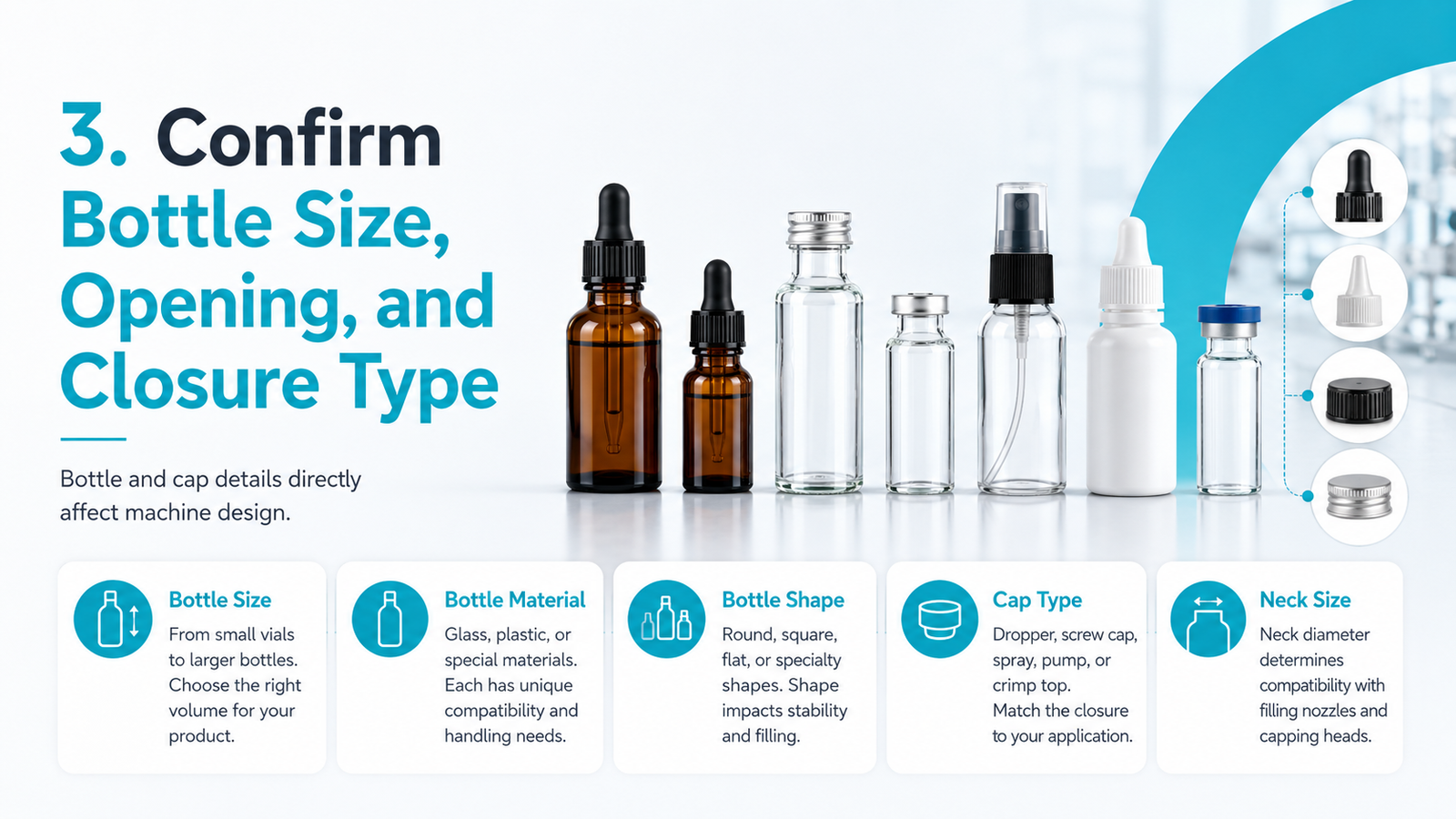
Bottle Size and Closure Type Guide
Small bottle size, neck opening and closure type guide for automatic filling and capping machine selection

Small bottles are more difficult to handle than large bottles because they are lighter, narrower, and easier to tip over. The bottle itself has a major influence on the filling line design.

You should provide your supplier with real bottle samples or detailed drawings. Photos are useful, but samples are better for testing.

Important bottle information includes:

  • Bottle volume: 5ml, 10ml, 15ml, 30ml, 50ml, 100ml, etc.
  • Bottle material: glass, PET, PE, HDPE, aluminum, or plastic
  • Bottle shape: round, square, flat, oval, or irregular
  • Bottle height and diameter
  • Neck inner diameter
  • Whether the bottle is stable on a conveyor
  • Cap type: screw cap, dropper cap, spray pump, press cap, child-resistant cap, rubber stopper, aluminum cap, or plug

A 10ml glass essential oil bottle is very different from a 10ml plastic eye drop bottle. A dropper bottle may require bottle feeding, filling, inner plug pressing, cap placing, and tightening. A vial may require filling, stoppering, and capping. An e-liquid bottle may require filling, tip inserting, cap tightening, and labeling.

This is why buyers should not ask only for “a small bottle filling machine.” A better inquiry is: “We need an automatic filling line for 30ml e-liquid bottles, including filling, tip inserting, capping, and labeling.”
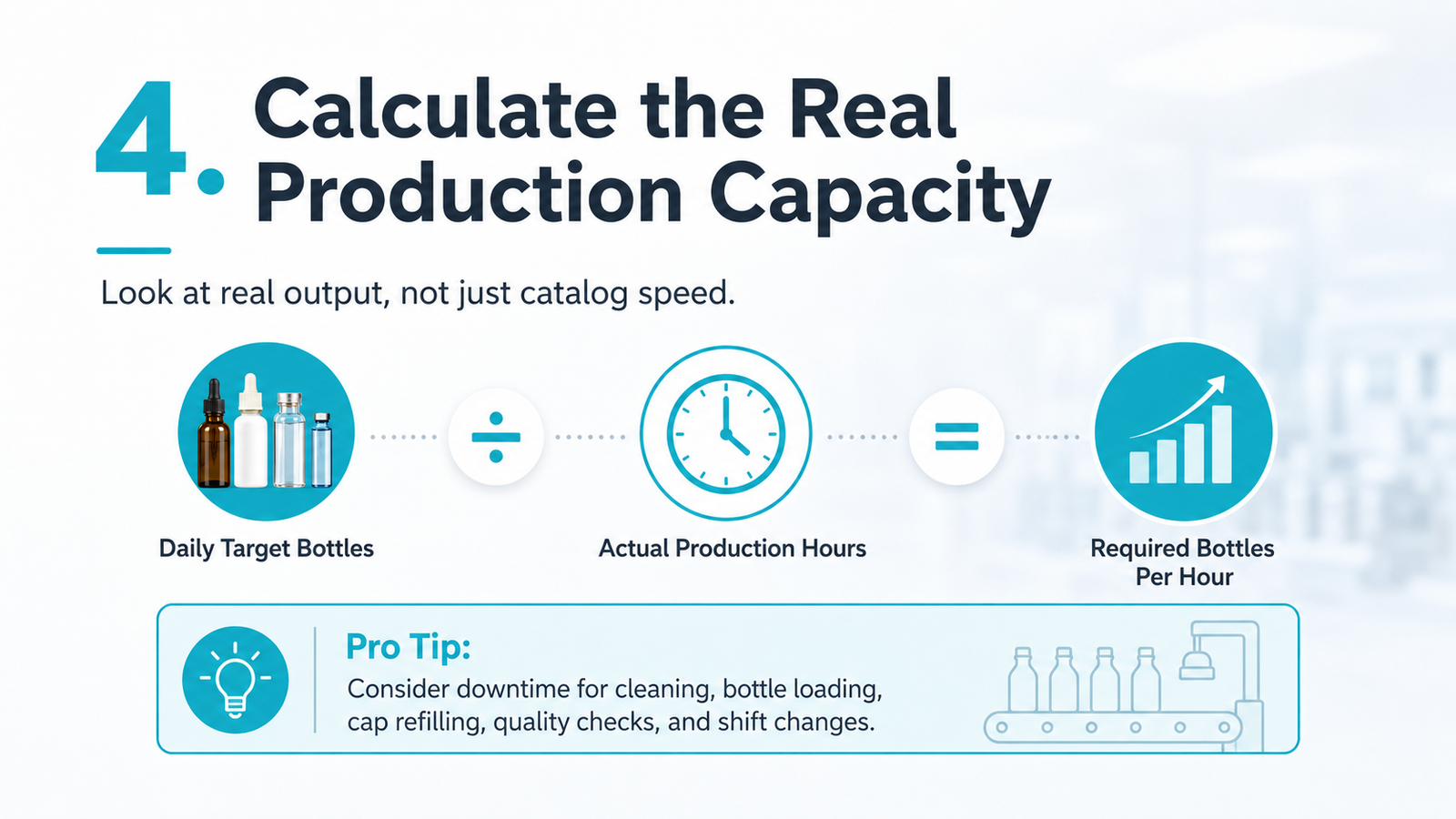
4.Calculate the Real Production Capacity You Need

Small Bottle Filling Capacity Calculation
Production capacity calculation for small bottle filling machine based on daily target bottles and working hours

Many buyers compare machines only by bottles per minute. This can be misleading.

A machine advertised as 40 bottles per minute may only reach that speed under ideal conditions: simple bottle shape, thin liquid, short filling volume, no foaming, stable bottle feeding, and experienced operators. Real production speed depends on filling volume, number of nozzles, liquid flow rate, cap handling, labeling speed, and operator workflow.

Use this simple calculation:

Required bottles per hour = Daily target bottles ÷ Actual production hours

If you need 20,000 bottles per day and your real production time is 8 hours, your line needs around 2,500 bottles per hour. But you should also consider downtime for cleaning, bottle loading, cap refilling, quality checks, and shift changes. A safer target may be 3,000 bottles per hour.

For small bottle filling, do not focus only on filling speed. The capping process is often the bottleneck. Small caps, droppers, plugs, and spray pumps may require special sorting and placing systems. If your filling machine is fast but your capping system is slow, the whole line is slow.
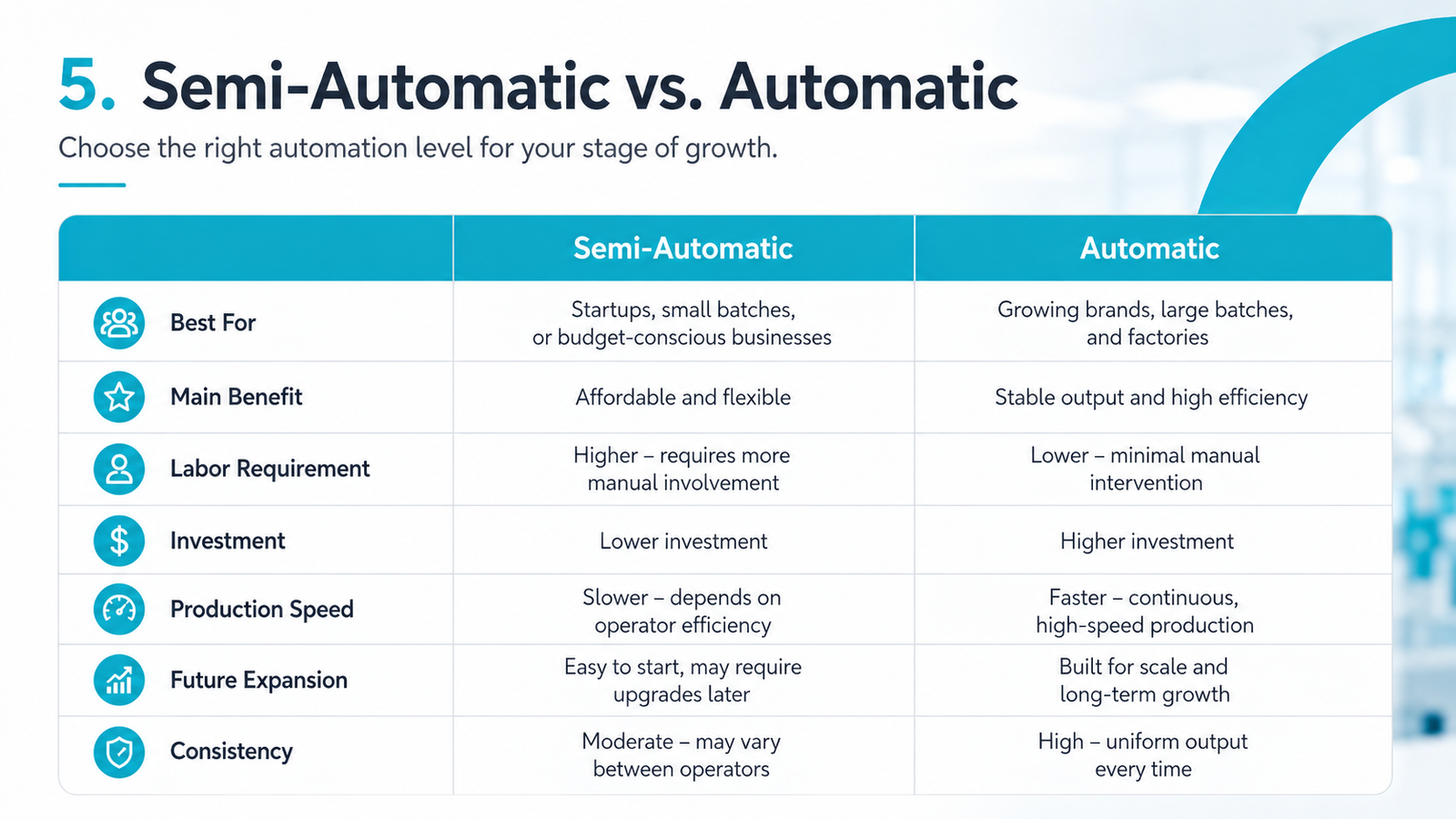
5.Decide Between Semi-Automatic and Automatic Filling

Semi-Automatic vs Automatic Filling Machine
Compare semi-automatic and automatic filling machines by labor requirement, investment, speed, consistency and future expansion.

The right automation level depends on your current order volume, labor cost, budget, and future growth.

A semi-automatic small bottle filling machine is suitable for startups, laboratories, pilot production, or small batch production. It costs less, takes less space, and is easier to operate. However, it requires more manual work for bottle placing, cap handling, and product transfer.

An automatic small bottle filling line is better when you need stable output, lower labor dependence, consistent filling accuracy, and a professional production process. It can combine bottle unscrambling, filling, plugging, capping, labeling, coding, inspection, and collection.

Here is a practical comparison:

OptionBest ForMain BenefitMain Limitation
Manual FillingVery small batches or testingLowest costSlow and inconsistent
Semi-Automatic FillingStartups and flexible productionAffordable and flexibleMore labor required
Automatic Filling LineGrowing brands and factoriesStable output and better consistencyHigher initial investment
Customized Complete LineMultiple bottle types or special processTailored to product and packagingRequires detailed planning

If your product line is still changing, a flexible semi-automatic or compact automatic machine may be a smart first step. If your bottle and cap are already finalized and demand is growing, a fully automatic filling line can reduce long-term cost.
6. Check Filling Accuracy and Repeatability

For small bottles, accuracy is one of the most important buying factors. A 1ml error on a 500ml bottle may not be serious, but a 1ml error on a 10ml bottle is a 10% difference.

Ask the supplier these questions:

  • What is the filling accuracy for my actual product and bottle size?
  • Is the accuracy based on water testing or my real liquid?
  • How many test samples are measured?
  • Can the machine store filling recipes for different products?
  • How easy is it to adjust volume?
  • Is the filling controlled by time, piston stroke, pump rotation, flow meter, or servo system?

For high-value products, you should request a filling test video and sample data. A professional supplier should be able to test several bottles, weigh the filled product, and show repeatability. If possible, ask for testing with your real product or a liquid with similar viscosity.

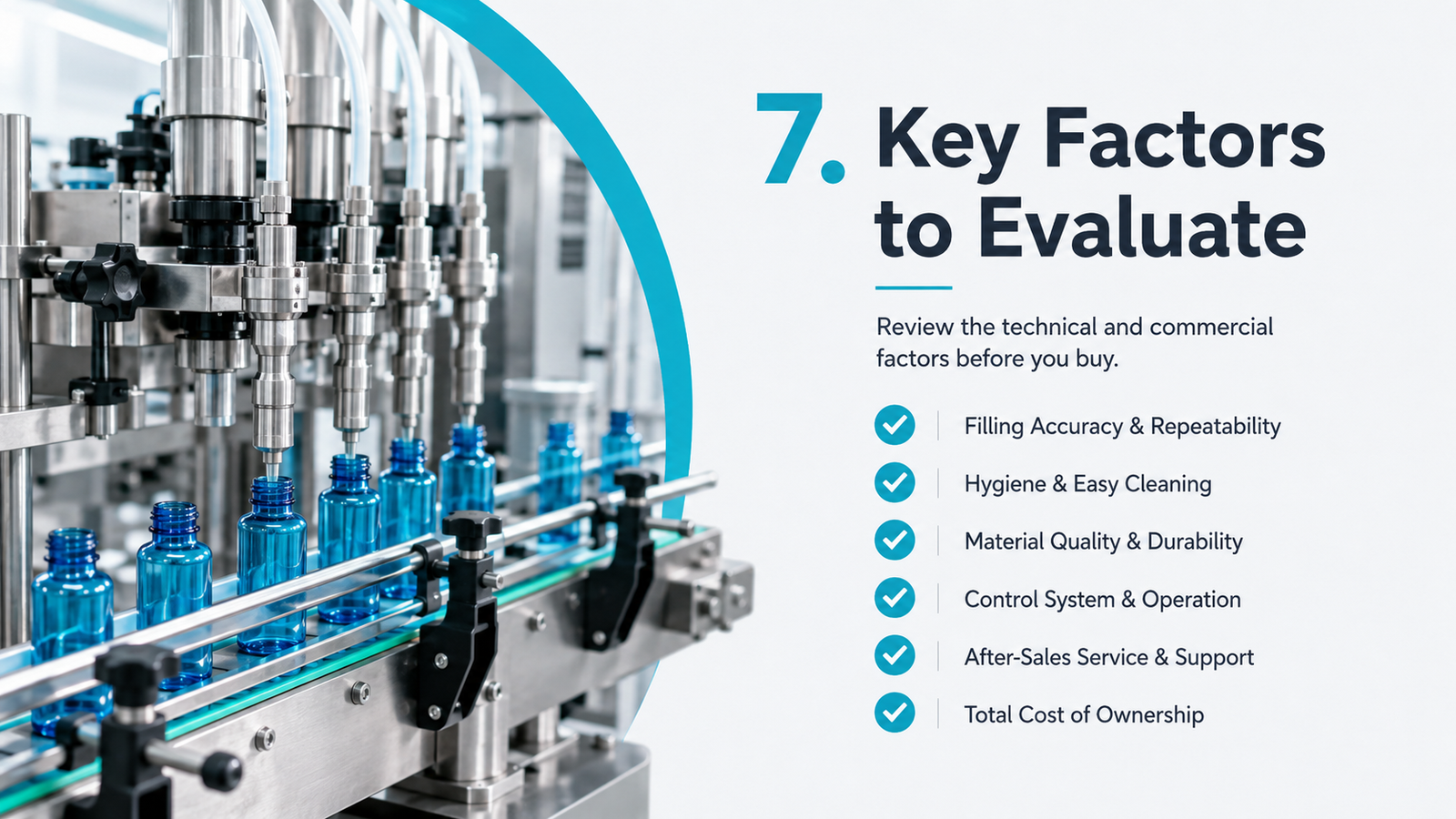
7. Evaluate Hygiene, Cleaning, and Contact Materials

Small Bottle Filling Machine Evaluation Checklist
Buyers should evaluate filling accuracy, hygiene design, contact material, control system, after-sales service and total cost before purchasing.

Cleaning is not an extra detail. It directly affects product safety, changeover time, and long-term reliability.

For food, cosmetic, pharmaceutical-style, and laboratory products, the machine should use suitable product-contact materials. Stainless steel, food-grade tubing, sanitary pumps, and cleanable nozzles are common requirements. The design should avoid dead corners where liquid can remain and contaminate the next batch.

Ask about:

  • Product-contact material
  • Whether parts are easy to remove
  • Whether the system supports CIP or manual cleaning
  • How long product changeover takes
  • Whether different tubing sets are available for different formulas
  • Whether seals, gaskets, and tubes are easy to replace

If you fill multiple flavors, fragrances, or formulas, cleaning time may affect production more than filling speed. For example, a peristaltic pump system with replaceable tubing may save time when switching products frequently.
8. Consider Line Layout and Future Expansion

A filling machine should fit your factory, not just your catalog requirement.

Before purchasing, check your available floor space, operator position, power supply, air supply, and connection with upstream or downstream equipment. If you plan to add labeling, coding, cartoning, or case packing later, leave enough space and choose a control system that can connect with future machines.

A common small bottle filling line may include:

  1. Bottle unscrambler or rotary feeding table
  2. Filling machine
  3. Inner plug inserting machine
  4. Capping machine
  5. Labeling machine
  6. Inkjet printer or laser coding machine
  7. Inspection and rejection system
  8. Collection table or packing station

For export buyers, it is also important to consider spare parts, remote support, machine manuals, training videos, and electrical standards. A good machine is not only built well; it should also be easy to install, operate, and maintain after delivery.

9. Understand the Real Cost, Not Just the Machine Price

The cheapest quotation is not always the lowest-cost solution.

When comparing suppliers, look at the total cost of ownership. A low-priced machine may become expensive if it causes product waste, unstable filling, long downtime, difficult cleaning, or frequent spare part replacement.

Check these cost factors:

  • Machine price
  • Customization cost
  • Mold or change part cost
  • Spare parts package
  • Shipping and import cost
  • Installation support
  • Training and documentation
  • Product waste during startup
  • Maintenance cost
  • Upgrade cost for future bottle sizes

For small bottle products, change parts are especially important. If you have several bottle sizes, ask whether one machine can handle them and what parts need to be changed. A flexible design may save money in the long run.

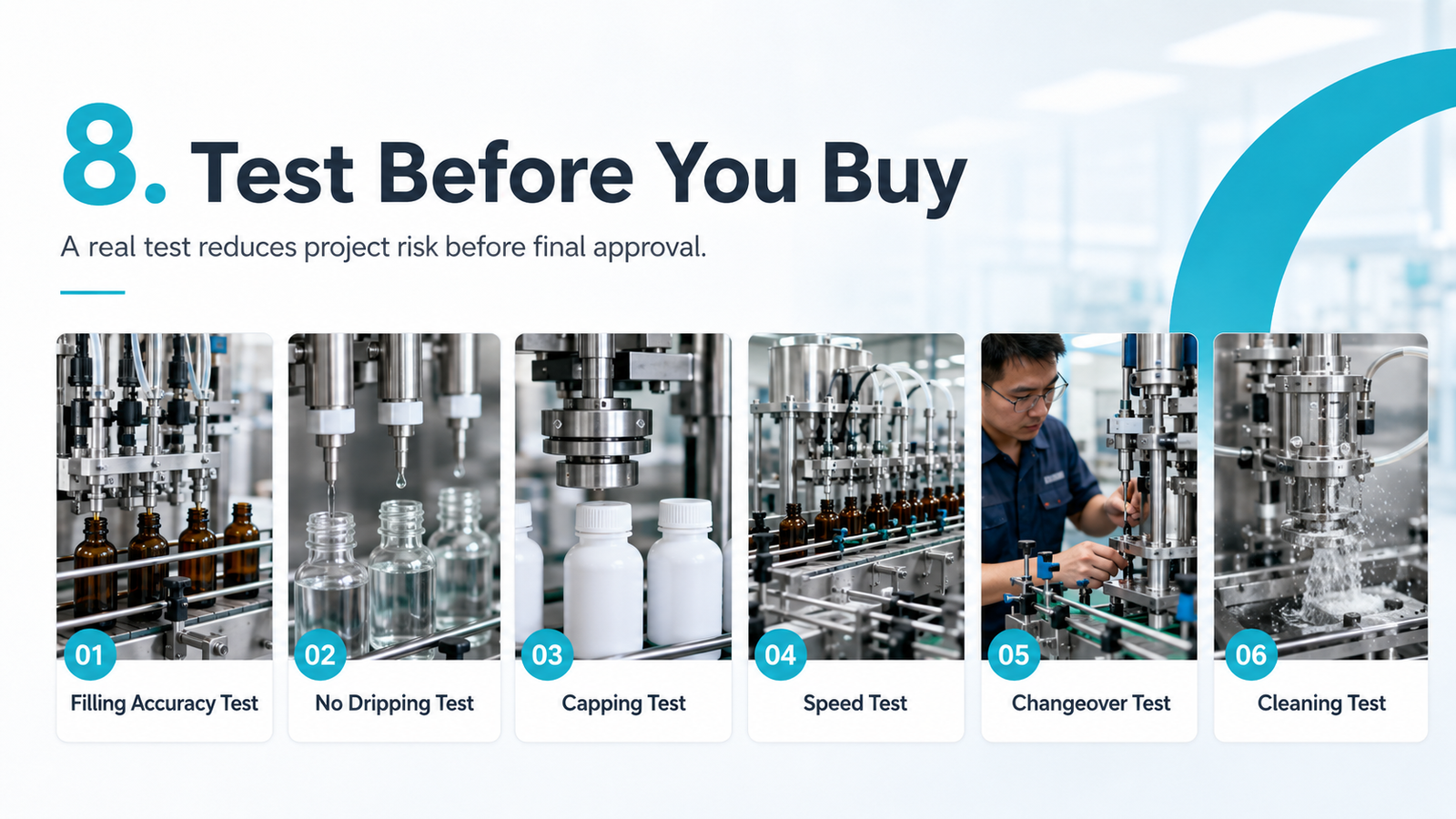
10. Ask for a Real Test Before Final Decision

Small Bottle Filling Machine Sample Testing
Sample testing helps verify filling accuracy, anti-drip performance, capping quality, speed, changeover and cleaning before purchase.

Before buying a small bottle filling machine, ask the supplier to test your bottle and product if possible. This is one of the best ways to reduce risk.

A useful test should show:

  • Bottle feeding stability
  • Filling accuracy
  • Dripping or no dripping
  • Foaming condition
  • Cap placing and tightening effect
  • Finished bottle appearance
  • Speed under realistic conditions
  • Changeover method
  • Cleaning and disassembly points

Do not rely only on a beautiful machine photo. A test video with your bottle type is much more valuable. If your product is not easy to ship, send a similar liquid or provide viscosity data.
11. Common Mistakes Buyers Should Avoid

Many filling machine problems happen because the buyer and supplier did not confirm enough details before production.

Avoid these common mistakes:

  • Choosing a machine only by price
  • Not sending bottle and cap samples
  • Ignoring liquid viscosity
  • Asking for high speed without checking capping capacity
  • Buying a standard machine for a special bottle shape
  • Forgetting future bottle sizes
  • Not confirming electrical standards
  • Not asking about spare parts
  • Not testing filling accuracy with real liquid
  • Ignoring cleaning and maintenance time

A good supplier should not simply say “yes” to every requirement. They should ask questions, review your samples, and explain what is possible, what needs customization, and what may create risk.

Before contacting a supplier, prepare the following information:

Information NeededExample
Product typeE-liquid, essential oil, perfume, serum, vial liquid
Filling volume10ml, 30ml, 50ml, 100ml
Bottle material and shapeGlass round bottle, plastic dropper bottle
Cap typeScrew cap, dropper, spray pump, plug, stopper
Target capacity1,000 bottles/hour or 20,000 bottles/day
Automation levelSemi-automatic or fully automatic
Accuracy requirement±0.5%, ±1%, or specific ml tolerance
Cleaning requirementManual cleaning, quick changeover, CIP
Factory conditionVoltage, air pressure, available space
Future planMore bottle sizes, more products, labeling, cartoning

The more complete your information is, the faster you can get an accurate proposal.

11. Ask for a Real Test Before Final Decision

Many filling machine problems happen because the buyer and supplier did not confirm enough details before production.

Avoid these common mistakes:

  • Choosing a machine only by price
  • Not sending bottle and cap samples
  • Ignoring liquid viscosity
  • Asking for high speed without checking capping capacity
  • Buying a standard machine for a special bottle shape
  • Forgetting future bottle sizes
  • Not confirming electrical standards
  • Not asking about spare parts
  • Not testing filling accuracy with real liquid
  • Ignoring cleaning and maintenance time

A good supplier should not simply say “yes” to every requirement. They should ask questions, review your samples, and explain what is possible, what needs customization, and what may create risk.

People Also Ask / FAQ:

There is no single best machine for every product. For thin and clean liquids such as essential oil, reagent, and some e-liquids, peristaltic pump filling is often a good choice. For thicker products such as serum, gel, or cream, piston filling may be better. The best choice depends on viscosity, bottle opening, filling volume, accuracy, and production capacity.

Accuracy depends on the filling method, pump system, liquid behavior, bottle stability, and machine control system. For small-volume products, it is important to test the actual product instead of relying only on water testing. High-value products usually require higher accuracy and better repeatability.

Yes, many machines can fill different bottle sizes, but they may need adjustment or change parts. Bottle height, diameter, neck size, and cap type all affect compatibility. If you have several bottle formats, tell the supplier at the beginning so the machine can be designed with flexibility.

A fully automatic line is better for stable mass production, lower labor cost, and consistent quality. A semi-automatic machine is better for small batches, startups, product testing, or frequent product changes. The right choice depends on your production volume and growth plan.

Send product details, bottle photos, cap photos, filling volume, target speed, accuracy requirement, and real samples if possible. If the product has special viscosity, foaming, corrosion, alcohol content, or hygiene requirements, mention them clearly.

Final Recommendation

Choosing the right small bottle filling machine is a technical and commercial decision. You need to match the machine with your liquid, bottle, cap, production speed, hygiene requirements, and future expansion plan. A good supplier should help you test, compare, and customize the right solution instead of only offering a standard model.

If you are planning a new small bottle filling project for e-liquid, essential oil, perfume, cosmetic serum, oral liquid, vial products, or other small-volume liquids, share your bottle size, product details, and target capacity with our engineering team. We can help you design a practical filling solution from semi-automatic equipment to a complete automatic filling, capping, labeling, and packing line.

Need help choosing the right small bottle filling machine? Contact us today for a customized solution, machine recommendation, and sample testing plan.

Contact Us For A Customized Solution:

Leave a Comment

Your email address will not be published. Required fields are marked *

"Reach out for a quote! We'll reply with specifics within 24 hours."

Let's have a chat