How to Choose a Liquid Filling Machine for 5ml, 10ml, 30ml and 50ml Bottles
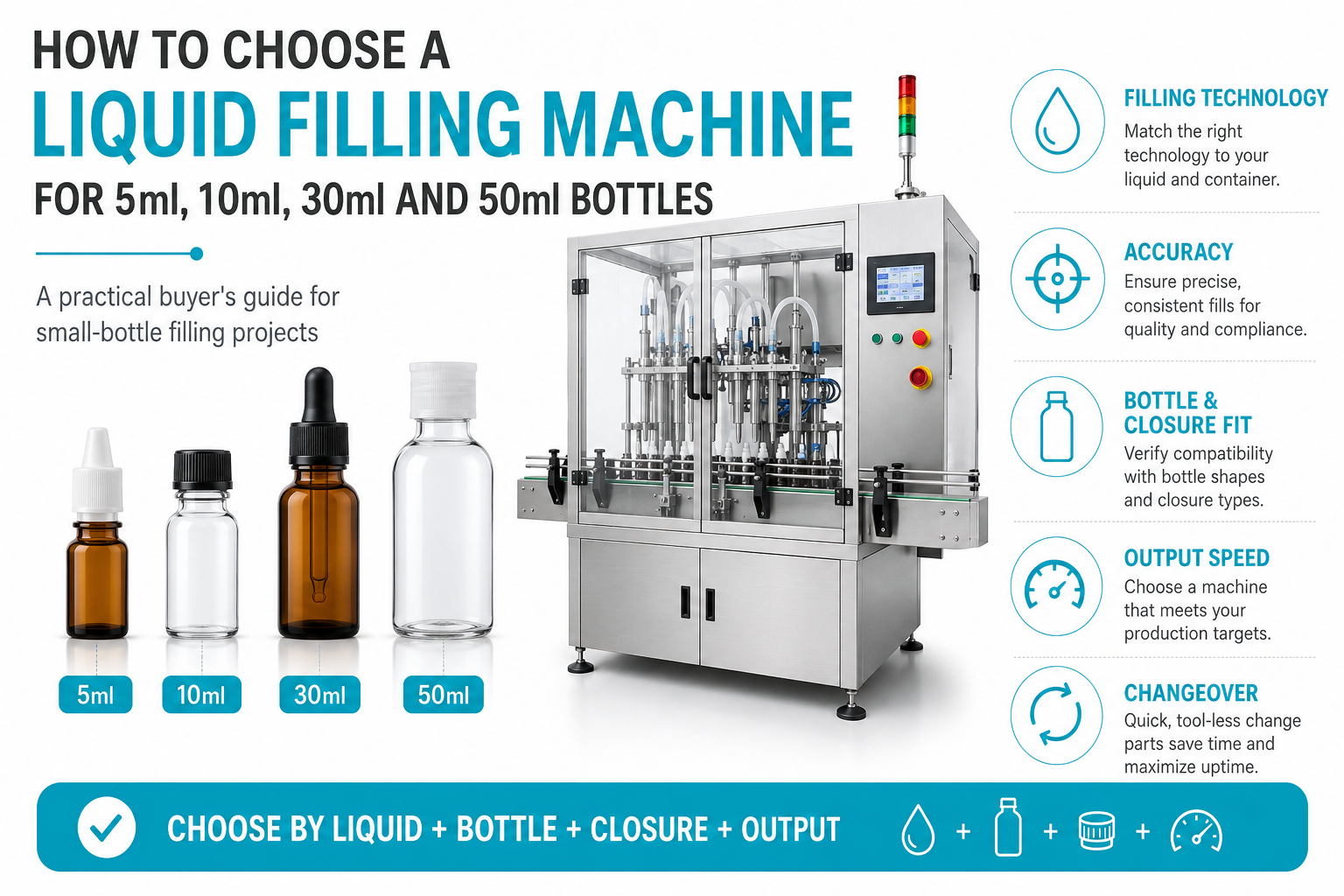
Choosing a liquid filling machine for 5ml, 10ml, 30ml or 50ml bottles is not simply a matter of matching the machine’s stated filling range to your bottle volume. A filler may technically cover all four sizes and still perform poorly with your real product. The better purchasing question is: can it fill your liquid accurately, handle your bottle and closure reliably, reach the required output, change between formats efficiently, and pass a repeatable factory acceptance test before shipment?
For small bottles, dosing error, narrow bottle openings and complex closures can affect both accuracy and line efficiency. Current industry guidance also emphasizes viscosity, container design, fill volume, opening size, speed and sanitation when selecting filling equipment.
Quick Answer: Which Filling Machine Is Best for 5ml, 10ml, 30ml and 50ml Bottles?

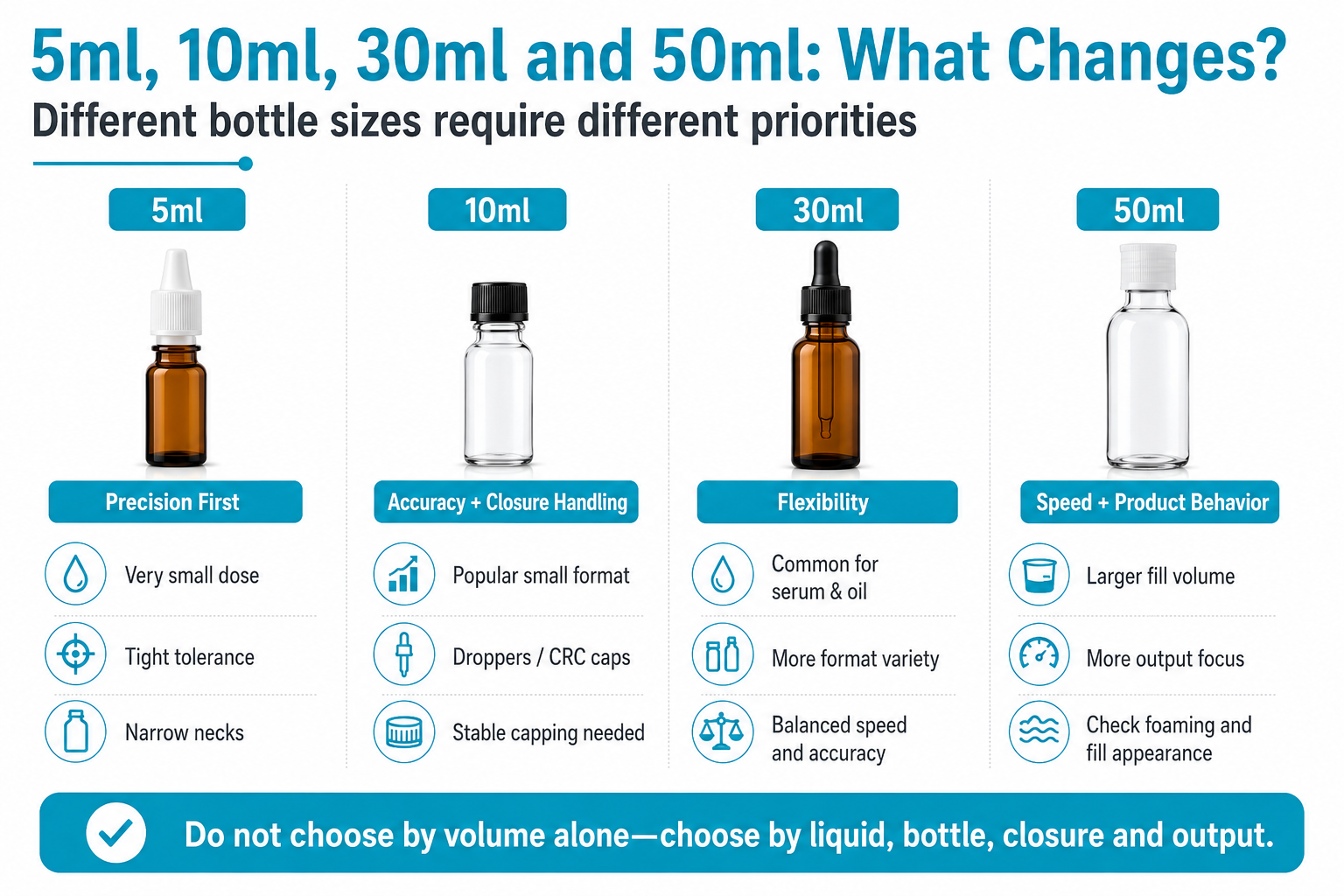
Use bottle volume as a starting point, not the final selection rule.
| Bottle Size | Typical Applications | Good Starting Technologies | Main Buying Concern |
|---|---|---|---|
| 5ml | Eye drops, reagent, perfume samples, essential oil | Peristaltic, ceramic pump, precision volumetric systems | Dosing repeatability, narrow neck, clean cut-off |
| 10ml | E-liquid, essential oil, tincture, eye drops | Peristaltic, ceramic pump, servo volumetric filling | Accuracy, insert/dropper handling, capping |
| 30ml | Serum, essential oil, tincture, cosmetic liquid | Peristaltic or positive-displacement systems depending on viscosity | Formula and closure flexibility |
| 50ml | Perfume, serum, e-liquid, oral liquid | Peristaltic, piston, vacuum or flow-controlled systems | Throughput, foaming, fill appearance, changeover |
The correct technology depends more on liquid behavior and packaging than on the number printed on the bottle.
1. Start With the Liquid, Not the Bottle Size
Before comparing machines, define the product:
- viscosity at normal filling temperature;
- foaming behavior;
- alcohol, oil, solvent or chemical content;
- whether viscosity changes with temperature or time;
- product-change frequency;
- cleaning and sanitation requirements.
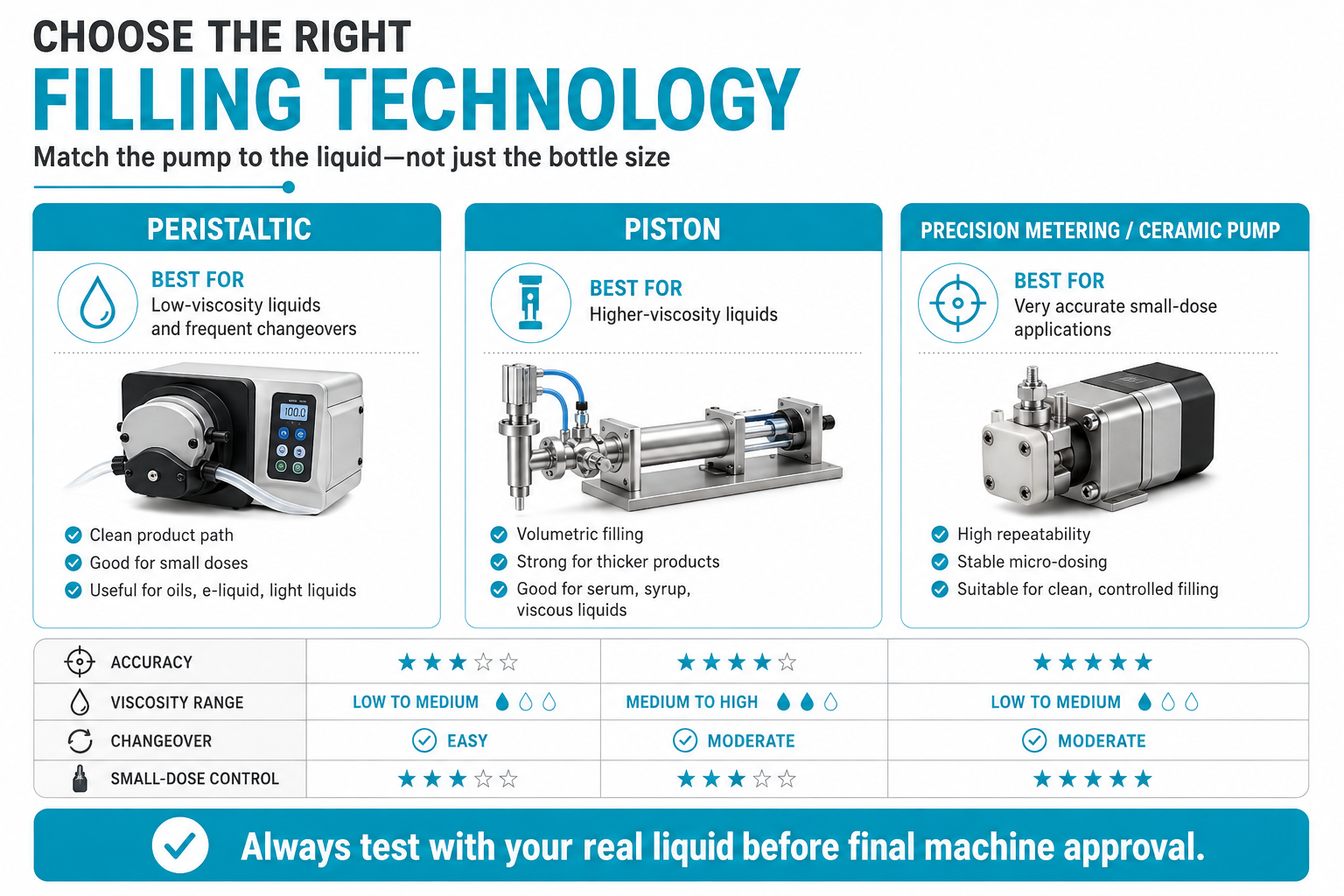
Low-viscosity liquids may work with peristaltic, vacuum or other controlled pump systems. Thicker serums, high-VG e-liquids or viscous oils may require piston or positive-displacement technology. Viscosity matters because it affects flow, nozzle design and dosing behavior.
This is why a “5–50ml filling machine” description is not enough. A system that performs well with a water-like liquid may not deliver the same speed or repeatability with a thick oil blend.
2. Match the Filling Technology to the Product

Peristaltic Pump Filling
Peristaltic filling is often a strong option for low-viscosity products and frequent formula changes. Product mainly travels through replaceable tubing, which can simplify changeover.
However, tubing condition, priming, speed and product viscosity affect real performance. Do not approve the machine from a catalogue accuracy claim alone.
Piston Filling
Piston filling is usually better suited to more viscous liquids requiring controlled volumetric dosing, including thicker cosmetic liquids, oils and syrups. Industry guidance commonly associates piston and positive-displacement systems with more viscous products.
For 5ml or 10ml doses, the piston size and control system must be designed for that range. A filler intended mainly for larger bottles should not automatically be assumed to perform well at 5ml.
Ceramic or Precision Metering Pumps
For clean, very small liquid doses, ceramic or other precision metering pumps can be attractive because they are designed for repeatable small-volume dosing.
The useful comparison is therefore not “Which pump is best?” but:
“Which pump gives the best result with my liquid, dose range, cleaning method and production schedule?”
For a deeper comparison, see our guide to piston vs peristaltic filling machines.
3. Why 5ml and 10ml Bottles Need Tighter Dosing Control
A 0.2ml deviation has a much larger commercial impact on a 5ml bottle than on a 50ml bottle. Small-dose projects should therefore define acceptance limits in both milliliters and percentage.
Instead of asking only:
“What is the machine accuracy?”
ask:
- What tolerance can you demonstrate with my actual liquid?
- How many consecutive bottles will be tested?
- Will the test be performed at production speed?
- How will fill quantity be measured?
- What happens after restart or product replenishment?
For 5ml and 10ml projects, also check nozzle cut-off carefully. A hanging drop can create bottle contamination, label problems and product loss over long runs.
This is particularly important when filling higher-value products such as essential oil, cosmetic serum, reagent or pharmaceutical-style liquids.
4. Bottle Neck and Closure Design Can Change the Entire Line

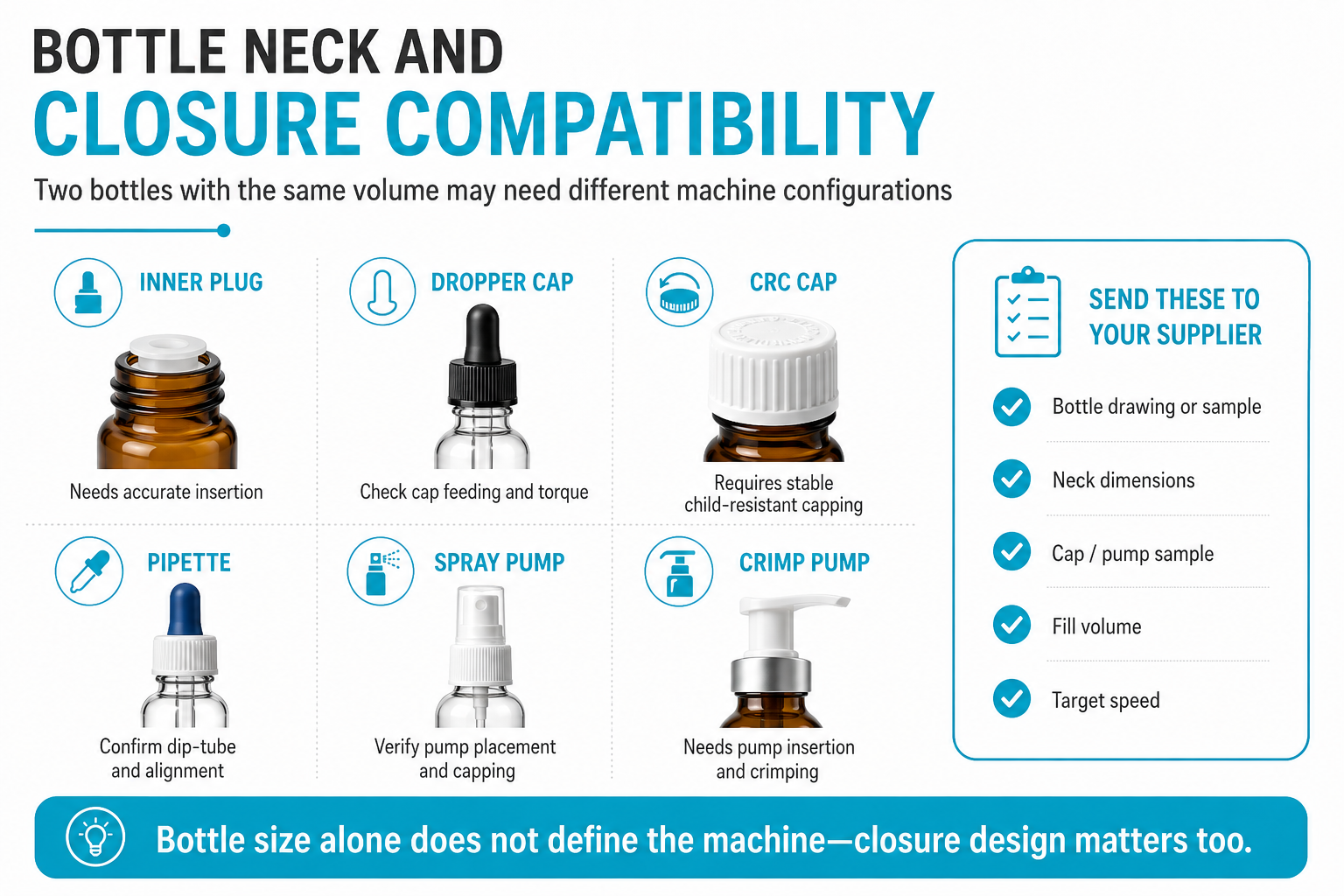
Two 10ml bottles can require very different machine configurations.
A glass essential-oil bottle with a dropper insert is not the same packaging problem as a 10ml chubby gorilla bottle. A 30ml serum bottle with a pipette cap creates another set of handling requirements.
Before the final quotation, send the supplier:
- bottle drawing or accurate dimensions;
- bottle material;
- neck inner and outer diameter;
- bottle height and body diameter;
- cap, plug, dropper or pump samples;
- dip-tube length if applicable.
Industry buying guidance also highlights container type, fill volume and filling-opening diameter as factors that can influence filling-machine selection.
In many small-bottle lines, filling is not actually the bottleneck.
Insert placement, pump feeding, capping or labeling may determine the real production output.
That is an important distinction when comparing quotations.
5. Choose the Complete Line Around the Closure

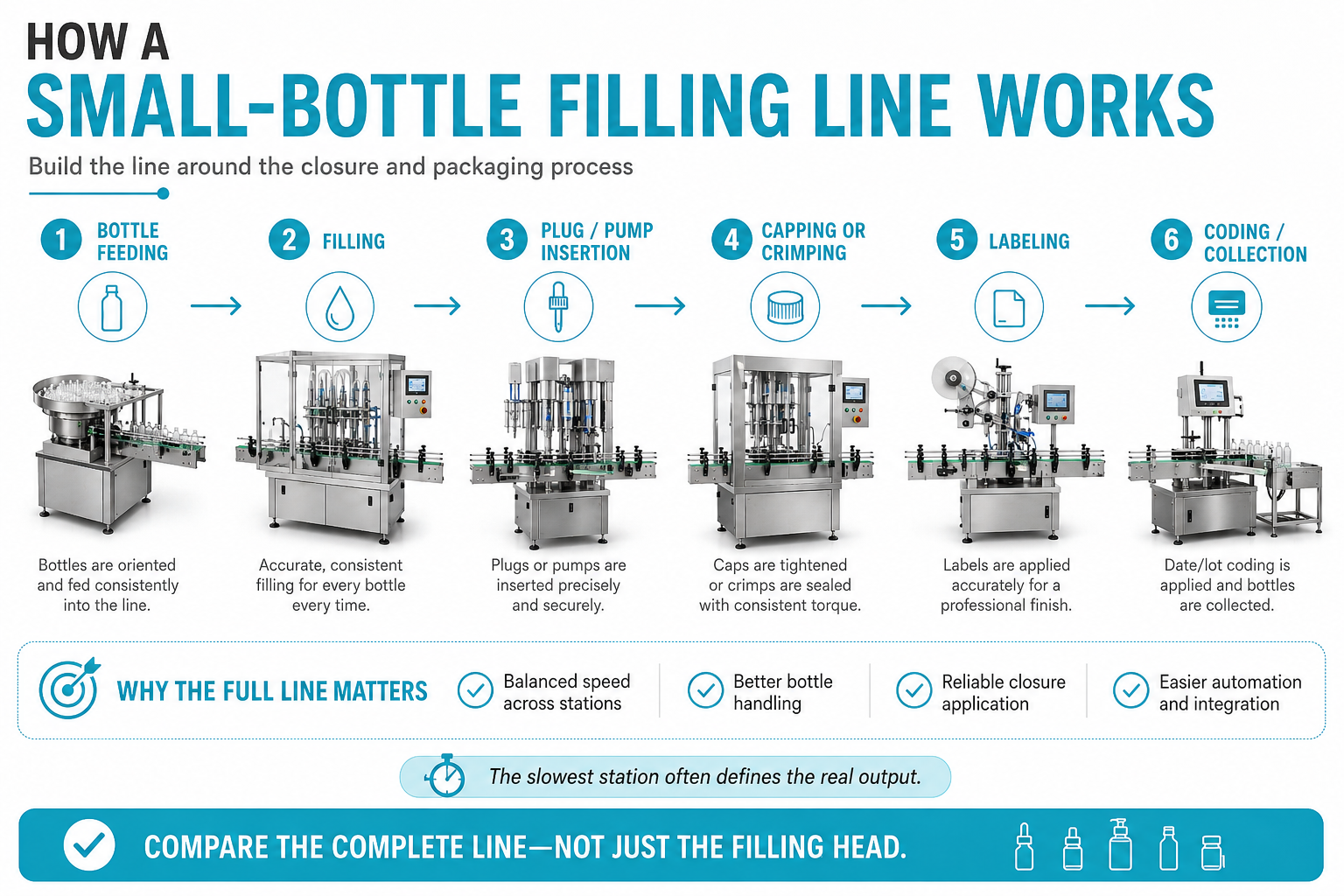
A typical automatic small-bottle line may follow:
Bottle Feeding → Filling → Plug/Dropper Insertion → Capping or Crimping → Labeling → Coding → Collection
Different packages require different processes.
For example:
- eye-drop bottles may need plug insertion before capping;
- essential-oil bottles may use an orifice reducer;
- e-liquid bottles may need nozzle-tip insertion and child-resistant capping;
- perfume bottles may require pump insertion and crimping.
If you plan to automate more than filling, compare the complete small bottle filling line instead of buying a filler first and trying to connect unrelated machines later.
This is especially important when your target is a stable automatic line rather than an isolated filling station.
6. Can One Machine Handle 5ml, 10ml, 30ml and 50ml Bottles?
Often yes, but “can fill” and “can change efficiently” are different questions.
A flexible machine should allow practical adjustment of:
- conveyor guide rails;
- nozzle height;
- filling recipes;
- bottle sensors;
- capping height;
- torque settings;
- labeling position.
Ask for the expected changeover time between your actual bottle formats and a list of replacement parts.
If dedicated holders, chutes or cap-feeder components are required, they should be clearly listed in the quotation.
For multi-SKU factories, changeover can matter more than maximum machine speed. A cheaper machine may cost more to operate if every bottle change takes hours.
7. Calculate Required Speed From Daily Output
Do not begin with a catalogue speed.
Start with your production target:
Required net speed = Daily required bottles ÷ Available production minutes
Then allow for:
- cleaning;
- SKU changeover;
- bottle and cap replenishment;
- operator intervention;
- minor production stops.
Also confirm whether the supplier’s quoted speed refers to the filling station or the complete line.
The slowest process—often capping, pump insertion or labeling—determines actual production output.
A factory running one 10ml SKU all day may benefit from a higher-speed multi-nozzle system. A factory producing 5ml, 10ml, 30ml and 50ml SKUs may gain more from fast changeover and stable bottle handling.
8. Define Hygiene, Materials and Safety Early
Product-contact design should match the application.
For drug-related applications in the United States, buyers should review applicable FDA Current Good Manufacturing Practice requirements, including requirements relating to equipment, production controls and finished pharmaceutical manufacturing. FDA guidance also addresses controls for drug-product containers and closures.
Food manufacturers can also refer to EHEDG hygienic design principles when evaluating equipment cleanability and contamination risk. EHEDG specifically notes that poor hygienic design can make equipment difficult to clean.
Ask your supplier:
- Which parts contact the product?
- What materials are used?
- Can the product path drain properly?
- How are hoses, tanks and nozzles cleaned?
- How much liquid remains in the system after production?
For expensive small-dose liquids, reducing retained product inside pumps and tubing can also reduce changeover loss.
Special Case: Alcohol-Based or Flammable Liquids
Alcohol-based perfume and solvent-containing products require an additional safety review.
Stainless steel construction alone does not make a machine suitable for flammable liquids. Electrical classification, ventilation, grounding/bonding and applicable hazardous-area requirements may affect the specification. OSHA regulations address electrical equipment in classified areas where flammable vapors, liquids or gases may be present.
For fragrance projects, see our perfume filling machine guide.
9. Compare Total Production Loss, Not Only Purchase Price
The lowest quotation is not always the lowest-cost solution.
| Cost Factor | What Buyers Should Check |
| Product giveaway | Average overfill per bottle |
| Rejects | Spills, missing caps, loose caps, label errors |
| Changeover | Time and labor between SKUs |
| Cleaning | Product loss and downtime |
| Wear parts | Tubing, seals, pistons and nozzles |
| Downtime | Spare-parts lead time and service support |
If your product is expensive, a small reduction in overfill or retained liquid may be worth more than a large discount on the machine itself.
For budget planning, read our small bottle filling machine cost guide and guide to filling machine price factors.
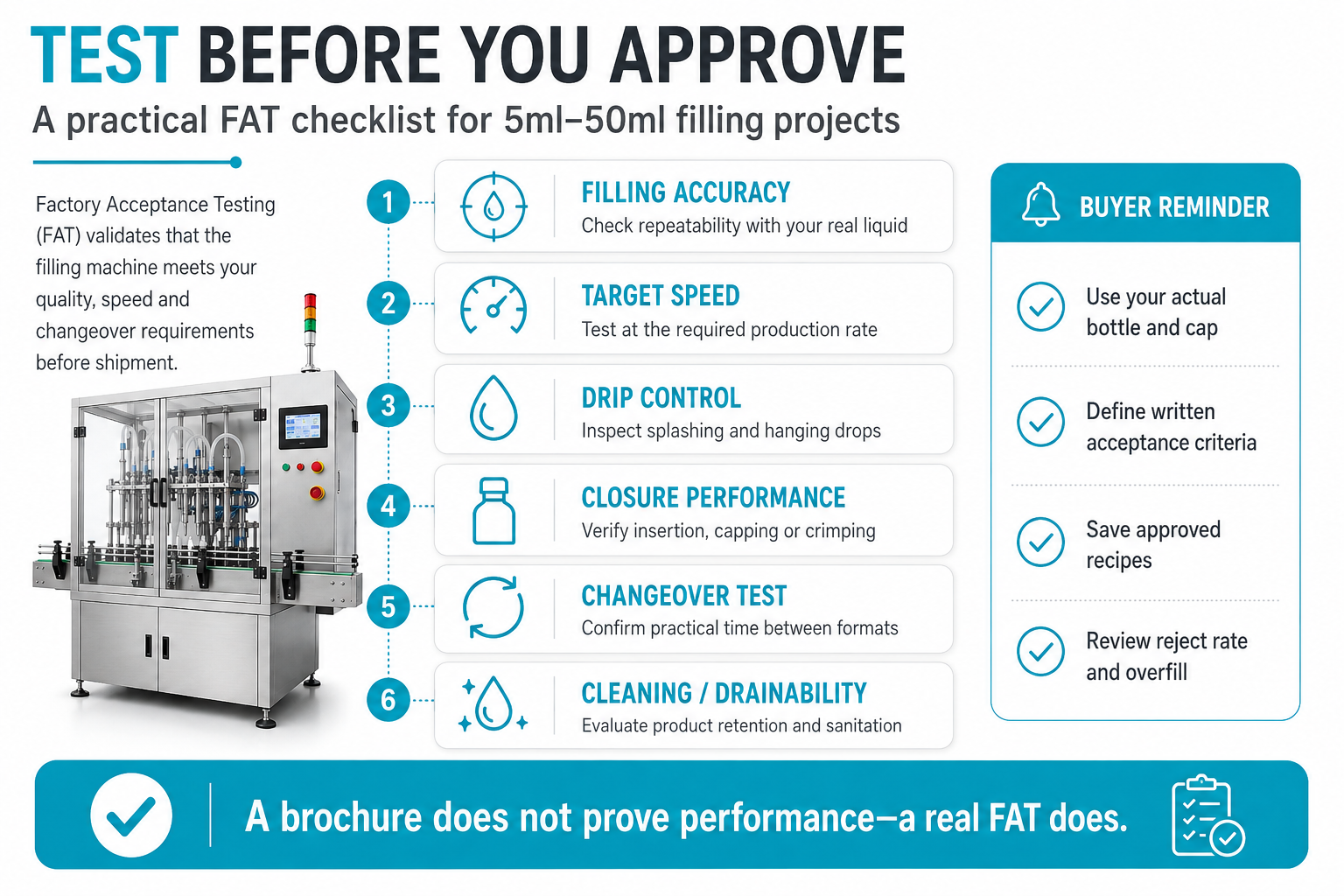
10. Require a Real Factory Acceptance Test

For 5ml–50ml bottles, the Factory Acceptance Test (FAT) should use your actual packaging whenever possible.
Check:
- fill repeatability over a meaningful consecutive sample;
- performance at target speed;
- bottle-feeding stability;
- dripping and splashing;
- plug, dropper, pump or cap insertion;
- capping torque or crimp quality;
- changeover between formats if required;
- draining and cleaning;
- final bottle appearance.
Acceptance criteria should be written, and tested recipe settings should be saved for installation.
This is an area many generic buying guides underplay:
Machine selection should end with a defined test protocol—not with a brochure comparison.
11. A Practical Buyer Decision Matrix
Use this sequence before approving a quotation:
Step 1: Define the liquid — viscosity, foaming, temperature and chemical behavior.
Step 2: Define each bottle — 5ml, 10ml, 30ml and 50ml dimensions and neck size.
Step 3: Define each closure — plug, dropper, screw cap, CRC cap, spray pump or crimp pump.
Step 4: Define bottles per hour and production hours per day.
Step 5: Define cleaning and changeover frequency.
Step 6: Select filling technology based on sample testing.
Step 7: Confirm the bottleneck of the complete line.
Step 8: Agree on written FAT criteria before machine production is completed.
A supplier that recommends a machine before asking for most of this information is probably quoting a generic configuration rather than your real packaging process.
People Also Ask / FAQ:
There is no single best system for every 10ml product. Peristaltic or precision metering systems are often good starting points for thin liquids and frequent formula changes, while positive-displacement systems may suit thicker liquids. Bottle neck, closure type and required speed should be evaluated together.
Yes, many automatic small-bottle fillers can cover that range, but the filling system must perform consistently across both doses and the bottle-handling and capping systems must accommodate both formats. Ask the supplier for an actual changeover demonstration rather than relying only on the stated filling range.
It depends on required net output, dosing time, liquid viscosity and downstream speed. More filling nozzles do not automatically produce a faster line if capping, bottle feeding or labeling is slower.
It can be, especially for low-viscosity liquids, but real performance depends on tubing, calibration, product properties and filling speed. Require testing with your actual product or a technically representative test liquid before final approval.
Send your liquid information, bottle drawings and samples, closure samples, fill volumes, target output, required packaging processes, electrical requirements and destination country.
The more accurate the input information is, the easier it is for the supplier to recommend a project-specific solution instead of a generic machine.
Final Recommendation
For 5ml, 10ml, 30ml and 50ml bottles, do not select a liquid filling machine from volume range alone.
Start with the liquid, then verify:
Filling Technology → Dosing Accuracy → Bottle Neck → Closure Handling → Output → Changeover → Cleaning → Factory Testing
The best buying decision is not necessarily the machine with the highest speed or lowest price.
It is the system that can produce stable finished bottles across your actual SKUs with the lowest combined product loss, downtime, reject rate and changeover cost.
Need Help Selecting the Right 5ml–50ml Filling Line?
If you are planning a new automatic small-bottle filling project, send Shanghai Honest Machinery:
- your liquid or product information;
- 5ml / 10ml / 30ml / 50ml bottle photos or drawings;
- cap, plug, dropper or spray-pump details;
- required bottles per hour;
- required filling, capping and labeling processes.
We can compare suitable filling methods, prepare a practical line configuration and test the machine with representative bottles and closures before shipment.
Send us your bottle and product details to get a filling-line recommendation for your project.