How Much Does a Small Bottle Filling Machine Cost?
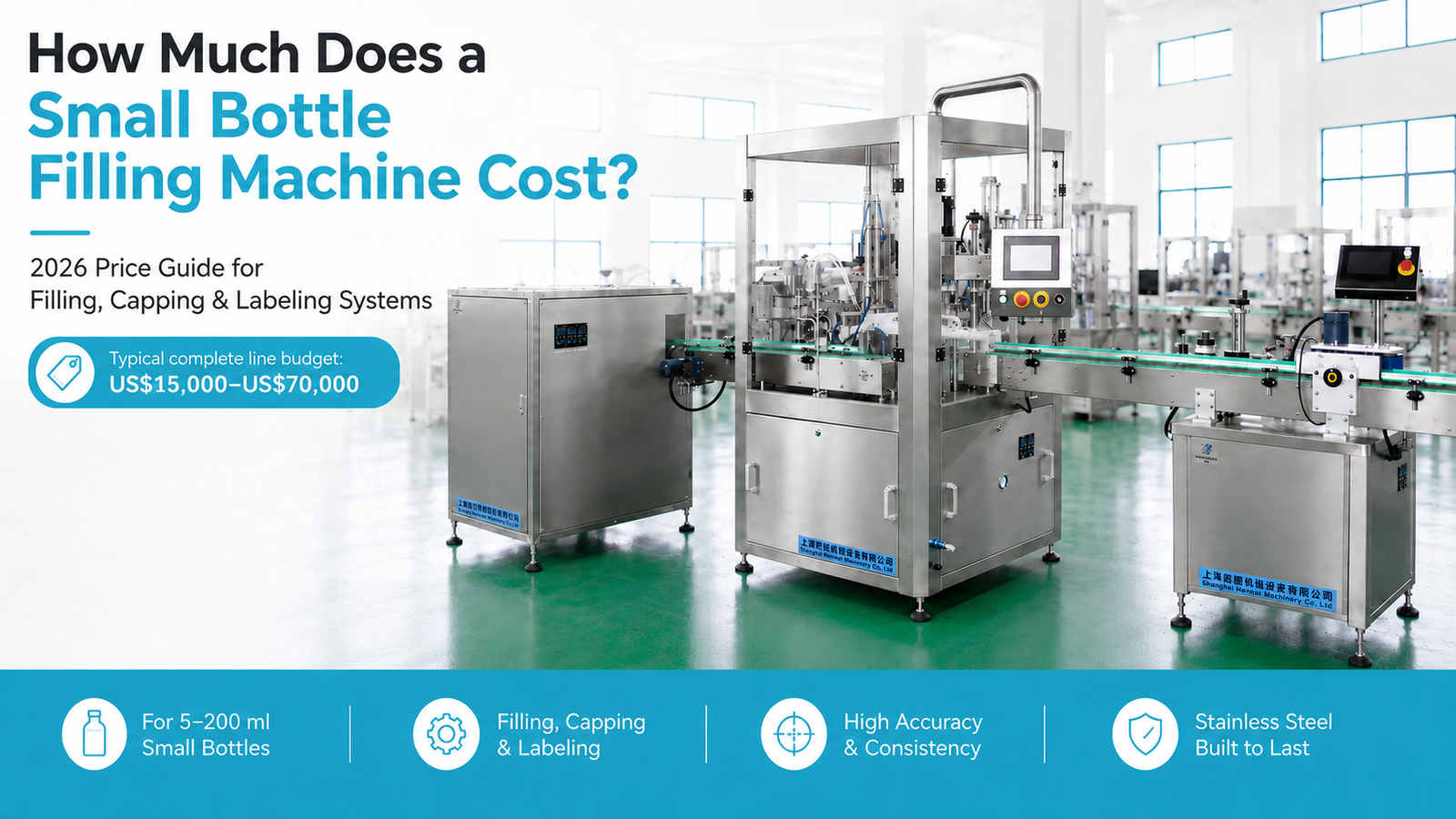
A small bottle filling machine typically costs US$10,000 to US$30,000 for a standalone automatic filler, while an integrated filling and capping system may cost US$15,000 to US$35,000. A complete automatic line with bottle feeding, filling, capping, labeling and coding can range from approximately US$30,000 to more than US$70,000.
These are planning ranges rather than fixed quotations. The actual small bottle filling machine price depends on what is being filled, the required output, dosing accuracy, bottle and closure design, hygiene standard, automation level and number of bottle formats.
The most useful question, therefore, is not simply “How much is the machine?” It is:
What configuration can meet my required output and quality standard at the lowest reliable cost per bottle?
This guide explains how to build a realistic equipment budget—and how to avoid comparing two quotations that include completely different scopes.
Small Bottle Filling Machine Prices at a Glance
The following figures are practical 2026 budget estimates for new industrial equipment. Freight, import duties, local taxes and site preparation are generally excluded unless stated otherwise.
| Equipment configuration | Typical price range | Suitable application |
|---|---|---|
| Automatic standalone filler | US$10,000–US$30,000 | Filling only; manual or existing bottle handling |
| Compact filling and capping machine | US$15,000–US$35,000 | Essential oils, e-liquid, serum, tincture and similar products |
| Automatic filling, capping and labeling line | US$30,000–US$70,000 | Growing brands requiring continuous production |
| High-specification pharmaceutical or controlled filling system | US$35,000–US$100,000+ | Eye drops, diagnostic reagents and regulated healthcare products |
| Customized multi-format production line | Project-specific | Multiple bottles, closures, products or secondary packaging processes |
Public market guides also show that fully automatic filling equipment generally begins around US$20,000–US$25,000 and can exceed US$80,000 as speed and integration increase. The wide range is why buyers should define the quotation scope before comparing prices.
If your project uses 5–200 ml containers, review our automatic small bottle filling lines to see the difference between a single machine and an integrated packaging line.
What Do You Receive at Each Price Level?
Entry-Level Automatic Filling Machine
A basic automatic filler usually includes:
- Product feeding system
- Filling pump or dosing mechanism
- One to four filling nozzles
- Bottle positioning system
- PLC and touchscreen controls
- Stainless-steel machine frame
- No-bottle-no-fill detection
- Basic safety guards
This option makes sense when the factory already has capping and labeling equipment or when those operations can temporarily remain separate.
However, confirm whether the quoted price includes a product tank, pump, conveyor, change parts and the electrical components required for your country.
Integrated Filling and Capping Machine
This configuration combines accurate dosing with closure placement and tightening. It is often the most practical option for small bottles because handling droppers, plugs, pipettes and miniature caps manually can become the production bottleneck.
Common applications include:
- 10–30 ml e-liquid bottles
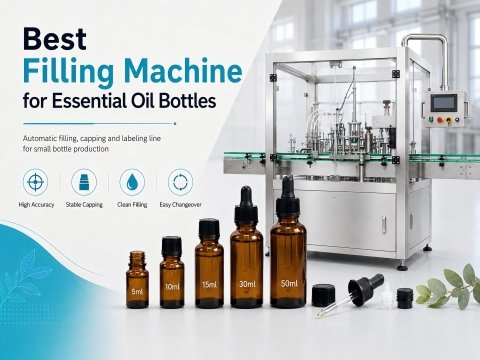
- Essential oil bottles with orifice reducers
- Glass dropper bottles with pipettes
- Eye-drop bottles with inner plugs
- Serum bottles with pumps
- Oral-liquid bottles with screw caps
The cap design may affect the price more than the bottle volume. A simple screw cap requires less handling equipment than a bottle requiring an inner plug, dropper, outer cap and torque control.
Complete Automatic Small Bottle Filling Line
A complete line may include:
- Bottle unscrambler or feeding table
- Filling machine
- Inner-plug or dropper inserter
- Cap feeder and capping machine
- Labeling machine
- Batch coder or inkjet printer
- Conveyors and line controls
- Optional cartoning or shrink-wrapping equipment
Explore our wider range of automatic bottle filling lines if you need filling, capping and labeling under one coordinated control system.
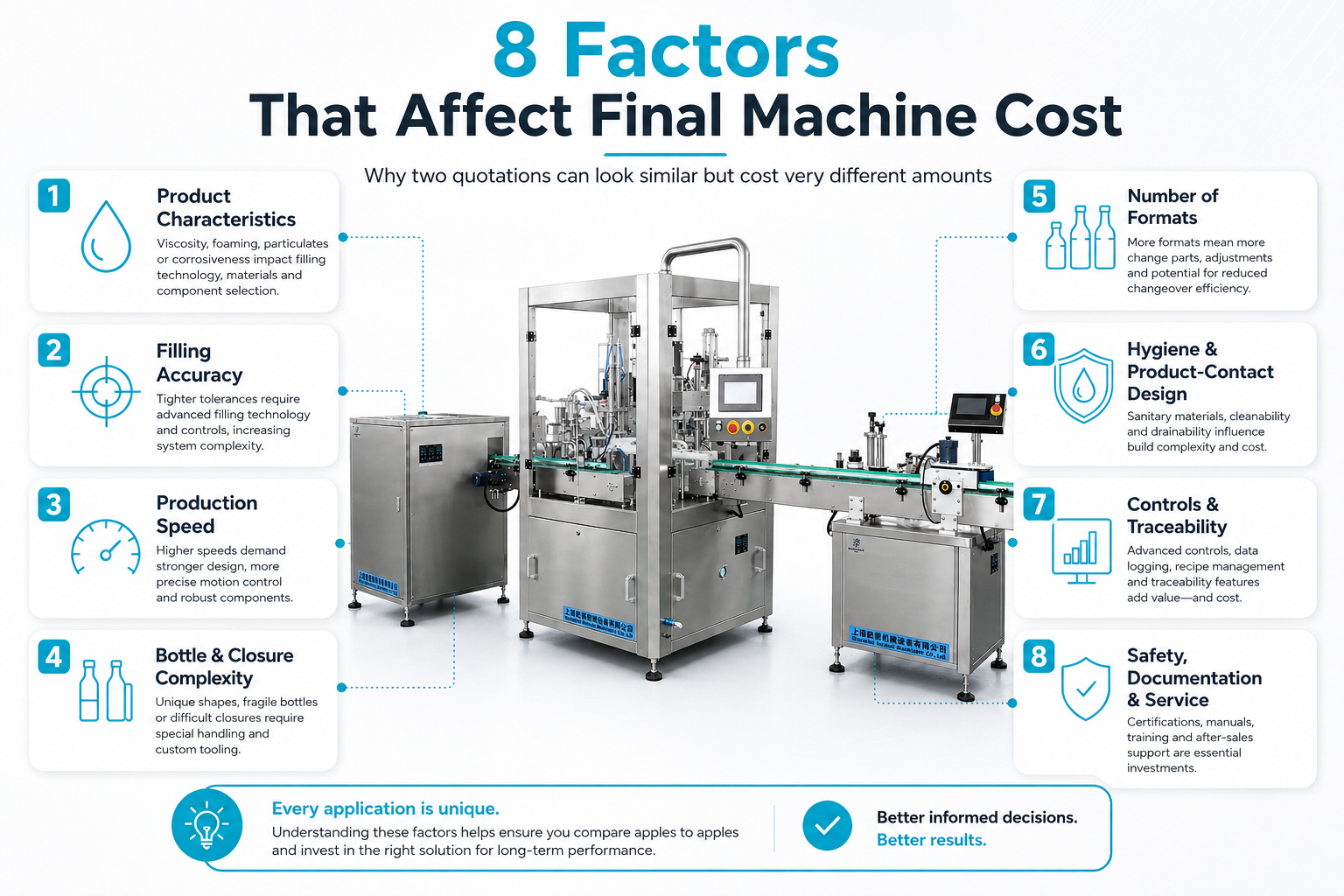
Eight Factors That Determine the Final Price
1. Product Characteristics
Viscosity, foaming, volatility, suspended particles and chemical compatibility determine the required dosing technology.
A free-flowing oral solution may use a peristaltic, time-pressure or flow-based system. A thicker serum may need a piston or servo pump. Essential oils may require compatible seals and controlled product-contact materials.
Sending only the filling volume is not enough. The supplier should also know:
- Product viscosity
- Density
- Foaming tendency
- Temperature during filling
- Presence of particles
- Alcohol or solvent content
- Required cleaning method
2. Filling Accuracy
Tighter tolerances usually require better pumps, sensors, controls and testing.
For a low-cost product, a small dosing variation may be commercially acceptable. For an expensive serum, diagnostic reagent or essential oil, even a 0.2 ml overfill can create substantial annual product loss.
A useful calculation is:
Annual overfill cost = overfill per bottle × annual bottles × product cost per ml
For example, an average overfill of 0.2 ml across 2 million bottles wastes 400,000 ml annually. If the product costs US$0.30 per ml, the loss reaches US$120,000 per year. In this case, a more accurate filler may pay for itself faster than a cheaper machine.
3. Required Production Speed
Higher output may require:
- More filling heads
- Servo-controlled dosing
- Continuous rather than intermittent motion
- Faster cap feeding
- Larger conveyors and accumulation sections
- Additional inspection systems
Do not specify speed only as “bottles per minute.” Tell the supplier the bottle volume, product, cap structure and expected shift pattern. A machine rated at 60 bottles per minute with water may not achieve the same output with a foaming product or a multi-part closure.
For most Honest Machinery small-bottle projects, the practical production range is approximately 1,000–7,000 bottles per hour, depending on the application and configuration.
4. Bottle and Closure Complexity
Bottle size alone does not determine cost. The following features can increase engineering work:
- Unstable or unusually shaped bottles
- Soft plastic bottles that deform easily
- Long pipettes
- Inner plugs or reducers
- Child-resistant caps
- Spray pumps
- Multiple cap components
- Tamper-evident rings
- Orientation requirements
Suppliers should test actual bottles, caps and products before final acceptance whenever possible.
5. Number of Formats
One line designed for a single 10 ml bottle is usually less expensive than a line required to handle 10 ml, 30 ml, 50 ml and 100 ml containers.
Ask whether each additional format requires:
- Mechanical change parts
- Guide-rail adjustment
- Separate cap tracks
- New filling recipes
- Additional star wheels
- New labeling components
Also request the expected changeover time. A lower machine price can lose its advantage if every format change stops production for several hours. Properly designed linear equipment can often provide greater format flexibility; our systems can be configured around faster size changes, with some applications targeting changeovers of approximately 35 minutes.
6. Hygiene and Product-Contact Design
Food, cosmetic and healthcare projects may require different surface finishes, sanitary connections, enclosed filling zones or cleaning procedures.
For food applications, 21 CFR 117.40 states that equipment should be installed to facilitate cleaning and maintenance and that food-contact surfaces must be corrosion-resistant. Pharmaceutical buyers should also consider the equipment cleaning and maintenance expectations under 21 CFR 211.67.
These requirements can affect:
- Stainless-steel grade
- Surface finish
- Hose and seal selection
- Tool-free disassembly
- Cleaning validation
- Product recovery design
- Enclosures or laminar-flow integration
7. Controls, Inspection and Traceability
Optional systems can significantly change the automatic bottle filling machine price:
- Recipe storage
- Filling-level inspection
- Cap presence detection
- Torque monitoring
- Vision inspection
- Reject station
- Batch-data recording
- Remote troubleshooting
- Printer or serialization integration
The correct choice depends on the cost of a defect. A cap-detection system may be unnecessary for a low-volume sample product but essential for a pharmaceutical or export production line.
8. Safety, Documentation and Service
Safety guarding should not be treated as a decorative option. OSHA’s general machine-guarding requirements address protection from moving parts and points of operation, while ISO 12100 provides principles for machinery risk assessment and risk reduction.
A complete commercial quotation should clarify whether it includes:
- Safety doors and interlocks
- Electrical drawings
- Operating and maintenance manuals
- Recommended spare-parts list
- Factory acceptance testing
- Installation guidance
- Operator training
- Warranty coverage
- Remote technical support
Paying less for undocumented equipment can make troubleshooting, local approval and future maintenance much more expensive.
Machine Price Is Not the Total Project Cost
The purchase price is only one part of the budget. Calculate the total installed cost before approving a project.
| Cost item | Typical budgeting method |
|---|---|
| Machine and selected options | Supplier quotation |
| Export packaging | Confirm whether included |
| Freight and insurance | Request by Incoterm and destination |
| Import duties and taxes | Confirm with local customs broker |
| Installation and commissioning | Supplier fee plus travel costs |
| Factory utilities | Electricity, air supply and product piping |
| Site preparation | Floor space, drainage and environmental controls |
| Spare parts | Initial one- or two-year package |
| Validation or local certification | Depends on industry and destination |
| Operator training | On-site or remote |
A Practical Budget Example
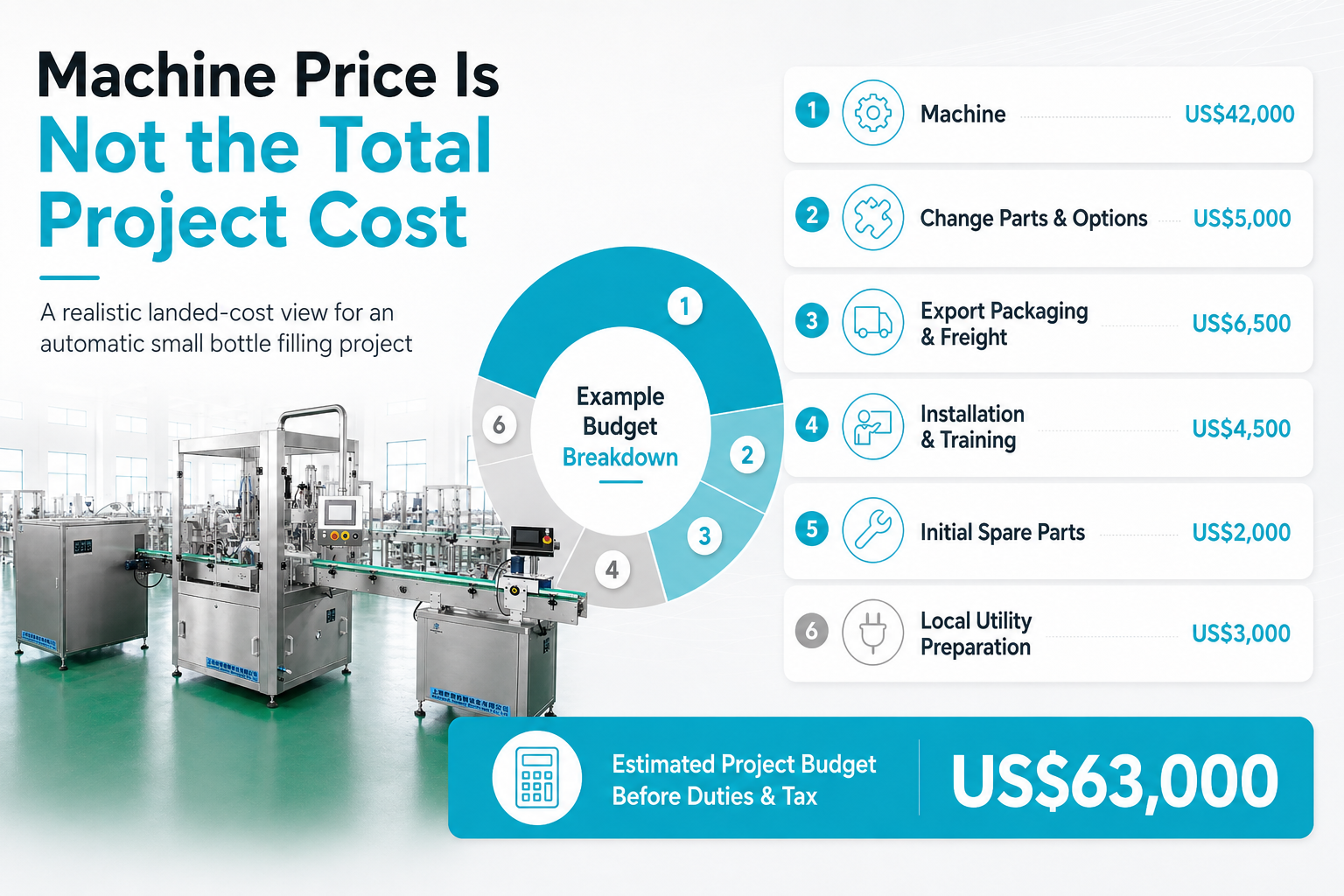
Assume an automatic filling, plugging and capping system is quoted at US$42,000.
| Budget item | Example amount |
|---|---|
| Machine | US$42,000 |
| Change parts and options | US$5,000 |
| Export packaging and freight | US$6,500 |
| Installation and training | US$4,500 |
| Initial spare-parts package | US$2,000 |
| Local utility preparation | US$3,000 |
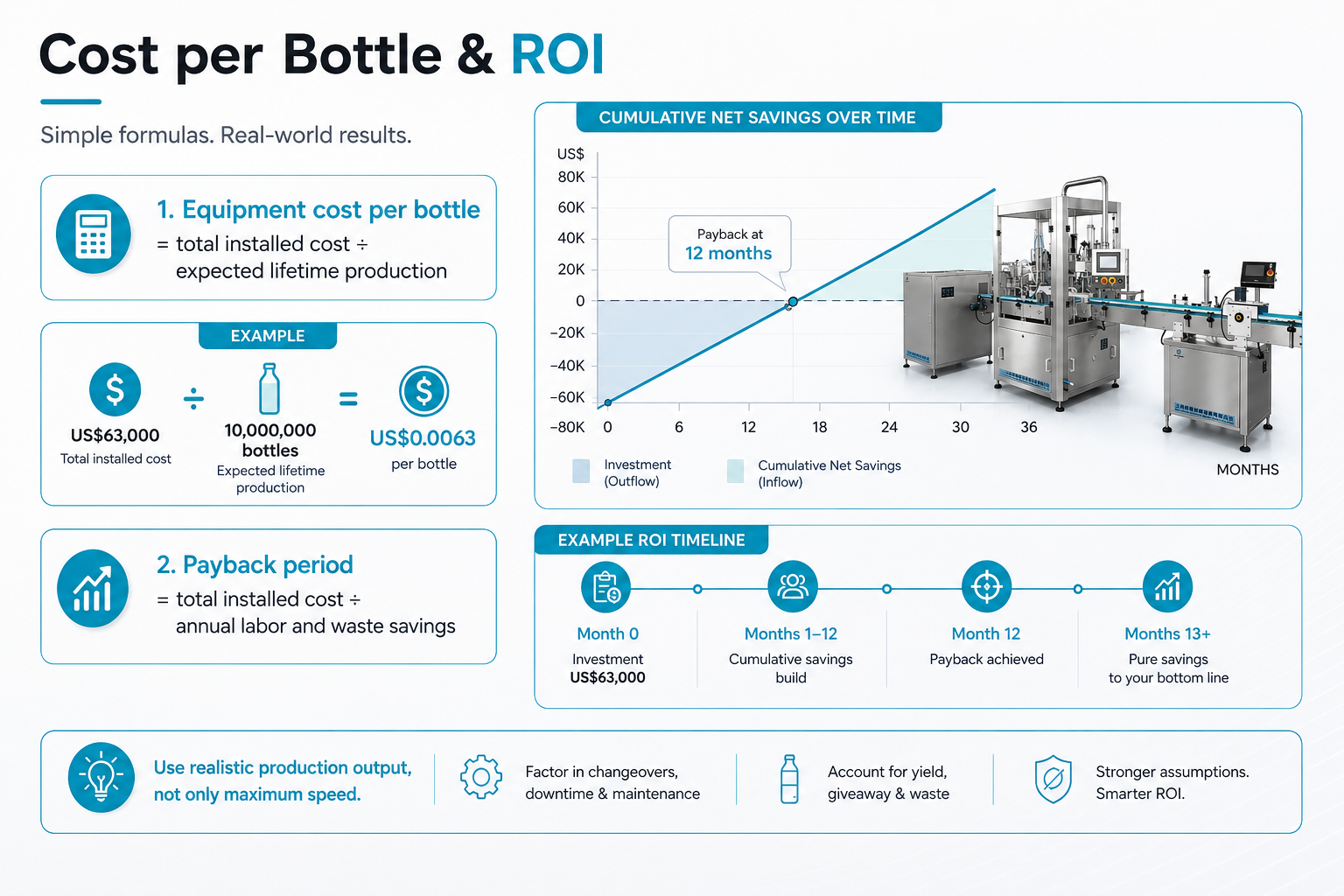
| Estimated project budget before duties and tax | US$63,000 |
In this example, the usable project budget is 50% higher than the machine-only price. This landed-cost view is one of the most important details missing from many filling-machine price comparisons.
How to Calculate Cost per Bottle and Payback
A higher-capacity machine is not automatically the better investment. Calculate whether the expected production volume can support it.
A simplified equipment cost per bottle is:
Equipment cost per bottle = total installed cost ÷ expected lifetime production
If a US$63,000 system produces 2 million bottles annually for five years, its capital cost is:
US$63,000 ÷ 10,000,000 bottles = US$0.0063 per bottle
This calculation should then be adjusted for:
- Labor
- Electricity and compressed air
- Maintenance
- Changeover downtime
- Rejects
- Product loss
- Packaging-material waste
To estimate payback:
Payback period = total installed cost ÷ annual labor and waste savings
Use realistic output rather than the machine’s maximum nameplate speed. Include planned cleaning, changeovers, breaks and maintenance.
How to Compare Two Filling Machine Quotations
Before choosing the lowest price, place each proposal into the same comparison table.
Check these points:
- Exact filling range and guaranteed accuracy
- Speed based on your product and bottle
- Number and type of filling pumps
- Bottle and cap formats included
- Product-contact material
- Main electrical and pneumatic brands
- Required utilities
- Changeover procedure and time
- Safety guards and interlocks
- Factory acceptance test conditions
- Spare parts and consumables
- Installation responsibility
- Warranty duration
- Technical response process
- Trade term: EXW, FOB, CIF or DDP
Ask each supplier to state what is excluded. A detailed exclusion list is often more valuable than a long list of general features.
When Does the Cheapest Machine Cost More?
The lowest quotation may become the most expensive option when it creates:
- Frequent filling errors
- Product dripping or overfill
- Poor handling of small caps
- Long format-change downtime
- Difficult cleaning
- Unavailable replacement parts
- Dependence on one specialist technician
- No testing with actual samples
- Mismatched upstream and downstream speeds
Price should therefore be evaluated against the line’s ability to run your actual container—not against a demonstration using an easy bottle and water.
For more selection guidance, read How to Choose the Right Small Bottle Filling Machine for Your Product.
Information to Send for an Accurate Quotation
Prepare the following before requesting a filling machine quotation:
- Product name and viscosity
- Filling-volume range
- Bottle dimensions and material
- Clear photos or drawings of the bottle
- Cap, plug, dropper or pump details
- Required bottles per hour
- Number of bottle formats
- Required filling accuracy
- Required processes: feeding, filling, capping, labeling, coding or cartoning
- Factory voltage and frequency
- Available compressed air
- Destination country and delivery term
- Industry or regulatory requirements
- Target installation date
- Actual bottle, cap and product samples
These details allow the manufacturer to select the filling principle and identify difficult handling points before issuing a commercial proposal.
People Also Ask / FAQ:
An industrial automatic 10 ml filling machine may cost approximately US$15,000–US$45,000. A filling, plugging and capping system usually requires a higher budget, commonly around US$25,000–US$70,000, depending on speed, accuracy and closure design.
Prices vary because quotations may cover different automation levels, pumps, filling heads, bottle formats, cap-feeding systems, inspection functions, safety standards and services. Two machines described as “automatic fillers” may have completely different capabilities.
Yes, provided the filling range, bottle transport and closure systems are designed for those formats. Some changes require only adjustments and stored recipes; others require dedicated guide rails, cap tracks or mechanical change parts.
A compact combined system can reduce floor space and transfer problems, especially for small bottles. Separate machines may provide more future flexibility and higher output. The better choice depends on production volume, closure complexity and expansion plans.
Not always. EXW and FOB quotations usually exclude at least some freight, duties, taxes and local installation costs. Ask for an itemized quotation and the applicable Incoterm before comparing suppliers.
Many projects target a payback period of one to three years, but the result depends on annual output, labor savings, product value, filling accuracy and downtime. Calculate payback using realistic production data rather than maximum rated speed.
Get a Configuration-Based Quotation
The right budget cannot be determined from bottle volume alone. Product behavior, closure design, required speed and the number of formats must be evaluated together.
Shanghai Honest Machinery develops automatic filling solutions for 5–200 ml bottles, including filling, plugging, capping, labeling and complete line integration. Our typical solutions cover essential oil, e-liquid, serum, eye drops, tincture, oral liquid and other small-dose products, with output configured around the customer’s actual containers.
Send us your bottle and cap photos, filling volume, product information and required hourly output. We will recommend a suitable configuration and provide an itemized quotation rather than an unclear package price.
View Small Bottle Filling Machines | Send Your Project Requirements