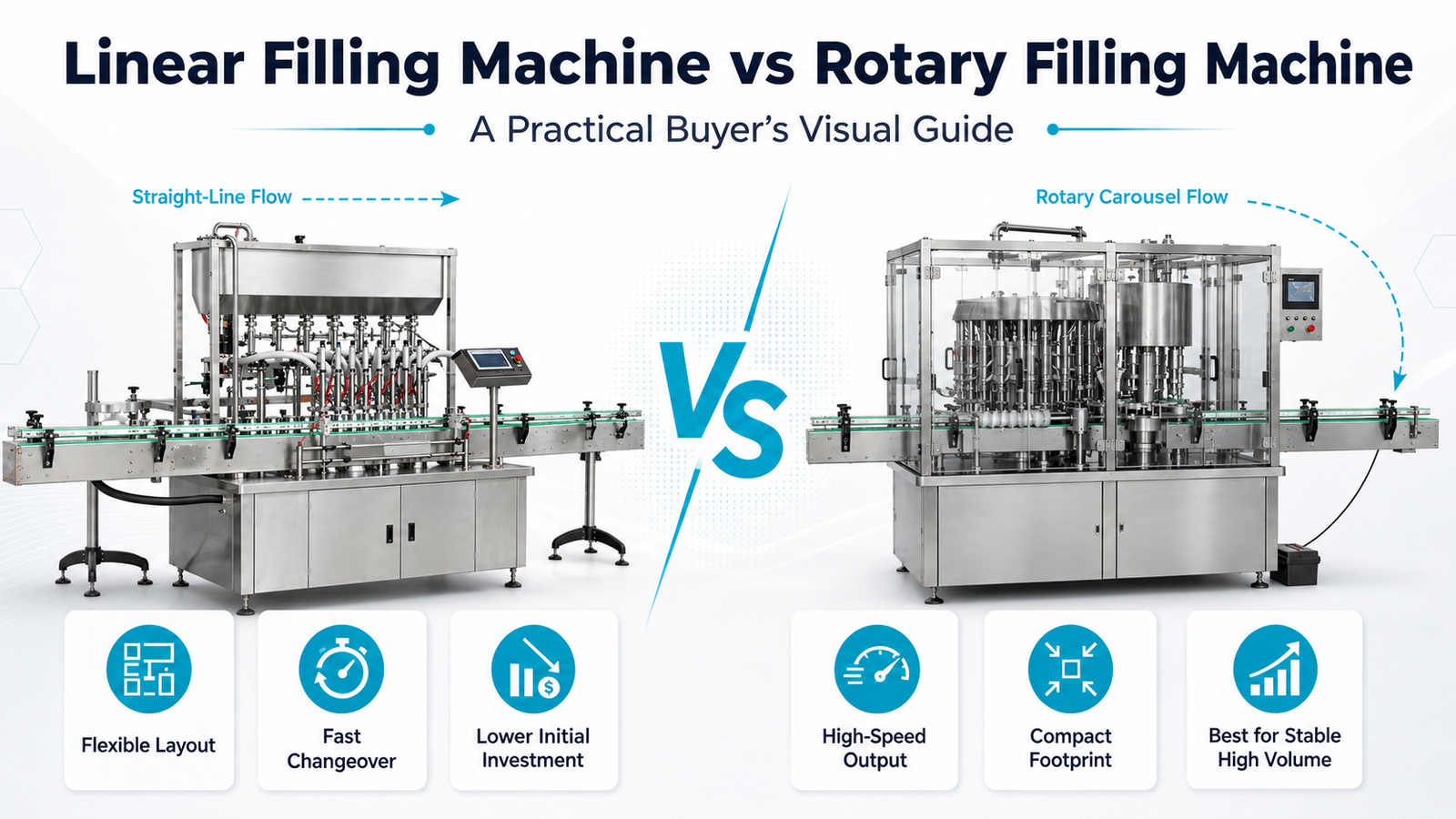
Linear Filling Machine vs Rotary Filling Machine: A Practical Buyer’s Guide

Linear Filling Machine vs Rotary Filling Machine Comparison

Quick Answer: Which Filling Machine Should You Choose?

Choose a linear filling machine if your factory runs several bottle sizes, changes products frequently, needs a lower initial investment, or wants equipment that is easier to expand and maintain.

Choose a rotary filling machine if you produce a stable product in standardized containers, require sustained high output, and can justify more specialized format parts, maintenance skills, and capital investment.

Speed alone should not decide the purchase. The better machine is the one that delivers the lowest cost per saleable bottle after changeovers, cleaning, downtime, rejected containers, labor, and future SKU growth are included.

What Is the Difference Between Linear and Rotary Filling Machines?

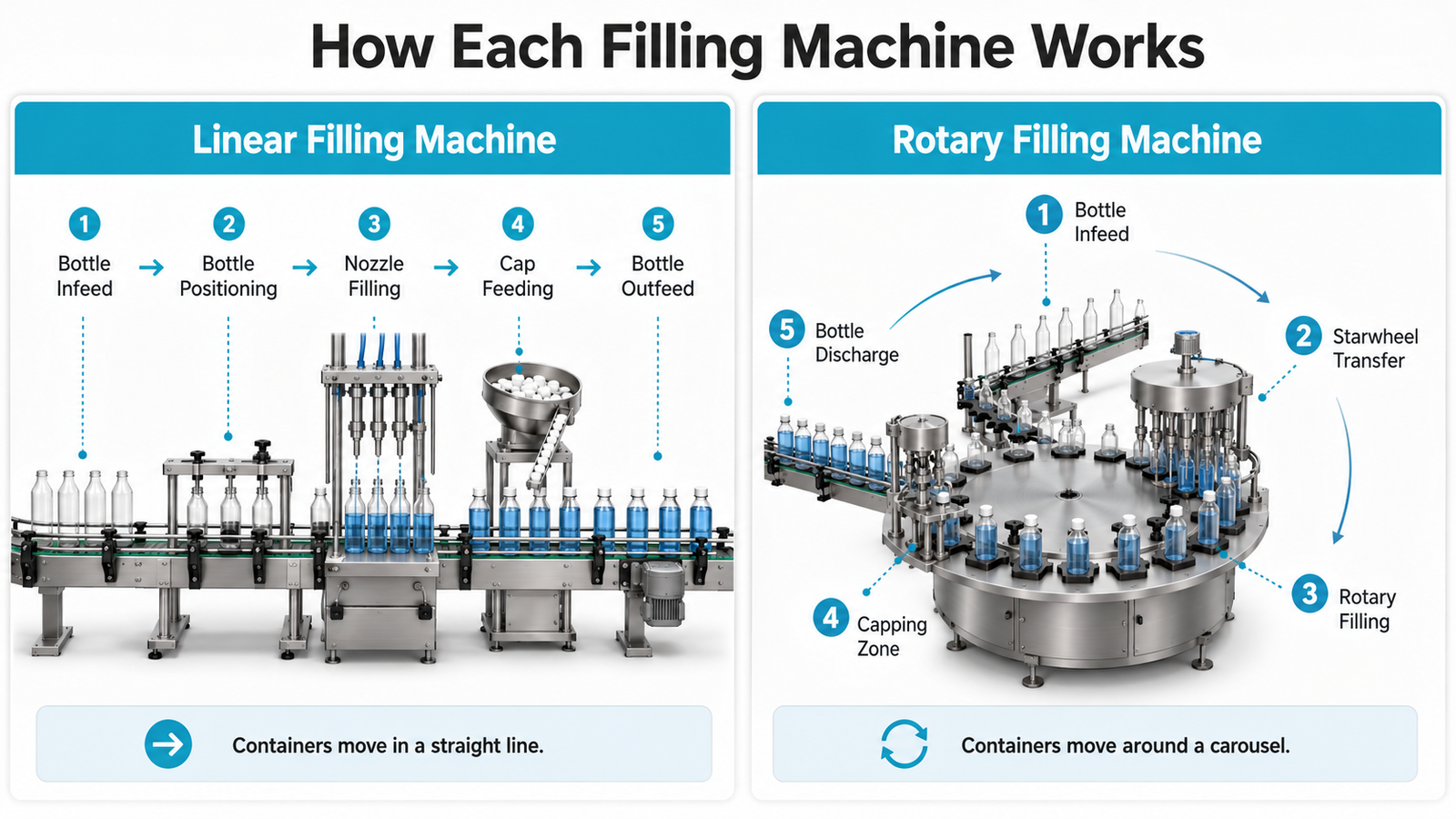
Inline vs Rotary Filling Machine Working Principle
Diagram showing straight conveyor movement and rotary carousel bottle filling

A linear filling machine—also called an inline filling machine or straight-line filler—moves bottles along a conveyor in a straight path. Containers are indexed beneath a row of nozzles, filled in batches, and released to the next station.

A rotary filling machine transfers containers onto a rotating carousel. Bottles are held by dedicated handling parts and move through multiple filling positions before returning to the discharge conveyor.

This describes the machine architecture, not the dosing technology. Either system may use gravity, piston, peristaltic, time-pressure, flowmeter, overflow, or net-weight filling. A rotary machine is therefore not automatically more accurate, and a linear machine is not automatically limited to low-speed work. Accuracy depends on the metering system, product consistency, controls, nozzle design, and validation method.
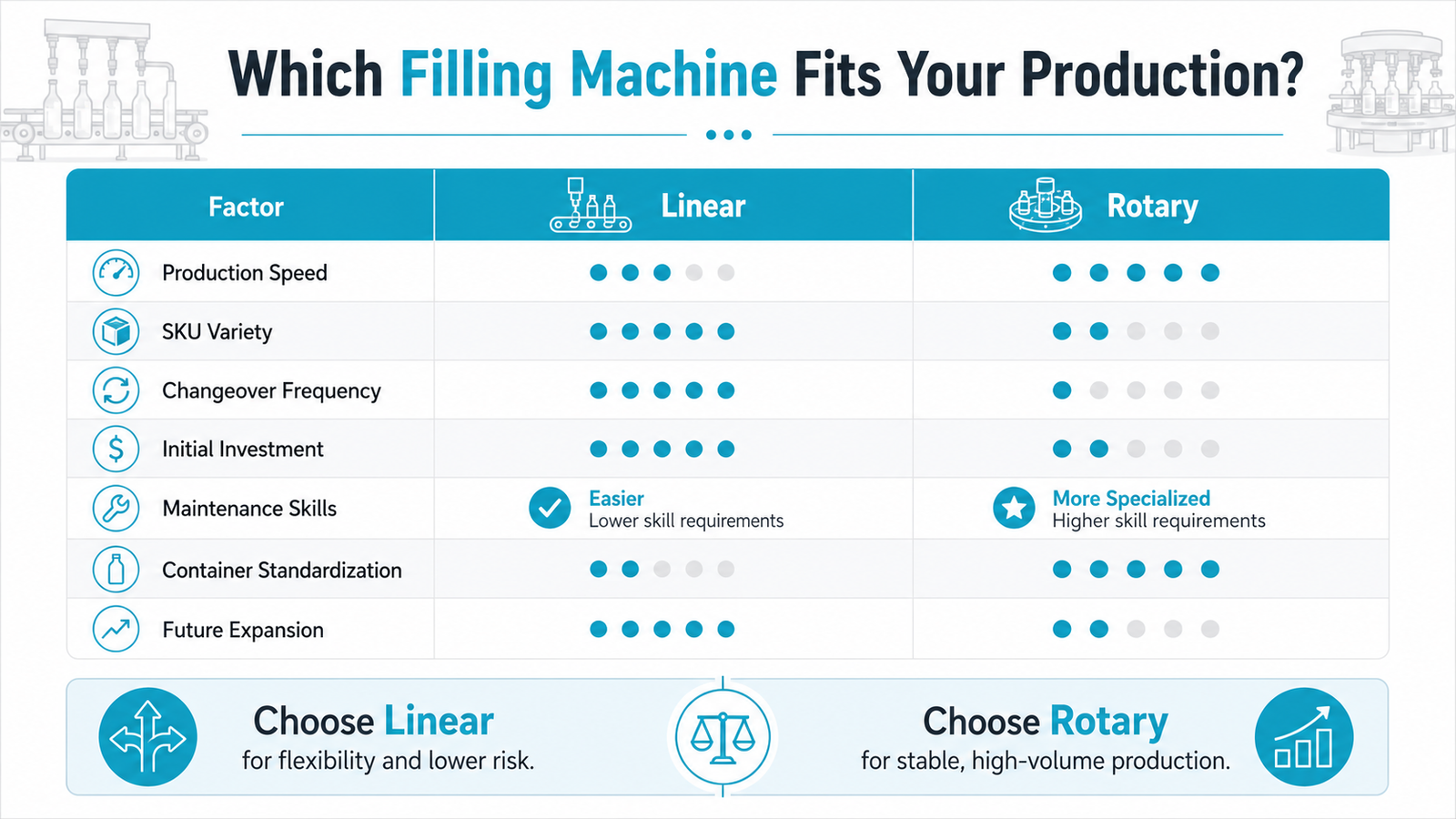
Linear vs Rotary Filling Machine Comparison

Linear or Rotary Filling Machine Selection Chart
Filling machine selection chart comparing speed, flexibility, changeover and investment
Decision FactorLinear Filling MachineRotary Filling Machine
Container movementStraight conveyor; usually indexed or batch fillingContainers circulate on a carousel
Best production modelMultiple SKUs, shorter runs, frequent changeoversStandardized containers, long campaigns
Output potentialLow to medium; higher outputs are possible with more nozzlesStronger for very high continuous throughput
Bottle flexibilityEasier adjustment for different sizes and shapesUsually needs dedicated starwheels or guides
ChangeoverOften faster and less tooling-intensiveMore format parts and skilled setup
InvestmentGenerally lowerGenerally higher
MaintenanceModular and accessibleMore integrated and specialized
Cleaning accessOpen layout often improves manual accessMay depend more on engineered CIP/SIP
ExpansionStations or heads may be upgraded independentlyA major capacity increase may require a new carousel
Best buying reasonFlexibility and lower operating riskHigh output from a stable package

When a Linear Filling Machine Is the Better Investment

You Run Several Products or Bottle Formats

Cosmetic, chemical, food, healthcare, and contract-packaging factories may handle different bottle heights, caps, viscosities, and fill volumes each week. A linear filler normally makes these changes easier because conveyor rails, nozzle height, filling recipes, and capping modules can be adjusted independently.

This flexibility is particularly useful for an automatic small bottle filling machine handling e-liquid, essential oil, serum, eye drops, oral liquid, perfume, or other 5–200 ml packages.

Your Sales Volume Is Still Growing

Buying excess speed can create an expensive machine that remains underused. A modular inline filling line allows a manufacturer to automate the current bottleneck first, then add filling heads, bottle feeding, capping, labeling, cartoning, or case packing when demand becomes stable.

This is often a lower-risk path for brands launching a product, entering export markets, or replacing manual filling in stages.

Your Product or Package Is Difficult to Handle

Lightweight PET bottles, rectangular containers, unstable jars, unusual necks, and complex closures may be easier to control on a straight conveyor with customized guides and positioning devices. A rotary system can also handle them, but it may require more dedicated change parts.

For honey, shampoo, lotion, jam, mayonnaise, or tomato paste, the more important decision may be the pump, nozzle, heating, agitation, and anti-drip configuration. Review the available paste filling machine solutions before choosing the layout.

When a Rotary Filling Machine Makes More Sense

You Have High, Predictable Demand

Rotary architecture becomes valuable when the same product and container can run for long periods. Continuous container movement reduces the repeated stopping and starting found in many indexed linear systems, supporting higher output from a synchronized machine.

The purchase should still be based on saleable production, not catalog speed. A rotary filler waiting for caps, labels, operators, or downstream packaging cannot deliver its theoretical advantage.

Your Container and Closure Are Highly Standardized

Rotary machines perform best when bottle geometry, neck finish, cap, fill level, and product behavior remain consistent. Dedicated starwheels can control containers precisely at high speed, but each additional bottle format may increase tooling cost, setup time, storage requirements, and validation work.

You Need an Integrated High-Speed Monoblock

For standardized beverage or pharmaceutical applications, rinsing, filling, and capping may be combined in a rotary monoblock. This reduces transfers between separate machines and improves synchronization. The trade-off is that cleaning, maintenance, and future modification must be planned as one integrated system.

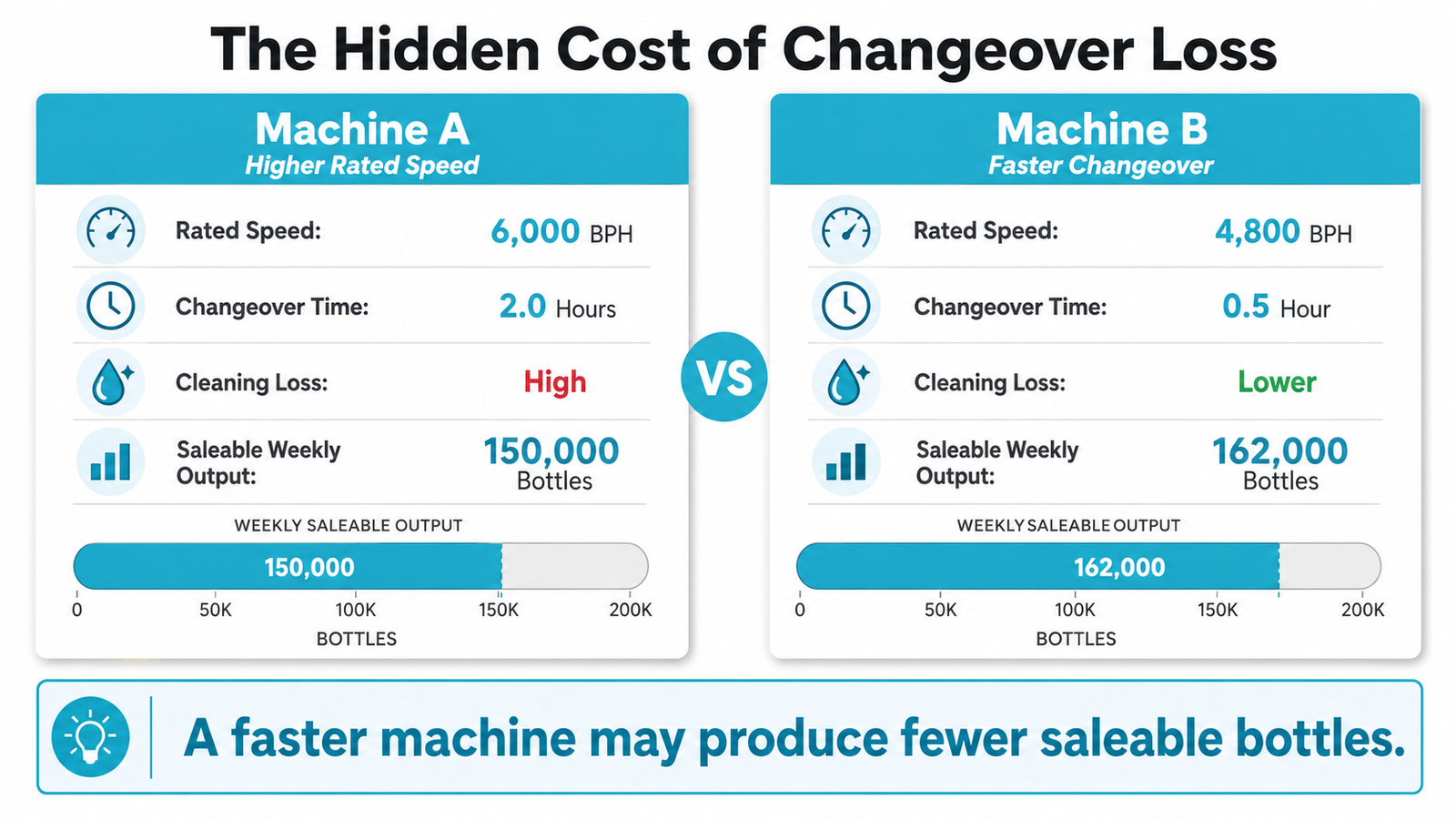
The Hidden Cost Most Comparisons Miss: Changeover Loss

Filling Machine Changeover Cost Comparison
Comparison of filling machine rated speed and saleable output after changeover losses

Machine buyers often compare only purchase price and bottles per hour. A better calculation is:

Saleable weekly output = rated speed × scheduled run time × actual line efficiency − changeover, cleaning, and reject losses

A faster machine that needs long mechanical changeovers may produce fewer saleable bottles than a slower machine that changes recipes and formats quickly. PMMI machinery research highlights changeover impact, total cost of ownership, and modular upgrade paths as important investment considerations.

Calculate the Speed You Actually Need

Required machine speed = target saleable bottles per shift ÷ productive hours ÷ expected line efficiency

Example:

  • Target: 24,000 bottles per shift
  • Productive time: 7 hours
  • Expected line efficiency: 75%

24,000 ÷ 7 ÷ 0.75 = approximately 4,572 bottles per hour
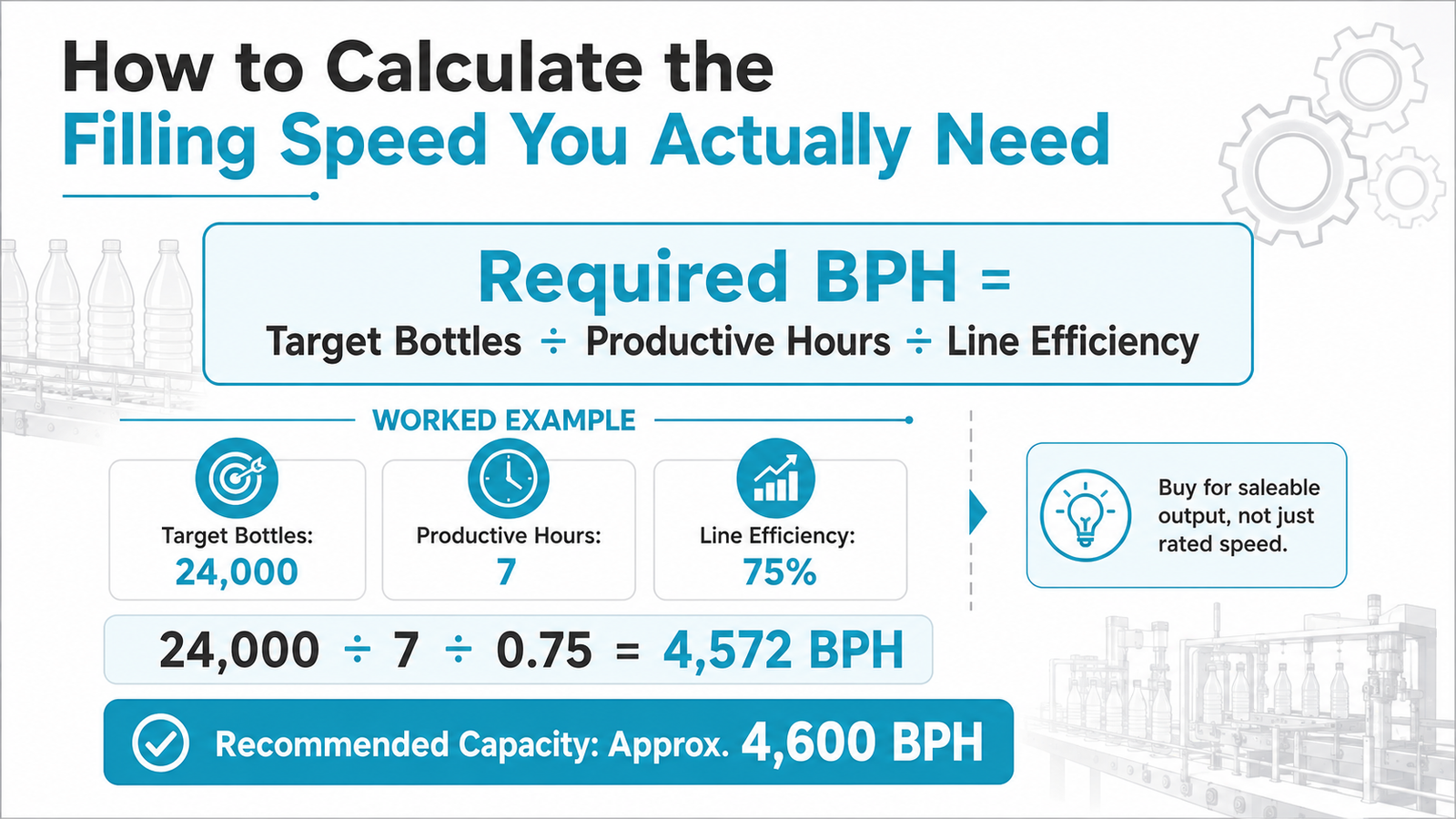
Filling Machine Capacity Calculation

This prevents two common errors: selecting a machine that cannot meet demand or paying for speed the rest of the line cannot use.
Compare the Whole Filling Line, Not Only the Filler

Actual output may be limited by bottle feeding, tank refill time, cap feeding, capping, labeling, coding, inspection, cartoning, or operator replenishment. A balanced automatic filling line running at 4,000 bottles per hour may be more profitable than a 6,000-bottle-per-hour filler that repeatedly waits for another station.

Ask the supplier for a speed chart showing the guaranteed output of every machine, planned accumulation, and test conditions.

Cleaning, Hygiene, and Safety

For food production, equipment must be designed and installed so it can be cleaned and maintained, with suitable corrosion-resistant food-contact surfaces. Pharmaceutical equipment must also be cleaned, maintained, and sanitized or sterilized at appropriate intervals to prevent contamination or changes in product quality.

Compare tool-free contact-part removal, drainability, CIP/SIP capability, gasket materials, cleaning recipes, flushing volume, inspection access, and validation documents. A rotary machine may offer advanced CIP, while a linear machine may provide easier physical access. Neither design is inherently hygienic without correct engineering.

Filling lines also contain conveyors, rotating parts, pinch points, and closing mechanisms. OSHA calls for guarding against moving-part hazards, while ISO’s packaging-machinery work addresses safety requirements for packaging equipment.

Total Cost of Ownership Questions

Do not compare quotations until both suppliers define the same scope. Request:

  1. Machine and line price
  2. Bottle and cap format parts
  3. Installation and commissioning
  4. Power, air, steam, and water requirements
  5. Cleaning and product-loss estimates
  6. Preventive-maintenance and critical spare parts
  7. Operator and technician training
  8. Expected changeover labor and time
  9. Software, recipe, and future-upgrade costs

For a linear filler, ask whether heads or stations can be added later. For a rotary filler, request the price and lead time for every format-parts set.

Practical Selection Guide

Choose Linear First When:

  • You produce several SKUs or bottle shapes
  • Batch sizes are short or seasonal
  • Fill volumes and viscosities change frequently
  • Operators need simple setup and cleaning access
  • You want staged automation
  • Current output requirements are moderate

Typical applications include liquid filling machines, cosmetics, detergents, oils, sauces, small-dose liquids, specialty chemicals, and contract packaging.

Choose Rotary First When:

  • Demand is high and stable
  • One or two bottle formats dominate production
  • Long campaigns minimize changeovers
  • Upstream and downstream equipment can match the filler
  • Skilled maintenance and tooling are available
  • Continuous throughput justifies the investment

Typical applications include standardized beverage bottles, large-volume edible oil lines, and high-output pharmaceutical or personal-care production.

Supplier Qualification and FAT Checklist

Send actual product, bottle, cap, plug, label, and carton samples whenever possible. During the factory acceptance test, verify:

  • Guaranteed speed with your real materials
  • Filling accuracy across every nozzle
  • Reject rate, dripping, and spill control
  • No-bottle-no-fill and missing-cap detection
  • Changeover time between planned formats
  • Cleaning and drainage procedure
  • Cap torque or sealing quality
  • Alarm history, recipes, interlocks, and emergency stops
  • Spare-parts list, manuals, drawings, and training
  • A continuous production trial, not only a short video

A sample-based FAT can expose bottle instability, foaming, cap-feeding problems, and downstream bottlenecks before shipment.

Final Verdict

For manufacturers with multiple products, changing containers, moderate output, and a controlled investment budget, a linear filling machine usually offers the better balance of flexibility, maintenance access, and expansion potential.

A rotary filling machine becomes the stronger choice when production is standardized, demand is consistently high, and the savings from continuous output exceed the additional tooling, maintenance, and capital costs.

Do not ask only, “Which machine is faster?” Ask, “Which machine produces the lowest-cost saleable bottle across my real weekly production schedule?”

Frequently Asked Questions:

Rotary systems generally have a higher ceiling for continuous production, but real output depends on fill volume, product flow, bottle handling, cap supply, cleaning, and downstream equipment.

A linear filling machine is usually more convenient because many changes involve guides, nozzle height, recipes, and modular parts. Rotary machines often require dedicated format components.

Neither layout guarantees better accuracy. The dosing method, calibration, product temperature, viscosity, controls, nozzle behavior, and container tolerances determine the result.

Not directly, because the architectures are different. A manufacturer can begin with a modular linear line and later install a rotary system for a proven high-volume SKU.

Prepare the product and viscosity, fill volume, bottle dimensions, cap structure, target speed, SKU count, working hours, hygiene requirements, floor plan, utilities, and downstream packaging needs.

Get a Filling-Line Recommendation Based on Your Product

Send Shanghai Honest Machinery your product details, bottle and cap samples, required output, floor plan, and packaging process. Our engineers will compare filling methods, linear configurations, capping options, and complete-line layouts before preparing a customized proposal.

Request a Custom Filling Solution

Contact Us For A Customized Solution:

Leave a Comment

Your email address will not be published. Required fields are marked *

"Reach out for a quote! We'll reply with specifics within 24 hours."

Let's have a chat