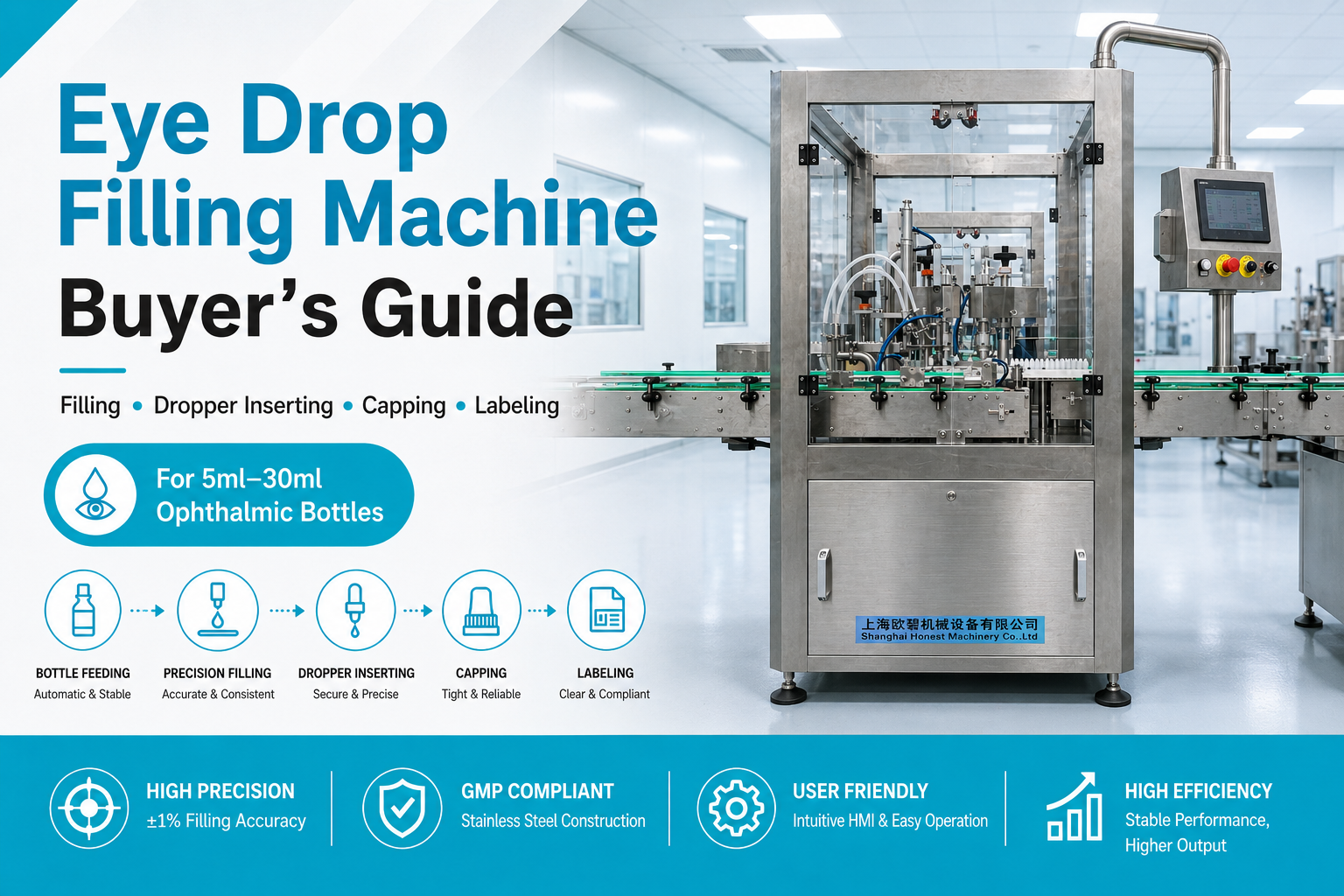
Eye Drop Filling Machine Buyer’s Guide: What to Know Before Purchasing
Choosing an eye drop filling machine is not simply a matter of finding a machine that can fill 5 ml or 10 ml bottles at the required speed. Ophthalmic products require accurate dosing, reliable closure handling and, above all, a production process capable of supporting the required sterility controls.
For buyers, this means the filling machine should be evaluated as part of the complete process—not as an isolated piece of packaging equipment.
The right system must handle your actual eye drop bottle, insert the dropper correctly, apply the cap consistently, minimize contamination risk and maintain stable production during a full batch. It should also fit your cleaning, qualification, documentation and future production requirements.
FDA states that drugs used in the eyes must be sterile because ophthalmic products bypass some of the body’s natural defenses. Facilities manufacturing ophthalmic drugs for the U.S. market are therefore subject to applicable CGMP requirements.
So before requesting quotations from several machine suppliers, answer a more useful question:
What equipment configuration will allow us to manufacture our ophthalmic product reliably, repeatedly and within our required quality system?
Quick Answer: What Should Buyers Check Before Purchasing?
Before buying an automatic eye drop filling machine, verify at least these points:
| Buying Factor | What You Should Confirm |
|---|---|
| Product | Composition, viscosity, sensitivity and required processing conditions |
| Fill volume | Minimum, maximum and most common dosage |
| Bottle | Material, dimensions, neck opening and stability |
| Closure | Dropper insert, nozzle, plug, screw cap or special ophthalmic closure |
| Filling system | Peristaltic, ceramic, piston or another validated dosing principle |
| Sterile processing | Required environmental and barrier configuration |
| Output | Sustainable bottles per minute—not only mechanical maximum |
| IPC | Fill verification, cap/plug detection, torque monitoring and rejection |
| Cleaning | Product-path cleaning, sterilization and changeover method |
| Documentation | FAT, IQ/OQ documentation, certificates and manuals |
| Samples | Actual bottles, droppers, caps and representative product |
| Support | Installation, training, spare parts and technical response |
These factors are much more important than choosing a machine because its catalogue says “5–30 ml, 60 bottles/min.”
1. Define Your Product and Packaging Before Choosing a Machine
An equipment manufacturer cannot properly engineer an ophthalmic filling machine from fill volume alone.
Start by creating a packaging specification for every SKU.
Include:
- nominal filling volume;
- bottle height, diameter and neck dimensions;
- bottle material;
- dropper or nozzle dimensions;
- closure type;
- cap diameter and height;
- required cap torque;
- product viscosity;
- number of product formulations;
- target production capacity.
This becomes particularly important when one line needs to handle several bottles.
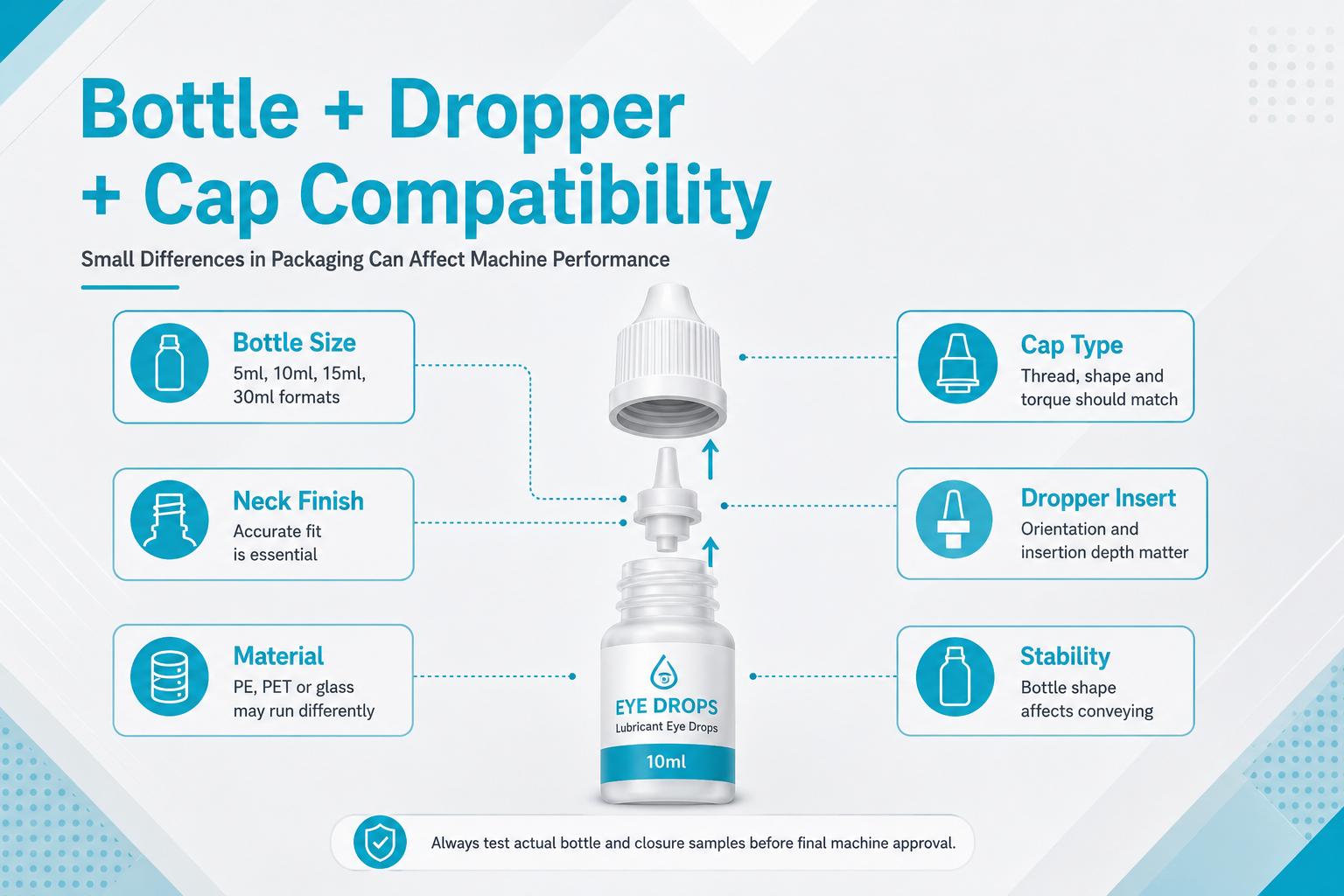
A machine capable of processing 5 ml, 10 ml or 30 ml bottles does not automatically mean that every bottle format will run reliably.. A soft PE bottle, rigid plastic container and glass bottle can behave very differently during conveying, positioning, plug insertion and capping.
Your actual packaging components should therefore be treated as part of the machine design.
2. Choose the Right Filling Technology

There is no single filling technology that is automatically best for every eye drop product.
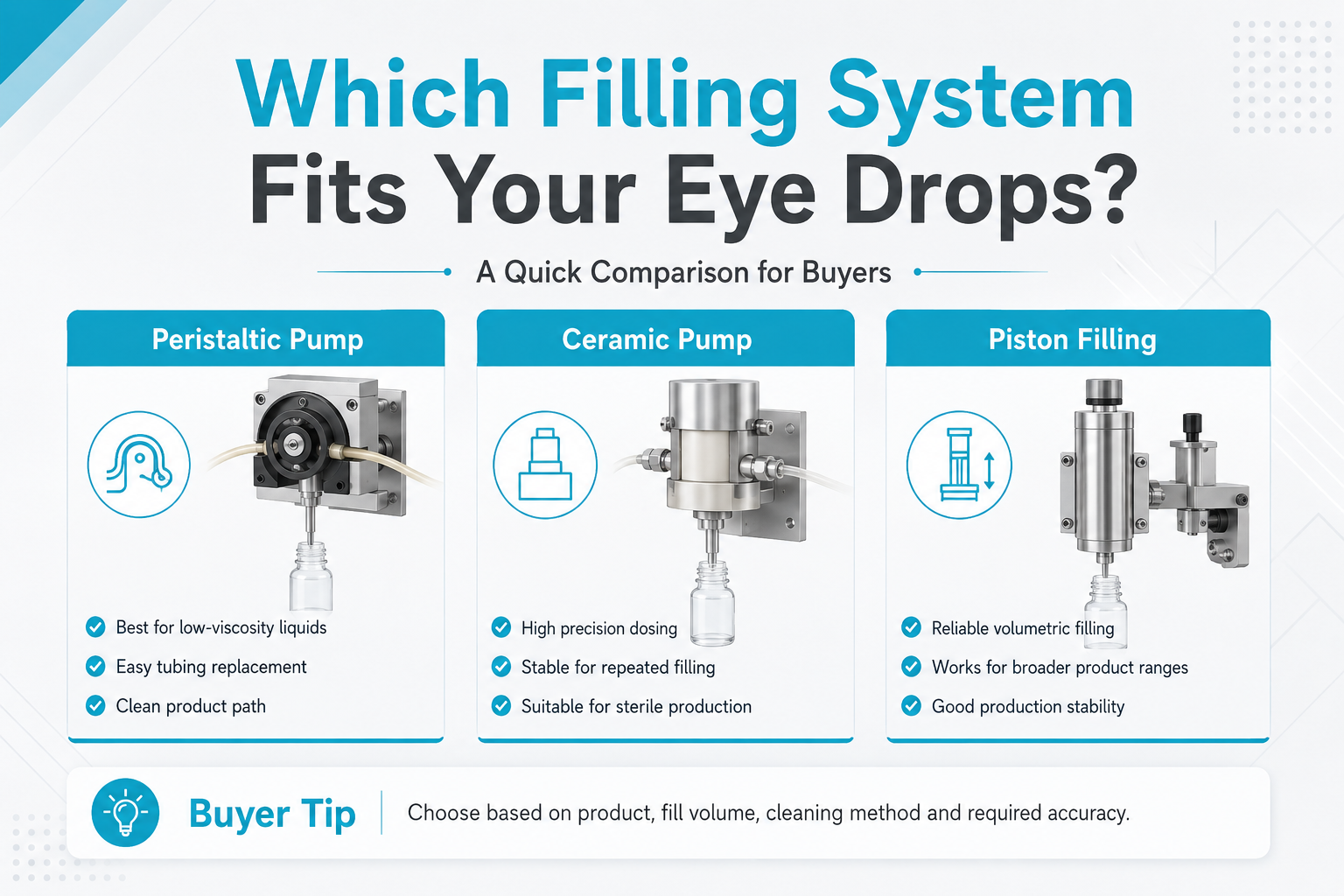
Modern ophthalmic filling systems may use different dosing technologies depending on the formulation, batch requirements and process design. Bausch+Ströbel, for example, describes both peristaltic and rotary-piston dosing technologies for ophthalmic filling applications.
Peristaltic Pump Filling
Peristaltic pumps are attractive for many low-viscosity ophthalmic liquids because the product can remain inside controlled tubing rather than passing through a large pump chamber.these dosing technologies are also widely used across different small bottle filling machines where filling volume, liquid properties and closure design vary between applications.
Potential advantages include:
- relatively simple product paths;
- convenient tubing replacement;
- good small-volume dosing capability;
- easier product changeover in suitable applications;
- reduced number of conventional pump components contacting the liquid.
However, tubing material, tubing life, dosing repeatability and sterilization strategy must still be evaluated for the actual formulation.
Ceramic or Piston Dosing
Precision piston or ceramic dosing systems can also provide repeatable volumetric filling.
They may be appropriate where the formulation, required speed and validation approach support this technology.
The important point is not whether a supplier advertises one pump as “better.”
Ask instead:
Why has this dosing technology been selected for my formulation, filling range, cleaning procedure and production target?
A supplier should be able to explain the engineering reason.
3. Understand the Aseptic Production Requirements
This is where an eye drop machine project becomes fundamentally different from many cosmetic or general liquid-filling applications.
FDA CGMP requirements applicable to sterile ophthalmic products include controls intended to prevent microbiological contamination and validation of aseptic and sterilization processes where applicable.
The revised EU GMP Annex 1 similarly places strong emphasis on contamination control, premises, equipment, utilities, personnel and barrier technologies in sterile medicinal-product manufacturing.
WHO also provides specific GMP guidance for sterile pharmaceutical products.
This means buyers may need to evaluate configurations such as:
- controlled unidirectional/laminar airflow;
- suitable clean-area integration;
- RABS;
- isolator integration;
- particle monitoring;
- sterilizable product-contact paths;
- minimized operator intervention;
- appropriate equipment surfaces and cleanability.
Higher-end ophthalmic lines may integrate IPC, particle monitoring, RABS or isolators and automated rejection. Dara, for example, lists these technologies among available ophthalmic filling configurations.
One important purchasing principle should therefore be remembered:
A machine advertised as “GMP” does not by itself make your manufacturing process GMP compliant.
Compliance depends on the complete facility, process, procedures, equipment qualification, personnel, contamination-control strategy and validation.
4. Do Not Select the Machine by BPM Alone
Suppose Supplier A quotes 60 bottles/min and Supplier B quotes 45 bottles/min.
Supplier A is not automatically the better choice.
Ask whether that speed refers to:
- filler speed;
- complete filling-and-capping speed;
- maximum mechanical speed;
- validated production speed;
- continuous operation with your actual bottle and closure.
The slowest operation often determines real line output.
For ophthalmic bottles, bottlenecks can occur during:
Bottle feeding → Filling → Dropper insertion → Cap feeding → Capping → Inspection
If the filler reaches 60 BPM but the closure feeder consistently supplies 42 caps/min, your production line is effectively a 42 BPM line.
Therefore, ask for a guaranteed line output using a defined bottle, fill volume, dropper and cap configuration.
This is why buyers evaluating an automatic small bottle filling line should compare the sustainable output of the complete system rather than the maximum speed of the filling station alone.
5. Pay Special Attention to Dropper and Cap Handling

Many first-time buyers focus almost entirely on filling accuracy.
In practice, the closure system can be equally important.
A typical multidose eye drop bottle may require:
- bottle positioning;
- liquid filling;
- dropper/nozzle feeding;
- insert placement;
- insert pressing;
- cap feeding;
- screw capping.
Small plastic inserts can stick together, turn upside down or feed inconsistently.
Ask the supplier to test:
- dropper orientation;
- feeding stability;
- insertion depth;
- missing-insert detection;
- cap orientation;
- capping torque;
- cross-threading risk;
- damaged or deformed bottles.
This testing should happen before shipment, not during installation at your factory.
6. Determine the Level of In-Process Control You Need
Higher-specification eye drop filling lines can incorporate substantially more process monitoring than basic automatic machines.
Options may include:
- fill-weight verification;
- bottle presence detection;
- no-bottle-no-fill control;
- dropper presence inspection;
- cap detection;
- torque monitoring;
- automatic rejection;
- batch-data collection;
- audit-trail or SCADA integration.
Some high-output ophthalmic equipment suppliers offer 100% IPC together with automatic rejection and torque monitoring.
Not every project requires every option.
But you should decide what must be checked before ordering, because adding inspection systems later can be more difficult and expensive.
7. Check Cleaning, Sterilization and Changeover
Ask the supplier to show exactly which parts contact the product.
Then verify:
- how those parts are removed;
- how they are cleaned;
- whether they can be sterilized using your intended procedure;
- how tubing is replaced;
- how long product changeover takes;
- what tools are required;
- whether any difficult-to-clean areas exist.
For multi-SKU operations, changeover time directly affects usable production capacity.
A machine that saves five minutes during filling but requires two additional hours for changeover may not be the more productive system.
8. Ask What Happens When Something Goes Wrong
Good automation is not simply about making the machine run.
It is about controlling what happens when the process does not run correctly.
Ask:
- What happens if no bottle arrives?
- What if filling fails?
- What if the dropper is missing?
- What if no cap is supplied?
- What happens when torque is outside limits?
- Is the affected bottle rejected automatically?
- Can the operator identify the reason for the alarm?
This discussion often reveals more about machine engineering quality than the brochure.
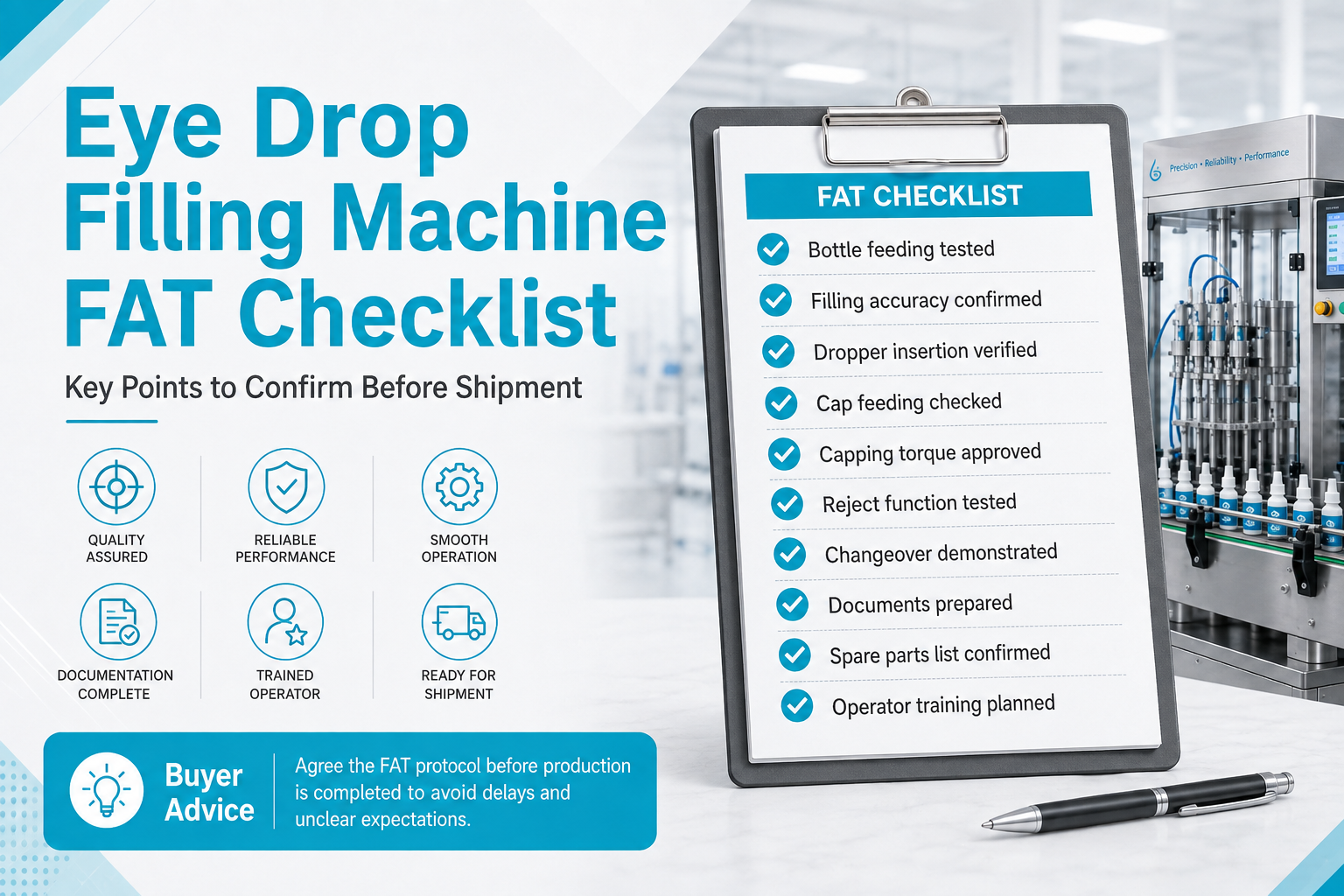
9. Define FAT Before You Place the Order
Do not wait until machine completion to discuss Factory Acceptance Testing.
The FAT protocol should ideally define:
- bottles to be tested;
- filling volumes;
- product or representative test liquid;
- droppers and caps;
- required speed;
- filling accuracy;
- closure success rate;
- test duration;
- alarm tests;
- changeover demonstration;
- documents to be provided.
Send sufficient quantities of your real packaging components whenever possible.
A 10-minute demonstration with generic supplier bottles is not equivalent to testing your production format.
10. Confirm Qualification and Documentation Requirements
For pharmaceutical projects, documentation can be as important as the machine itself.
Discuss the required documentation package during quotation.
Depending on your project, this may include:
- equipment drawings;
- electrical diagrams;
- component lists;
- operating manuals;
- material certificates;
- calibration documentation;
- FAT protocols;
- spare-parts lists;
- IQ/OQ documentation;
- software and control documentation.
If these requirements are introduced only after manufacturing begins, they can increase both project cost and delivery time.
11. Compare Total Project Cost—not Machine Price Alone
Two eye drop filling machine prices cannot be compared until their scopes are aligned.
Quotation A may include only filling, plugging and capping.
Quotation B may additionally include:
- bottle feeding;
- laminar-flow enclosure;
- inspection;
- automatic rejection;
- coding;
- qualification documentation;
- installation;
- spare parts.
The lower equipment price may therefore become the more expensive project after everything else is added.
Evaluate:
Machine + tooling + inspection + clean-area integration + validation support + installation + spare parts + future format changes
That is a far more useful purchasing comparison.
12. Send Suppliers a Complete URS Before Requesting a Final Quote
One of the simplest ways to improve quotation quality is to prepare a short User Requirement Specification.A reliable filling machine manufacturer should review these requirements before recommending the final equipment configuration.
At minimum, send:
Product: formulation and relevant characteristics
Volume: all required filling volumes
Containers: drawings, dimensions and physical samples
Closures: dropper, plug and cap samples
Capacity: required bottles/hour
Quality: filling tolerance and inspection requirements
Environment: intended cleanroom/barrier concept
Automation: required upstream and downstream equipment
Documentation: FAT/IQ/OQ and certification requirements
Utilities: electricity, compressed air and other requirements
This allows suppliers to quote an engineered solution rather than a catalogue machine.
Eye Drop Filling Machine Procurement Checklist

Before approving the purchase order, you should be able to answer yes to these questions:
- Has the supplier reviewed my actual bottles?
- Have the dropper and cap been tested?
- Is the filling technology suitable for my formulation?
- Is sustainable production speed defined?
- Are required sterile-processing interfaces confirmed?
- Are product-contact materials documented?
- Is filling verification defined?
- Is closure inspection defined?
- Is cleaning/changeover documented?
- Is the FAT protocol agreed?
- Are qualification documents included where required?
- Are installation and after-sales responsibilities clear?
If several answers are still “no,” the project is probably not ready for final machine approval.
People Also Ask / FAQ:
Sterile ophthalmic drug manufacturing requires an appropriately controlled process capable of maintaining product sterility. The exact equipment and environmental configuration depends on the manufacturing process, formulation, container system and applicable regulatory requirements. FDA and EU GMP guidance should therefore be considered during facility and process design rather than relying on the filling machine alone.
Peristaltic pumps are commonly considered for low-viscosity small-dose liquids because they can provide a relatively simple product path. Rotary piston or other precision dosing technologies are also used in ophthalmic production. Selection should be based on formulation, dose range, accuracy, sterilization strategy and production speed rather than pump type alone.
Many automatic systems are designed around common small ophthalmic bottles such as 5 ml, 10 ml, 15 ml and 30 ml containers, although the actual format range depends on bottle dimensions, neck design, closure and machine tooling. Your supplier should confirm compatibility using drawings and physical samples.
Required accuracy should come from your product specification and validated manufacturing process rather than a generic industry number. Ask suppliers to define the filling tolerance they can demonstrate with your actual volume and product under agreed FAT conditions.
Some pharmaceutical equipment platforms can handle ophthalmic and nasal products, and manufacturers such as Dara offer systems specifically intended for both eye drops and nasal sprays. However, filling components, closures, pumps, cleaning procedures and change parts must be evaluated for each format.
A standalone filler may make sense if your factory already has compatible closing and inspection equipment. For new production projects, an integrated filling, dropper inserting and capping system can reduce manual handling and simplify line synchronization. The final configuration should be based on production volume, automation requirements and your contamination-control strategy.
Get the Right Eye Drop Filling Solution Before You Invest
Buying an ophthalmic filling machine should begin with your product, bottle, dropper, cap and manufacturing requirements—not a machine catalogue.
Shanghai Honest Machinery supplies automatic small-bottle filling solutions that can be configured for eye drop bottles, ophthalmic liquids and other precision small-dose applications. Our automatic eye drop systems can integrate filling, dropper insertion, capping, bottle feeding, labeling, coding and additional inspection according to the project requirements.
Send us:
your bottle and closure photos or drawings + filling volume + product information + required bottles per minute + required production standard.
We can evaluate the packaging format first and recommend a suitable eye drop filling and capping machine configuration before preparing the final quotation.
→ Request an Eye Drop Filling Machine Solution for Your Bottles