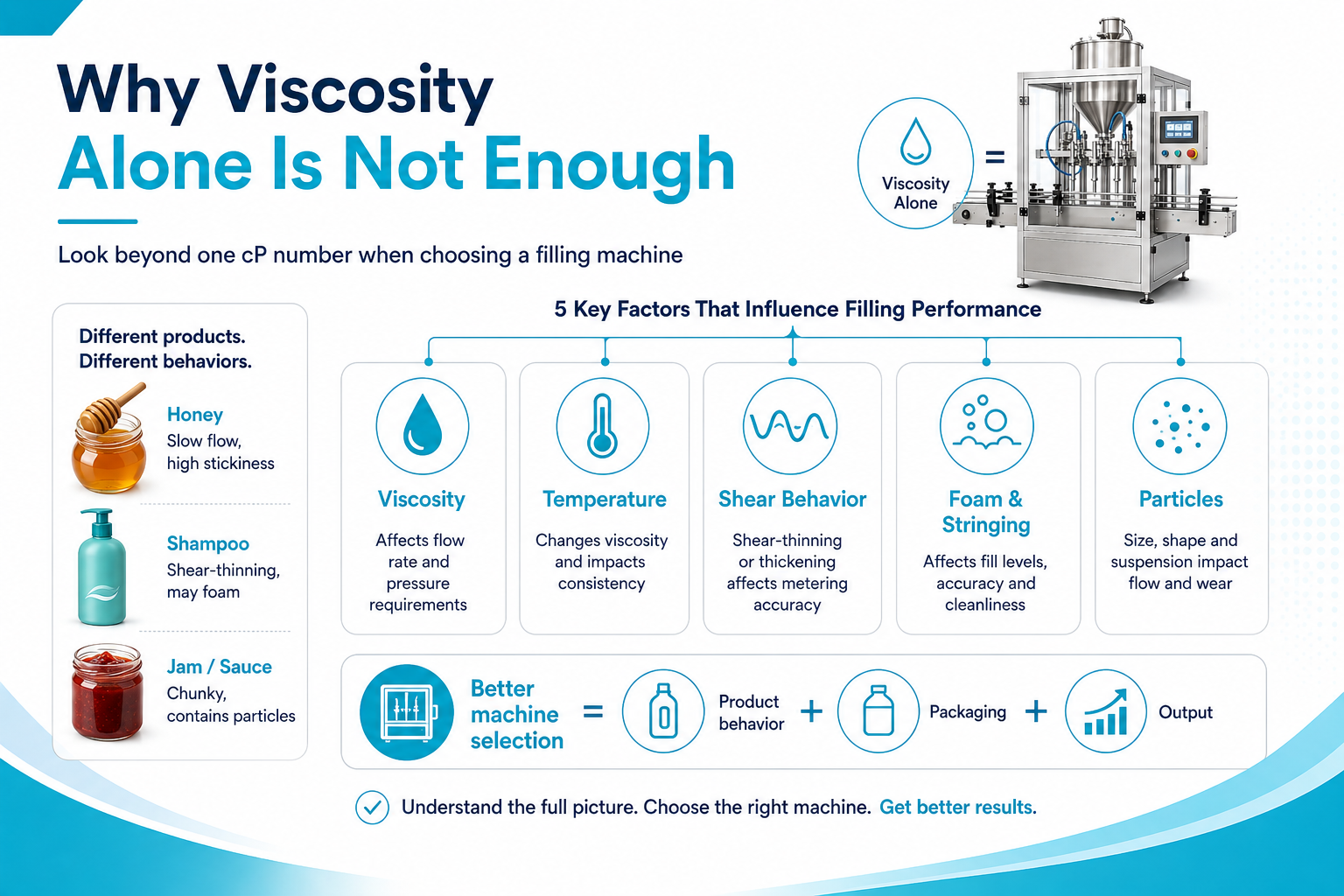
Viscosity describes a liquid’s resistance to flow and is commonly expressed in centipoise (cP). It is useful, but buyers often make a costly mistake: they send a supplier one viscosity value and expect that number alone to determine the machine.
It cannot.
Check viscosity at the actual filling temperature
A product measured at 20°C may behave very differently when it is filled at 35°C or 50°C.
Honey, chocolate sauce, petroleum jelly and some cosmetic formulations become considerably easier to move when warmed. If the temperature drops during production, the same product may:
- fill more slowly;
- leave more residue inside hoses;
- require higher pressure;
- create inconsistent cut-off at the nozzle;
- reduce actual production capacity.
For this reason, tell your filling-machine manufacturer both the viscosity and the temperature at which that viscosity was measured.
Consider shear behavior
Many sauces, creams, gels and cosmetic products are non-Newtonian. Their apparent viscosity can change when they are mixed, pumped or pushed through a narrow nozzle.
This is one reason why two products reported as “10,000 cP” may require different machine configurations.
ASTM D2196, a recognized method for evaluating rheological properties of non-Newtonian materials, considers viscosity under different rotational conditions rather than relying solely on one measurement.
For machine selection, this means you should also tell the supplier whether your product:
- becomes thinner during pumping;
- becomes thicker during agitation;
- must not be exposed to excessive shear;
- changes after standing for several minutes.
This information can influence pump selection, agitation design and filling speed.
Do not forget foam, particles and stringing
Three products with similar viscosity can create completely different problems.
A shampoo may foam. Honey may produce long strings after the nozzle closes. Jam may contain fruit pieces.
Therefore, a proper viscous-liquid filling assessment should include:
viscosity + temperature + particles + foaming + stringing + chemical properties + required accuracy.
That equation is far more useful than viscosity alone.
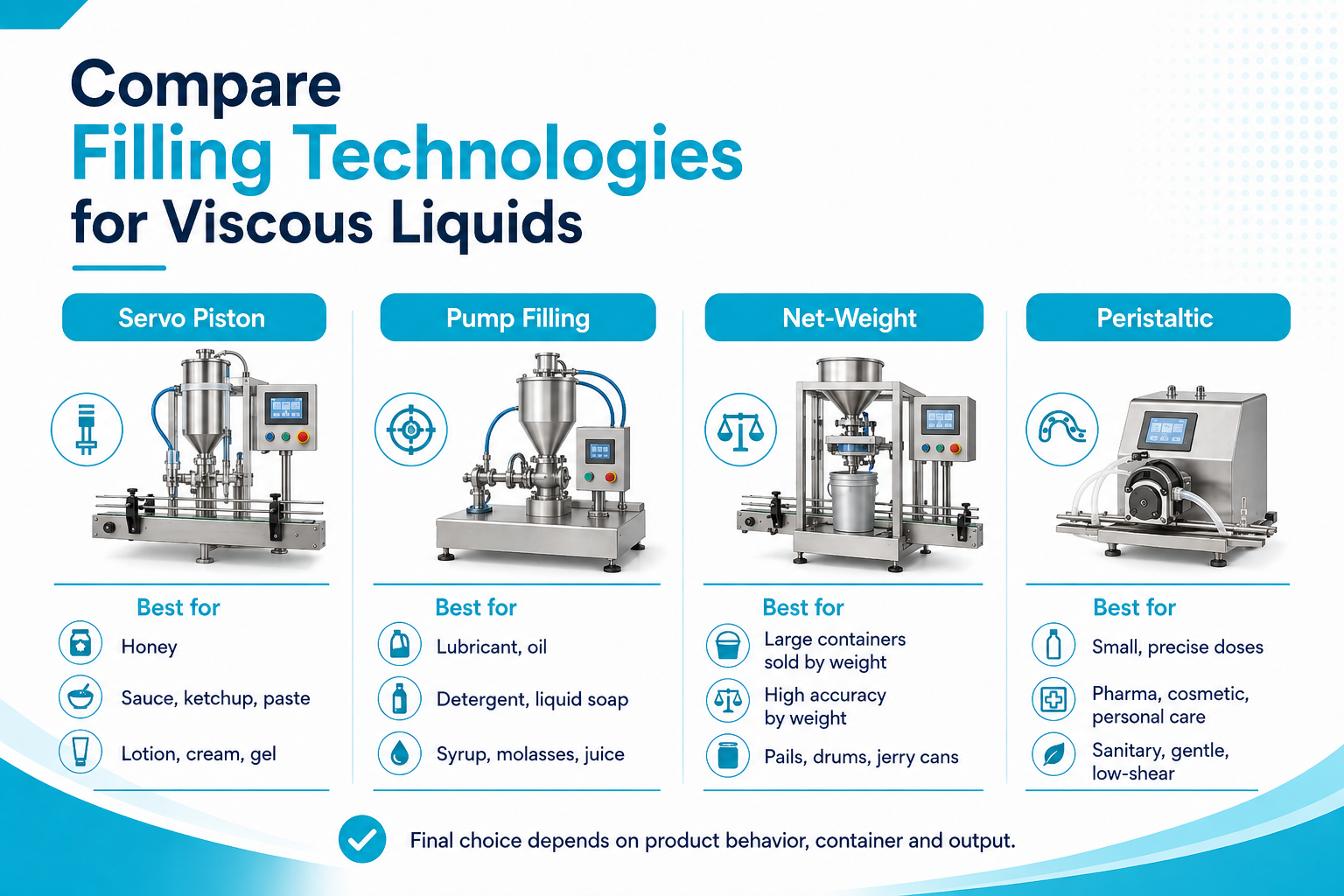
Servo Piston Filling Machine
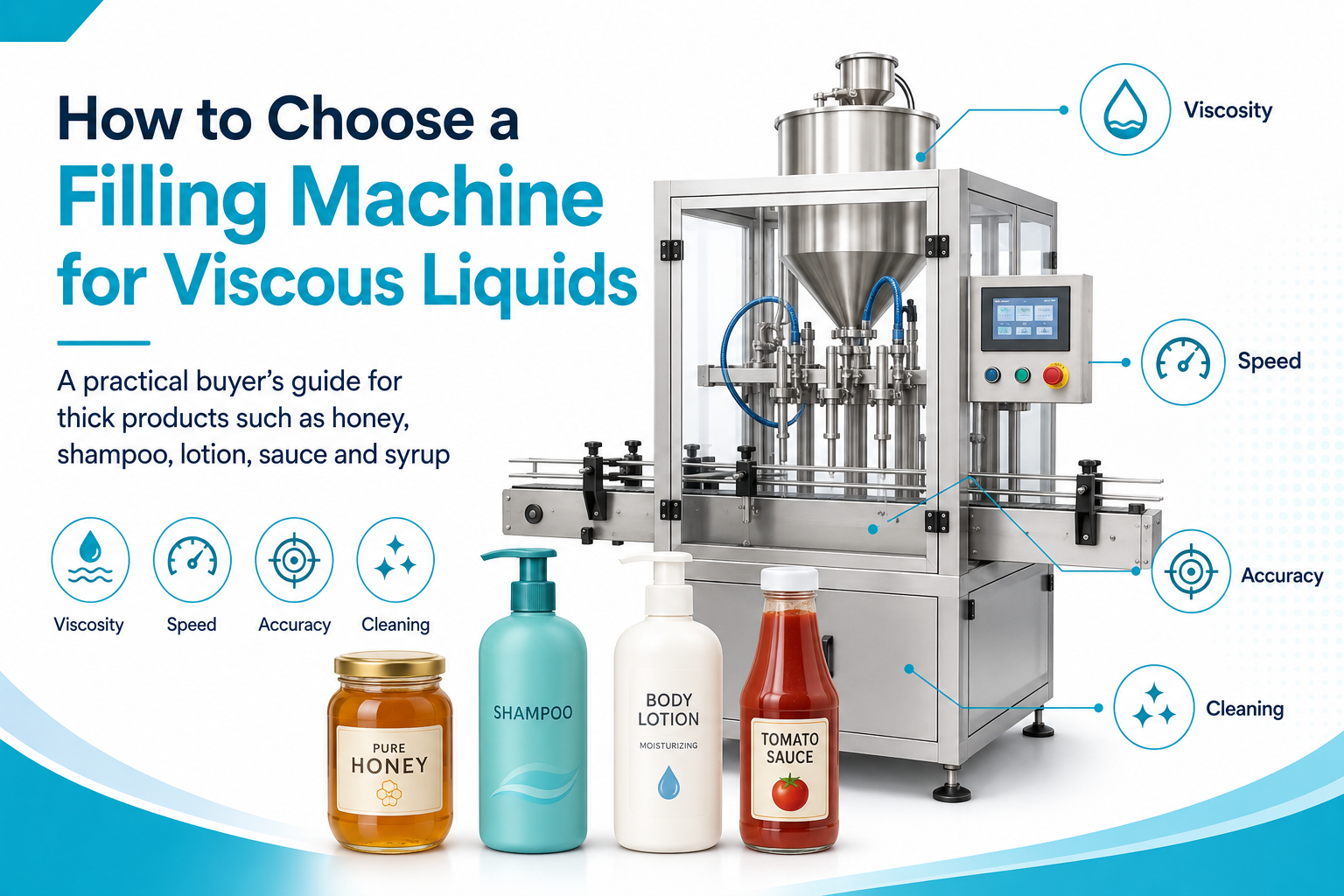
For many buyers, a servo piston filling machine is the most versatile option for high-viscosity products.
The piston draws a measured volume of product into a cylinder and then pushes it into the container. Because the product is mechanically displaced rather than relying on gravity, thick products can be filled more consistently.
Typical applications include:
- honey;
- ketchup and sauces;
- mayonnaise;
- shampoo and conditioner;
- lotion and cream;
- shower gel;
- liquid soap;
- paste-like products.
Servo control also allows filling volume and filling profiles to be adjusted through the HMI, which is useful when one production line handles several bottle sizes.
However, piston filling is not automatically the best solution for every viscous product. Valve passages, cylinder size, particle size and cleaning requirements must still be evaluated.
Gear Pump or Other Pump Filling Systems
Pump filling can work well for smooth, pumpable products such as lubricants, detergents, syrups and some cosmetic liquids.
A servo-controlled pump system provides electronic control over dosing and can be convenient for products requiring frequent volume changes.
But the pump type matters.
A gear pump suitable for a smooth lubricant may not be suitable for a sauce containing large particles. Likewise, a shear-sensitive formulation may require a gentler pump principle.
Do not purchase a machine simply because the quotation states “pump filling.” Ask:
What pump is being used, and why was that pump selected for my product?
Net-Weight Filling Machine
A net-weight filler measures the amount of product by weighing the container during filling.
This is especially worth evaluating when:
- containers are relatively large;
- the product is commercially sold by weight;
- product giveaway is expensive;
- density can vary;
- fill-weight control is more important than volumetric dosing.
For example, a 20L lubricant or chemical container may justify a net-weight system even when a volumetric machine could technically fill the product.
Peristaltic Filling
Peristaltic systems isolate the product inside flexible tubing and can be valuable for certain small-dose or hygienic applications.
However, they should not be treated as a universal solution for very thick products. Tubing size, viscosity, dose volume and required output can limit performance.
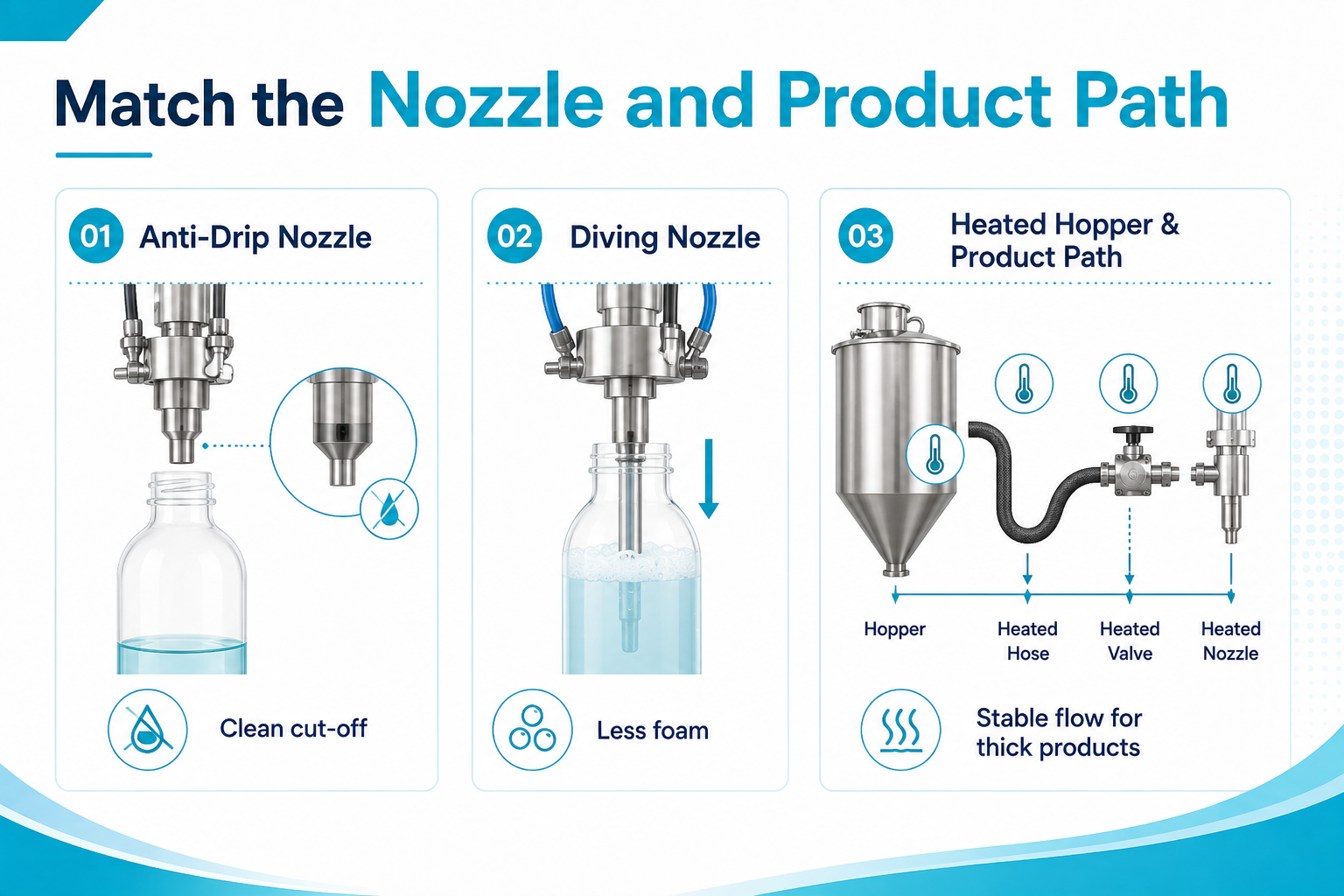
Selecting the filling mechanism is only half of the job.
The product must still travel through a tank, pipe, valve and nozzle before reaching the bottle.
For viscous products, evaluate the following:
Anti-Drip or Positive Shut-Off Nozzles
Honey, syrup, gel and sauces can continue flowing after the main filling cycle finishes.
A properly designed shut-off nozzle or suck-back function helps reduce:
- dripping;
- stringing;
- contaminated bottle necks;
- dirty conveyors;
- product waste.
This becomes particularly important when a cap, induction seal or label is applied immediately after filling.
Diving or Bottom-Up Filling
Foaming products such as shampoo, detergent and liquid soap may benefit from a nozzle that enters the bottle and rises gradually as filling progresses.
The objective is not simply faster filling. It is to achieve the required output without filling the bottle with foam instead of product.
Heated Hopper and Product Path
Some high-viscosity products become difficult to pump when their temperature falls.
In these applications, heating only the hopper may not solve the problem if the product then cools inside a long unheated hose or nozzle.
Ask whether temperature control is required across the:
hopper → pump/cylinder → hose → valve → filling nozzle.
Agitation
Products containing suspended ingredients or formulations that separate during production may require controlled agitation.
The mixing system should maintain product uniformity without introducing unnecessary air or damaging the formulation.
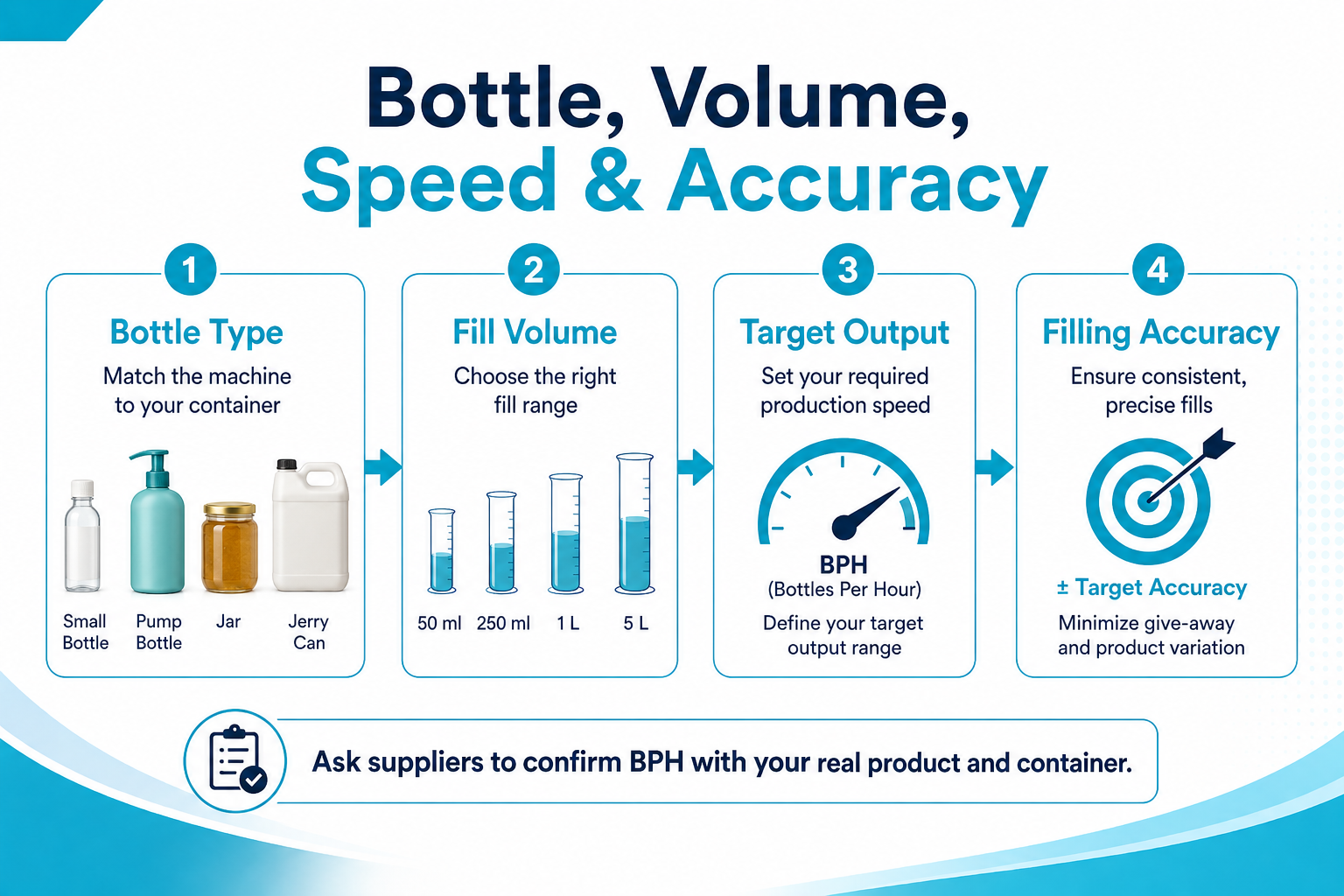
The same liquid behaves differently when filling a 50ml bottle and a 5L jar.
Before requesting a quotation, provide:
- minimum and maximum filling volume;
- bottle material;
- bottle height and diameter;
- bottle-neck opening;
- container shape;
- bottle stability on a conveyor;
- cap type;
- photos or technical drawings.
A narrow bottle opening can restrict nozzle diameter and reduce filling speed for thick products.
Likewise, unstable or lightweight containers may need bottle clamps or positioning devices during filling.
If your factory runs several SKUs, ask the supplier to explain the exact changeover process instead of simply accepting the statement “suitable for different bottles.”
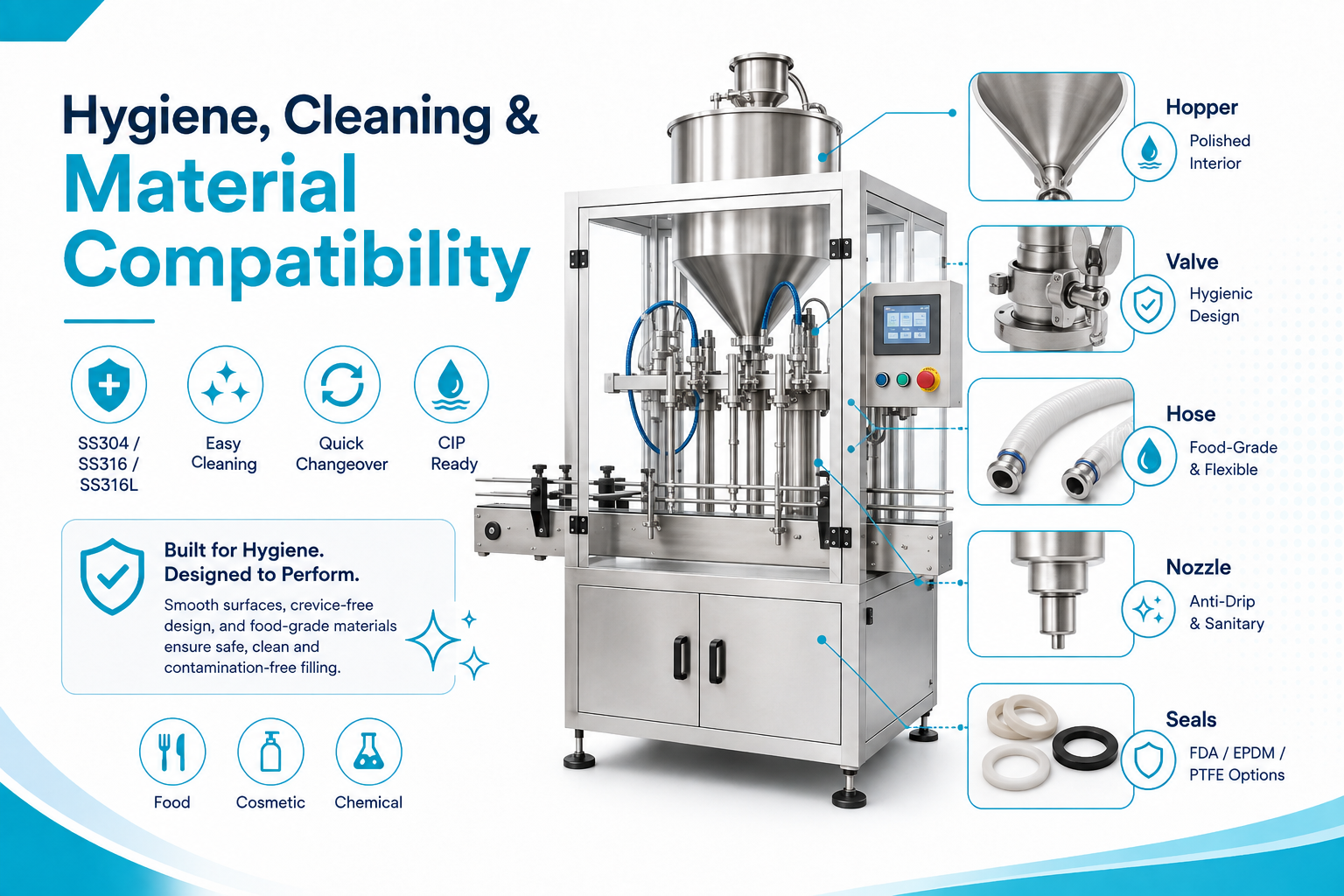
This is particularly important for food, cosmetic and pharmaceutical-related applications.
The U.S. FDA’s Current Good Manufacturing Practice requirements under 21 CFR Part 117 address equipment design, maintenance, sanitary operations and cleanability for food manufacturing.
EHEDG hygienic-design principles similarly emphasize equipment that can be effectively cleaned and does not create unnecessary contamination traps.
When purchasing a viscous liquid filler, therefore, do not evaluate only whether the visible machine frame is stainless steel.
Ask about the actual product-contact system:
- hopper;
- piston cylinder;
- pump;
- valves;
- hoses;
- fittings;
- gaskets;
- nozzles.
Depending on the product, SS304, SS316 or SS316L and compatible sealing materials may be considered.
Also decide whether your process requires:
- manual dismantling;
- quick-release connections;
- automatic flushing;
- CIP integration.
A machine that takes three hours to clean between products may be more expensive to operate than a slightly higher-priced machine that changes over much faster.
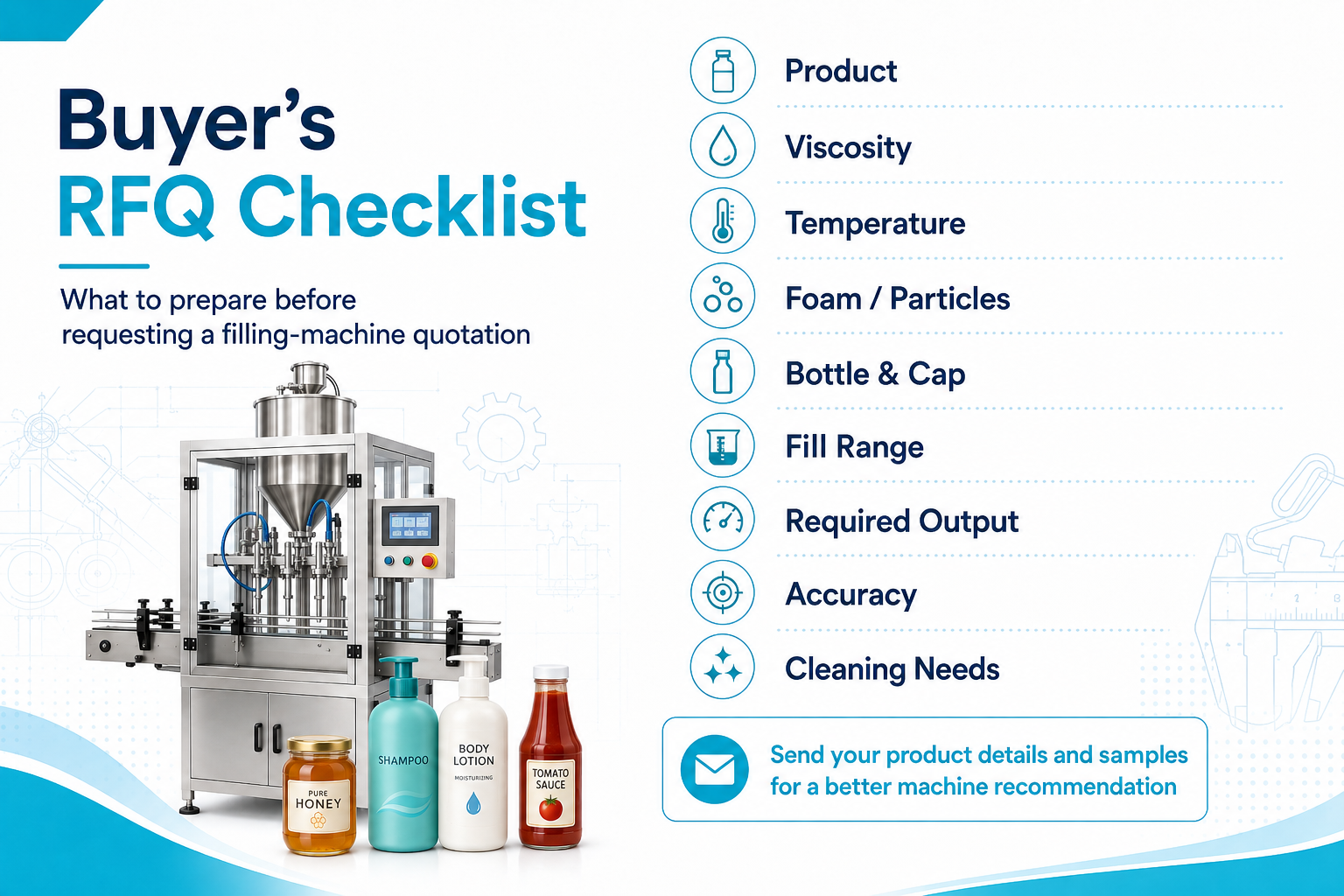
Before asking a supplier for a quotation, prepare these details:
- Product: What exactly are you filling?
- Viscosity: What is the viscosity and measurement temperature?
- Product behavior: Does it foam, string, separate or contain particles?
- Filling volume: What are the minimum and maximum volumes?
- Containers: What bottles or jars will you use?
- Production speed: How many bottles per minute or hour are required?
- Accuracy: What fill tolerance does your process require?
- Temperature: Is the product hot-filled or heated during filling?
- Cleaning: How often will products change?
- Automation: Do you need only filling or a complete filling, capping and labeling line?
Whenever possible, send actual product, bottle, cap and label samples before final machine approval.