Automatic vs Semi-Automatic Filling Machine: Which One Is Right for Your Business?
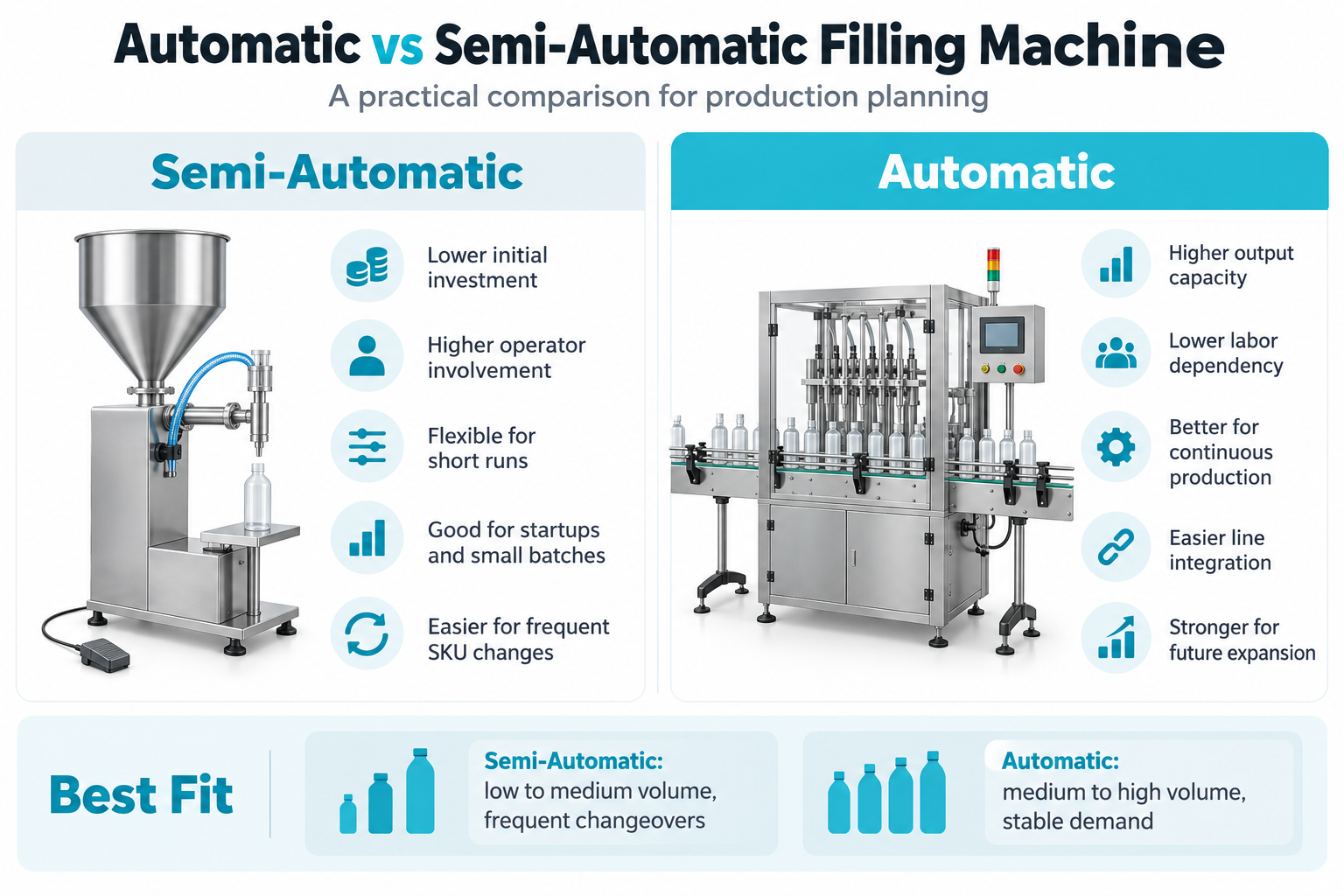
Choosing between an automatic vs semi-automatic filling machine is not simply a question of buying the faster machine. The better choice depends on how many bottles you actually need to produce, how often you change products or containers, your labor cost, product characteristics, available factory space, and where you expect production to be two or three years from now.
For a small manufacturer producing short batches of several SKUs, a semi-automatic filler may deliver a better return. For a factory running the same bottles every day, however, an automatic filling machine can reduce manual handling, improve production consistency and make future expansion considerably easier.
This guide shows you how to compare the two systems from a buyer’s perspective—not just from a machine specification sheet.
Quick Answer: Automatic or Semi-Automatic Filling Machine?
If you need a quick starting point, use this table.
| Decision Factor | Semi-Automatic Filling Machine | Automatic Filling Machine |
|---|---|---|
| Production volume | Low to medium | Medium to high |
| Operator involvement | High | Low |
| Initial investment | Lower | Higher |
| Continuous production | Limited | Excellent |
| Frequent SKU changes | Usually convenient | Depends on changeover design |
| Line integration | Limited | Excellent |
| Labor dependency | High | Lower |
| Factory space | Smaller footprint | More space required |
| Future expansion | Moderate | High |
| Best use | Startups, short batches, trial production | Stable commercial production and growth |
There is no universal production number at which every factory should automate.
The correct point comes when the additional cost of automation becomes smaller than the labor, downtime, product loss and capacity restrictions created by manual production.
What Is the Real Difference Between Semi-Automatic and Automatic Filling Machines?
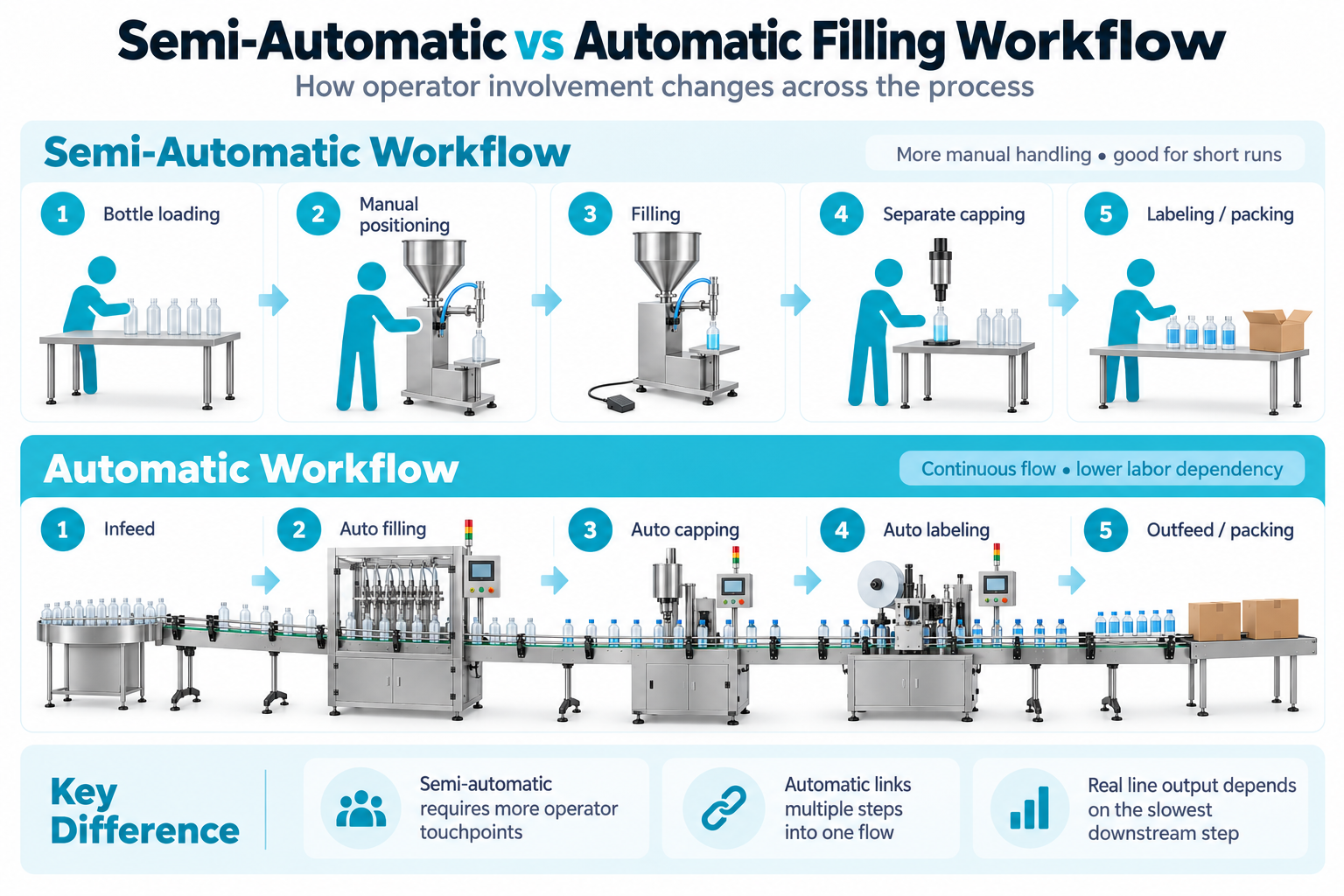
A semi-automatic filling machine automates the dosing operation but still depends heavily on an operator.
The operator may need to:
- place bottles beneath the filling nozzles;
- activate each filling cycle;
- remove filled bottles;
- transfer bottles to capping or labeling;
- continuously coordinate the production rhythm.
A fully automatic filling machine, by comparison, normally uses conveyors, sensors, bottle-positioning devices, PLC control and automatic filling cycles to move containers through production with much less manual intervention.
When integrated with capping, labeling and coding equipment, it becomes a complete automatic bottling line.
You can explore typical configurations in our automatic filling machine solutions and complete automatic filling lines.
However, “automatic” does not mean “zero operators.” Someone still needs to replenish bottles, caps and labels, monitor quality, perform changeovers, clean the machine and respond to alarms.
That distinction matters when calculating ROI.
Automatic vs Semi-Automatic Filling Machine: Detailed Comparison
1. Production Output: Do Not Compare Nameplate Speed Alone
Production speed is usually the first specification buyers compare, but it is often misunderstood.
Suppose a filling machine is rated at 60 bottles per minute.
That does not automatically mean your factory will produce 60 finished bottles per minute.
If your:
- capper can only handle 45 bottles/min;
- labeler stops frequently;
- operators cannot supply bottles fast enough;
- product generates excessive foam;
- bottles jam on the conveyor;
your real output may be much lower.
The metric buyers should request is sustained accepted output, not theoretical maximum filling speed.
Ask the supplier:
How many correctly filled, capped and finished bottles can the complete system continuously produce with my actual product and packaging?
This question is more useful than simply asking for the maximum BPM.
2. Labor Cost: Calculate the Real Automation Break-Even Point
The higher purchase price of an automatic filler often makes buyers hesitate. However, machine price alone does not show the real cost of production.
Consider:
Annual labor saving = Operators eliminated × loaded hourly labor cost × annual operating hours
Then calculate:
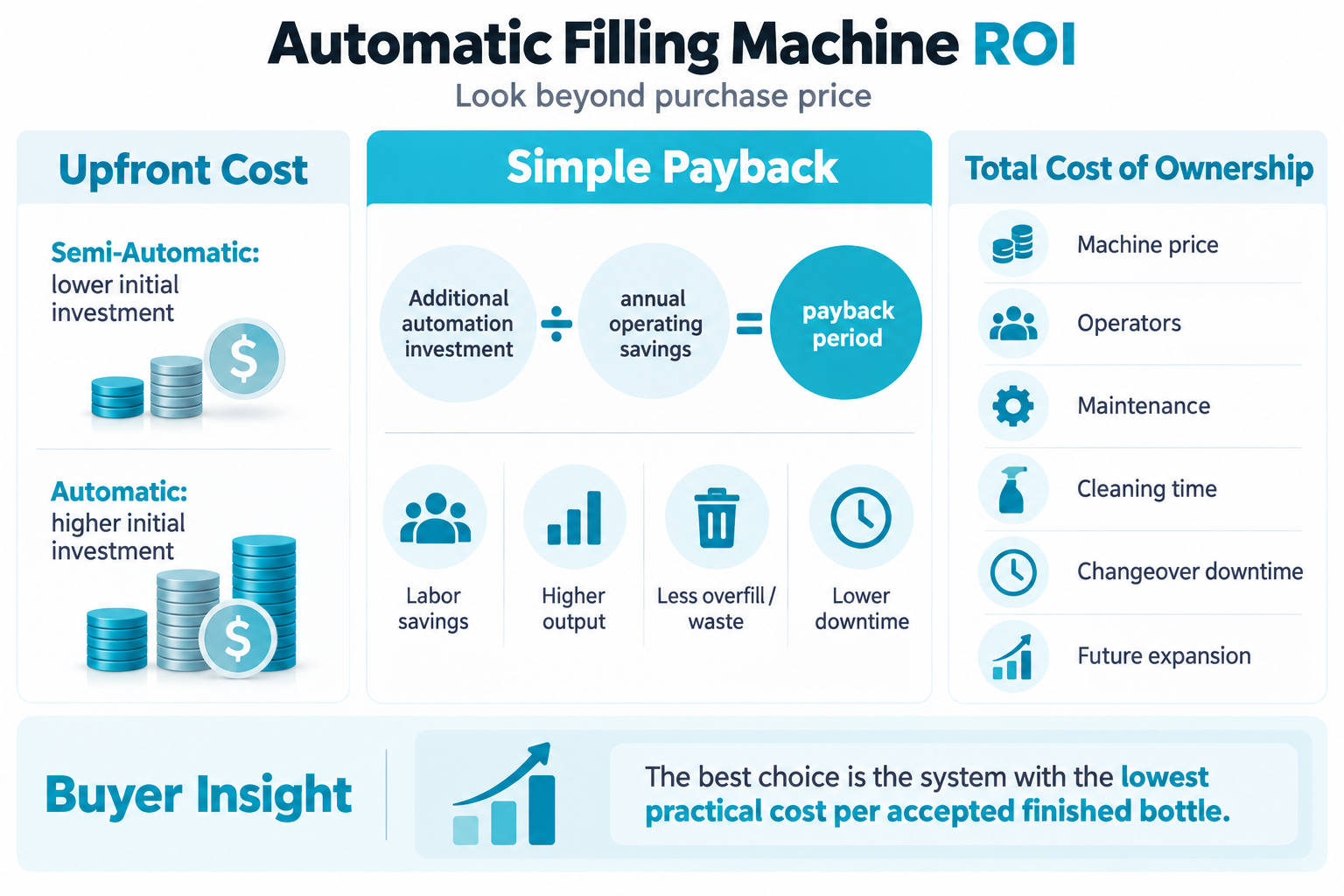
Simple payback period = Additional automation investment ÷ annual operating savings
For example, imagine automation reduces a line from three operators to two.
If one operator costs the company $18 per hour and the plant runs:
- 16 hours per day,
- 300 days per year,
the annual labor saving would be approximately:
$18 × 16 × 300 = $86,400 per year
If automation costs an additional $55,000, the labor-only payback would be roughly 7.6 months.
This is only an example—the calculation must use your actual labor cost and operating schedule.
It should also include savings from lower product giveaway, fewer rejected bottles and additional production capacity.
Do Not Ignore Operator Ergonomics
Automation can also remove repetitive bottle loading, carrying and transferring tasks.
OSHA’s ergonomics guidance recommends reducing the frequency and range of manual material handling and notes that conveyors can be used for horizontal movement where practical.
That does not mean automation automatically solves every ergonomic problem, but operator workload should be part of your equipment evaluation.
3. Filling Accuracy Depends More on Technology Than Automation Level
A common assumption is that an automatic filling machine is always more accurate.
That is not necessarily true.
Accuracy depends on factors such as:
- filling principle;
- pump or metering technology;
- liquid viscosity;
- temperature;
- filling volume;
- foam;
- particles;
- nozzle design;
- control system;
- machine speed.
A well-designed semi-automatic piston filler can be very accurate. Likewise, an incorrectly selected automatic filling system can perform poorly.
The more important question is:
Which filling technology fits my product?
Common solutions include:
| Filling Method | Typical Applications |
|---|---|
| Gravity filling | Water and free-flowing liquids |
| Piston filling | Cream, honey, sauce and viscous liquids |
| Peristaltic pump | Small-volume or easily cleaned liquid applications |
| Gear/servo pump | Oil and medium-viscosity liquids |
| Flowmeter filling | Oils, chemicals and larger volumes |
| Net-weight filling | Large containers and weight-controlled products |
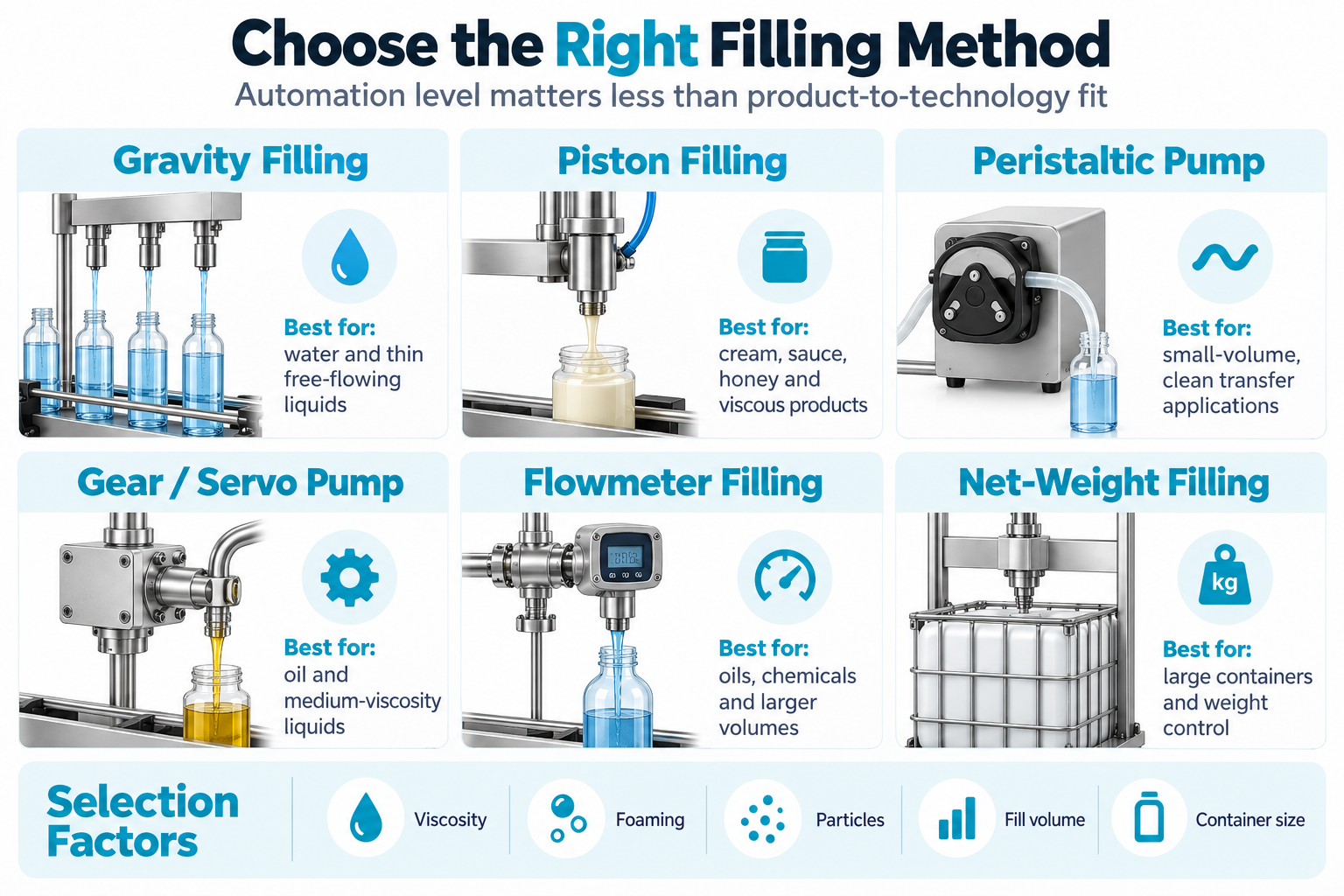
For example, high-viscosity petroleum jelly may require heating, mixing and piston filling rather than simply selecting a larger automatic machine. See our petroleum jelly and viscous product filling solution for a typical application.
4. Product and Bottle Stability Can Matter More Than Volume
Here is one factor many comparison articles overlook:
Automation works best when the process itself is stable.
Imagine Factory A produces 8,000 identical bottles every day.
Factory B produces the same total quantity but changes between:
- six bottle formats;
- four cap designs;
- five products;
- several label sizes.
Factory A may benefit significantly more from automation, even if daily volume is identical.
Why?
Because every format change requires machine adjustment.
Therefore, before buying an automatic filling line, calculate:
Effective production time = Available shift time − cleaning − changeovers − maintenance − planned stops
If your production involves many short batches, a simpler machine with faster changeover can sometimes outperform a high-speed line over an entire shift.
5. Changeover: Ask for Time, Not “Easy Adjustment”
Machine suppliers often describe equipment as “easy to adjust.”
That phrase tells you very little.
Instead, ask:
- How long does a complete bottle changeover take?
- Which parts need tools?
- Are format parts required?
- Can filling volume be changed from the HMI?
- Are recipes stored?
- Does nozzle height adjust automatically?
- How many operators are required?
- Can the supplier demonstrate the changeover during FAT?
For manufacturers selling many bottle sizes, a machine producing 20% faster but requiring one extra hour for every changeover may not be the better investment.
6. Cleaning, Hygiene and Product Contact Materials
Cleaning becomes especially important for food, cosmetics, pharmaceutical and healthcare applications.
If you manufacture food products for the U.S. market, FDA requirements under 21 CFR 117.40 state that processing and packing equipment should be adequately cleanable, properly maintained, and designed to reduce contamination. Food-contact surfaces must also be suitable for their intended environment and resistant to corrosion.
For pharmaceutical manufacturing, FDA guidance similarly emphasizes equipment design that supports intended operation, cleaning and maintenance, with product-contact surfaces that do not adversely affect the product.
Therefore, discuss:
- SS304, SS316 or SS316L contact parts;
- tool-free disassembly;
- dead zones in piping;
- sanitary connections;
- CIP requirements;
- drainage;
- product recovery;
- cross-contamination between SKUs.
Do this before comparing machine prices.
A cheaper filling machine that takes two extra hours to clean every day may quickly become the more expensive machine.
7. When Is a Semi-Automatic Filling Machine the Better Choice?
Semi-automatic equipment can be the smarter investment when:
Your sales volume is still uncertain
If a product has just entered the market, investing heavily in capacity that may remain unused creates unnecessary financial pressure.
You produce very small batches
Short production campaigns may not justify a complete automated line.
You change SKUs constantly
Manual handling can sometimes provide useful flexibility when bottle and product formats change several times per day.
Labor is readily available
In markets where labor costs are relatively low, automation may take longer to repay its additional investment.
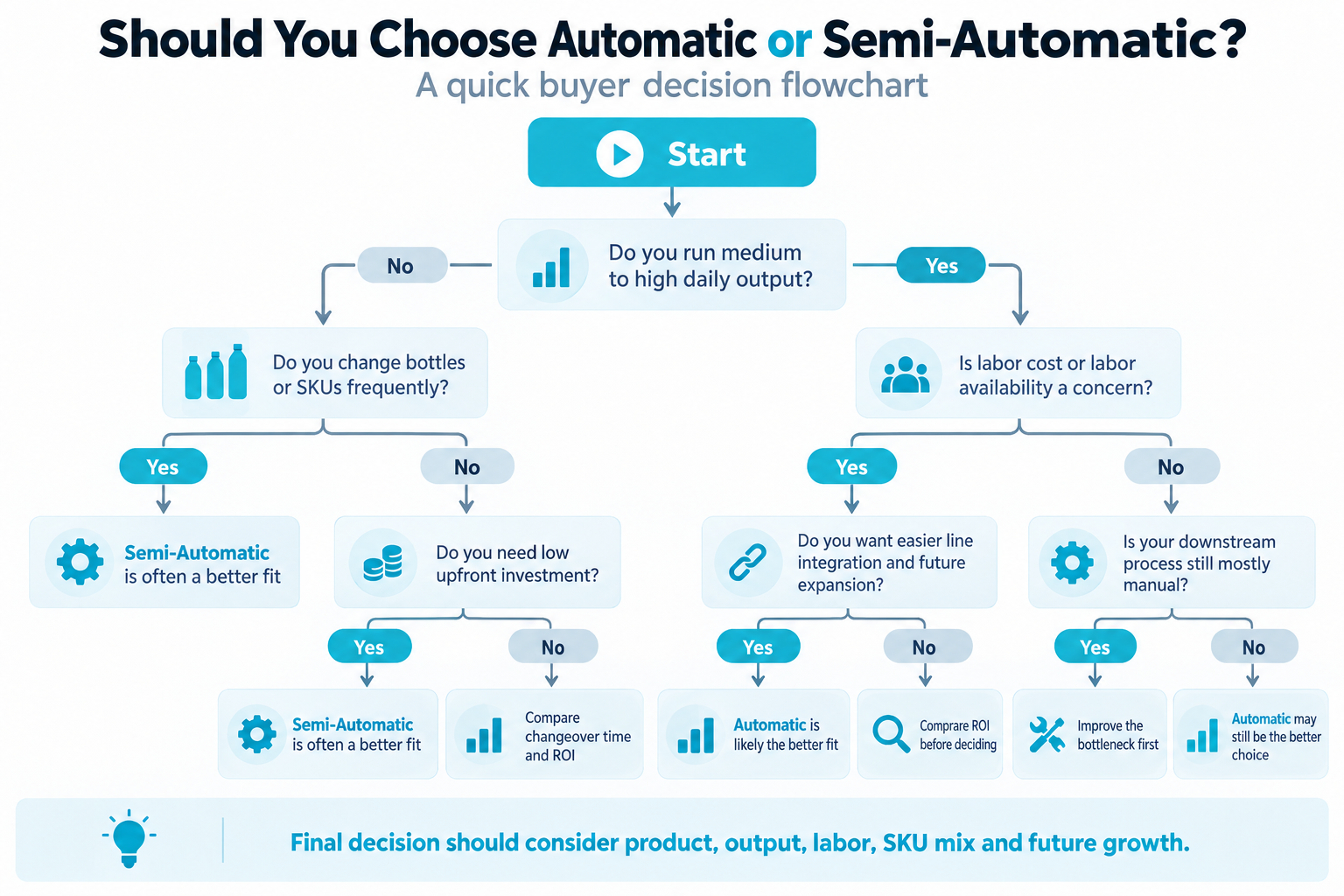
Your downstream process is still manual
There is little benefit in installing an extremely fast automatic filler if employees still manually cap, label and pack every bottle.
In this situation, improving the bottleneck first can produce a better ROI.
8. When Does an Automatic Filling Machine Make More Sense?
Automation becomes increasingly attractive when:
- production runs every day;
- demand is stable or growing;
- manual bottle handling limits output;
- labor availability is becoming difficult;
- bottles, caps and labels are relatively standardized;
- filling consistency is commercially important;
- production records and recipes are useful;
- downstream capping and labeling can also be automated;
- future expansion is expected.
For small bottles such as e-liquid, essential oil, tincture or serum containers, filling is often only one part of the challenge. Plug insertion, cap feeding and accurate capping can consume substantial labor.
A connected automatic e-liquid filling machine can integrate filling with plugging and capping rather than simply replacing the dosing operation.
The same principle applies to larger chemical products. Product characteristics such as corrosion, foam and viscosity should determine the filling method before the automation level is finalized. Our automatic liquid fertilizer filling machine provides an example of how filling technology can be configured around the material rather than using one universal system.
9. The Hidden Costs Buyers Often Forget
When comparing quotations, calculate total cost of ownership, not only purchase price.
Include:
- Machine purchase price
- Freight and installation
- Electrical and compressed-air requirements
- Operators
- Product waste and overfill
- Cleaning time
- Changeover downtime
- Format parts
- Spare parts
- Preventive maintenance
- Production lost during breakdowns
- Future expansion costs
One of the most expensive mistakes is purchasing a low-cost machine today and replacing the entire system eighteen months later because production has grown beyond its capability.
But oversizing the line is also a mistake.
The objective is not maximum automation.
The objective is the lowest practical cost per accepted finished bottle over the expected life of the equipment.
10. Ask for a FAT With Your Actual Product
Specifications on a quotation cannot completely predict real production.
Whenever possible, send the manufacturer:
- actual liquid or product samples;
- each bottle size;
- caps, plugs or pumps;
- labels if line integration is required.
Then establish FAT acceptance criteria before the machine is completed.
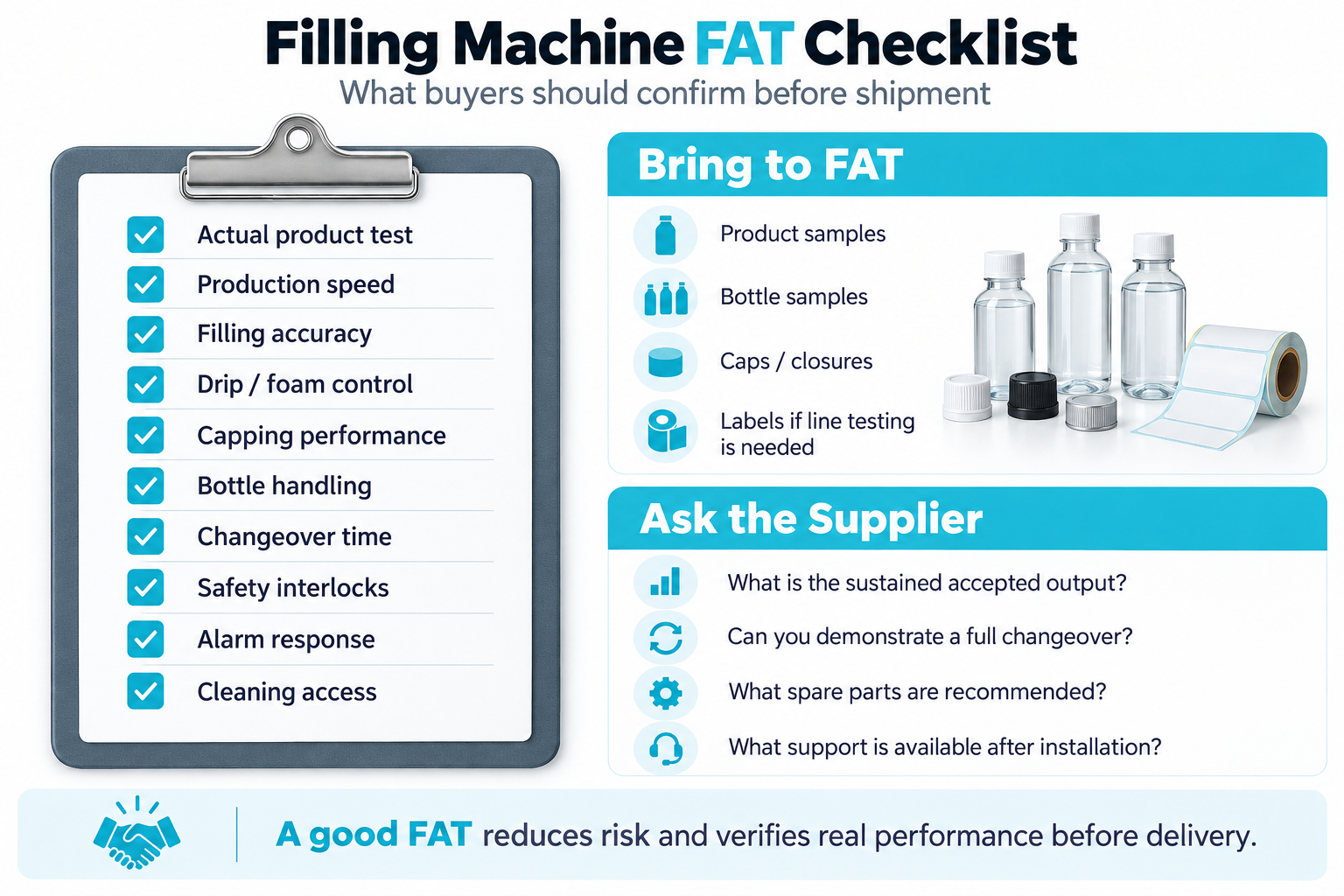
A useful FAT should evaluate:
| FAT Item | What to Confirm |
|---|---|
| Production speed | Sustained acceptable bottles/hour |
| Filling accuracy | Agreed tolerance using actual product |
| Dripping/foaming | Clean bottle mouth and stable filling |
| Capping | Correct torque and pass rate |
| Bottle handling | No excessive jams or scratches |
| Changeover | Measured time between major SKUs |
| Safety | Guards, interlocks and emergency stops |
| Alarms | Correct response to missing bottles/caps |
| Cleaning | Practical access to product-contact components |
This is often more valuable than comparing two suppliers based on brochure specifications.
11. Seven Questions to Answer Before Requesting a Filling Machine Quote
Before contacting a manufacturer, prepare the following information:
- What product are you filling?
Include viscosity, foam, particles, corrosiveness and filling temperature. - What filling volumes do you need?
For example: 30 ml, 100 ml, 500 ml and 1 L. - What are the bottle dimensions?
Provide samples, drawings or clear photos. - What closure do you use?
Screw cap, pump, dropper, trigger, cork or press cap? - What is your required finished output?
State bottles per minute or bottles per hour. - How often will you change products or containers?
- What production capacity will you need in two or three years?
These seven answers allow an experienced equipment supplier to recommend the filling principle, number of nozzles and automation level much more accurately.
Automatic vs Semi-Automatic Filling Machine: Final Decision
Choose a semi-automatic filling machine when flexibility, low initial investment and small-batch production matter more than maximum continuous output.
Choose an automatic filling machine when stable daily production, labor reduction, consistent workflow and future capacity matter more than initial purchase price.
Most importantly, do not choose based on the word “automatic.”
Choose based on:
product + container + output + labor + SKU mix + cleaning + future growth + total cost per bottle.
That combination tells you what your factory actually needs.
People Also Ask / FAQ:
A semi-automatic filler automates the dosing process but normally requires an operator to position and remove containers. An automatic filling machine uses conveyors, sensors and controls to move containers through the filling process with substantially less manual handling.
No. Filling accuracy depends heavily on the filling technology, product characteristics, filling volume and machine configuration. Automation can improve repeatability, but the correct metering system is more important than automation level alone.
There is no universal bottle-per-hour threshold. Calculate the labor required by your current process, expected operating hours, downtime, product waste and future demand. Automation becomes attractive when its additional investment costs less than the operating losses it removes.
Yes, if the machine is designed for the required bottle range. However, you should confirm changeover time, required format parts, nozzle adjustment and control recipes before purchase.
Normally, no. Operators are still needed for material replenishment, quality checks, cleaning, changeover, maintenance and supervision.
Send your product information, viscosity or material characteristics, filling volume, bottle and cap photos or samples, required production speed, power supply and available factory layout. The more complete the information, the more accurately the machine can be engineered.
Need Help Choosing the Right Automatic Filling Solution?
If you are unsure whether your project needs a standalone automatic filler or a complete filling, capping and labeling line, send us your product, bottle sizes, cap samples and required bottles per hour.
Shanghai Honest Machinery can evaluate the product characteristics, filling method, production capacity and line layout before recommending a configuration.
The goal is not to sell you the biggest machine.
It is to build an automatic filling system that makes financial and operational sense for your actual production.
Send us your product and packaging information to request a customized filling solution and quotation.