How to Choose a Dropper Bottle Filling Machine for Essential Oils and Tinctures

automatic-dropper-bottle-filling-machine

Choosing the right dropper bottle filling machine is not just about filling 10ml or 30ml bottles accurately. For essential oil and tincture manufacturers, the equipment must also handle different liquid formulations, delicate glass bottles, dropper assemblies and screw caps without slowing down production.

A machine that fills perfectly during a short demonstration may struggle with your actual bottles, thicker oils or frequent product changes.

This guide explains how to compare filling technologies, evaluate capping performance, calculate realistic production capacity and avoid costly purchasing mistakes. Whether you are launching a new essential oil brand or upgrading an existing tincture packaging line, you will learn what to check before requesting a quotation.

1. Quick Answer: Which Dropper Bottle Filling Machine Should You Buy?

For most manufacturers, the right machine depends on three factors: liquid properties, packaging components and required output.

A low-viscosity essential oil with several fragrance variations may benefit from a peristaltic pump. A thicker oil-based tincture may require a servo-driven piston filling system.

If your production involves glass pipettes, rubber bulbs or child-resistant caps, automatic closure assembly deserves as much attention as filling accuracy.

Your Production Needs

Suggested Configuration

Multiple essential oil fragrances

Peristaltic filling system

Thick oil-based tinctures

Servo piston filling system

Very small, precise doses

Precision ceramic or suitable metering pump

Glass bottles with pipette droppers

Filling + dropper insertion + capping

High-volume production

Integrated automatic filling line

These are starting points, not universal specifications. Confirm the final configuration through testing with your actual product and packaging samples.

2. Understand Your Product Before Choosing the Filling System

Not all liquids sold in dropper bottles behave the same way.

Essential oils, herbal extracts, alcohol-based tinctures and oil-based formulations can have different viscosities, flow characteristics and chemical compatibility requirements.

Before selecting an essential oil filling machine, answer these questions:

  • Is your product oil-based, alcohol-based or glycerin-based?

  • What is its viscosity at the actual filling temperature?

  • Does it foam, drip or leave residue?

  • How many formulations will share the equipment?

  • Do you need special cleaning or contamination controls?

Essential Oils vs. Tinctures: What Changes?

Essential oils may flow easily, but certain formulations contain aggressive ingredients that can affect seals, tubing and other components.

Alcohol-based tinctures introduce an additional concern: flammable vapor.

Glycerin-based extracts and thicker carrier-oil blends may require different pumping and nozzle arrangements to maintain a clean fill.

Ask your equipment supplier to evaluate the complete product-contact path, including hoses, gaskets, valves and filling nozzles.

For customized extract packaging, explore our automatic tincture filling machine  configurations.

3. Peristaltic vs. Piston vs. Ceramic Pumps: Which Is Better?

peristaltic-vs-piston-filling-systems
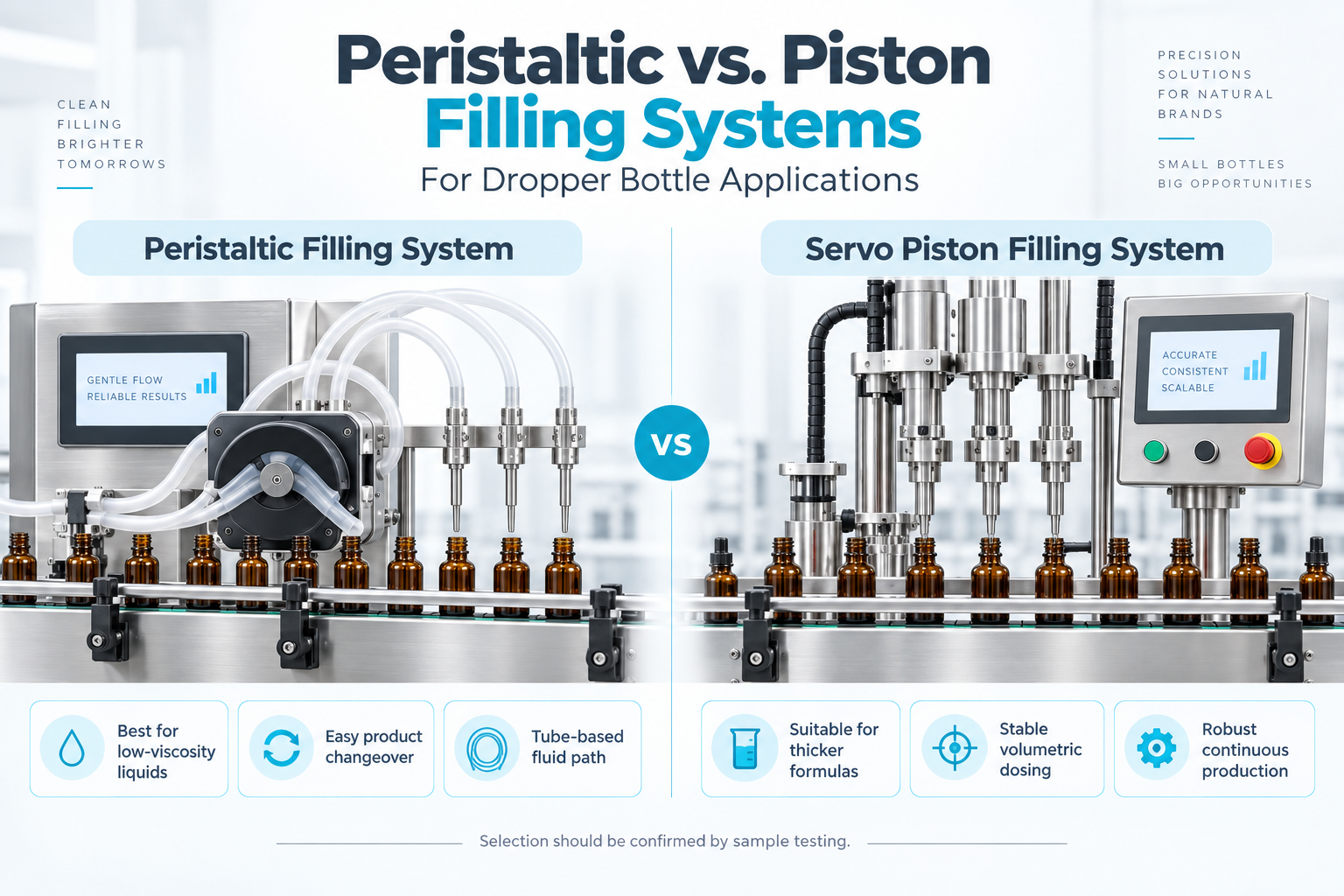
Illustrated comparison of peristaltic and servo piston filling systems for small-volume dropper bottle applications.

ump selection affects filling accuracy, cleaning time, product loss and maintenance costs.

A machine suitable for one product is not automatically suitable for every liquid in your portfolio.

Peristaltic Pump: Practical for Multiple Fragrances

A peristaltic pump moves liquid by compressing flexible tubing.

Because the liquid passes through the tube rather than the pump mechanism, the product-contact path can be relatively simple.

It is particularly useful when you manufacture several low-viscosity essential oil formulations.

Advantages include easier tubing replacement, potentially faster cleaning and reduced product contact with mechanical pump components.

However, tubing must be chemically compatible with the formulation. Wear, compression changes and tubing replacement can also affect dosing performance.

Servo Piston Pump: Suitable for Thicker Formulations

A servo-driven piston pump controls a defined dispensing volume.

It can be a practical option for thicker oil-based tinctures and formulations that need controlled positive-displacement filling.

The trade-off is a potentially more complex product-contact path. Cleaning time and residual liquid should be considered when changing products frequently.

Ceramic Pump: An Option for Precision Dosing

Ceramic metering pumps can be considered for small-volume applications where repeatable dispensing is important.

However, suitability depends on the pump design, liquid properties, particles and cleaning requirements.

Our recommendation: Do not select a pump solely because a supplier advertises high accuracy. Request filling trials using your actual product at the smallest and largest intended volumes.

You can also review our essential oil filling machine  for configurable peristaltic and piston filling solutions.
4. Bottle and Dropper Compatibility: The Detail Buyers Often Miss

glass-dropper-bottle-components
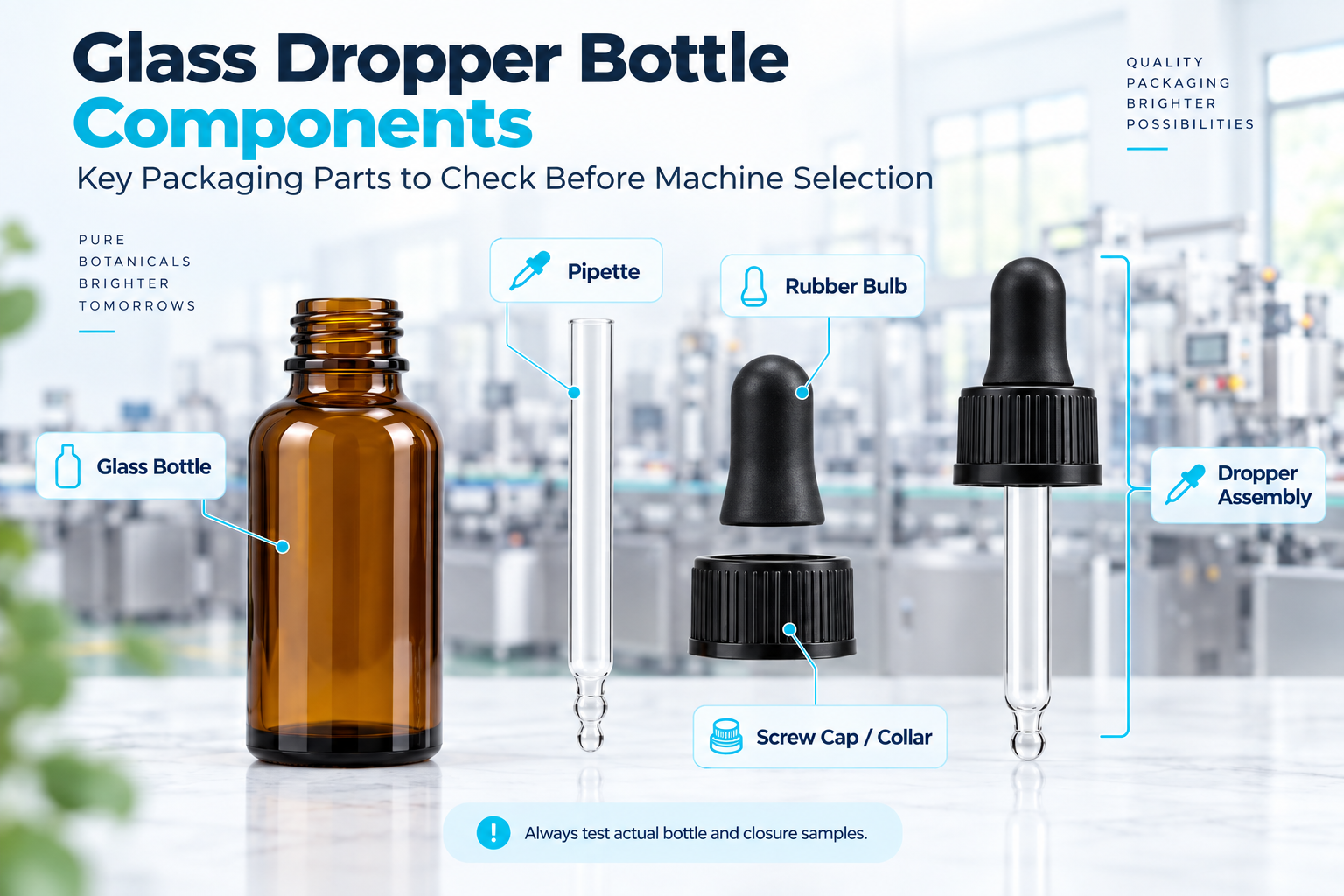
Exploded-view illustration of an amber glass dropper bottle showing the glass pipette, rubber bulb, screw cap and complete dropper assembly.

Two 30ml glass bottles may look identical but have different neck dimensions, tolerances or thread designs.

A filling machine must position the bottle accurately without tipping, scratching or breaking it.

The closure introduces another challenge.

Understand Your Dropper Assembly

A complete dropper package may include:

  • Glass or plastic bottle

  • Pipette or dropper insert

  • Rubber bulb

  • Screw collar or cap

  • Optional tamper-evident components

A pipette that is too long may contact the bottom of the bottle. A tilted assembly can damage the bottle neck or prevent proper sealing.

Different bulb materials may also react differently to essential oils.

Ask your packaging supplier for component drawings and material specifications. Then send complete, assembled packaging samples to the machine manufacturer.

Why Capping Torque Matters

Insufficient torque can lead to loose caps and leakage.

Excessive torque may damage threads, deform sealing components or make the bottle difficult for customers to open.

A suitable dropper bottle capping machine should provide adjustable torque and stable cap positioning.

During testing, check not only whether the cap is tightened but also whether it seals correctly and can be opened normally.

This is particularly important for international shipments, where packaged products experience temperature changes, vibration and handling.
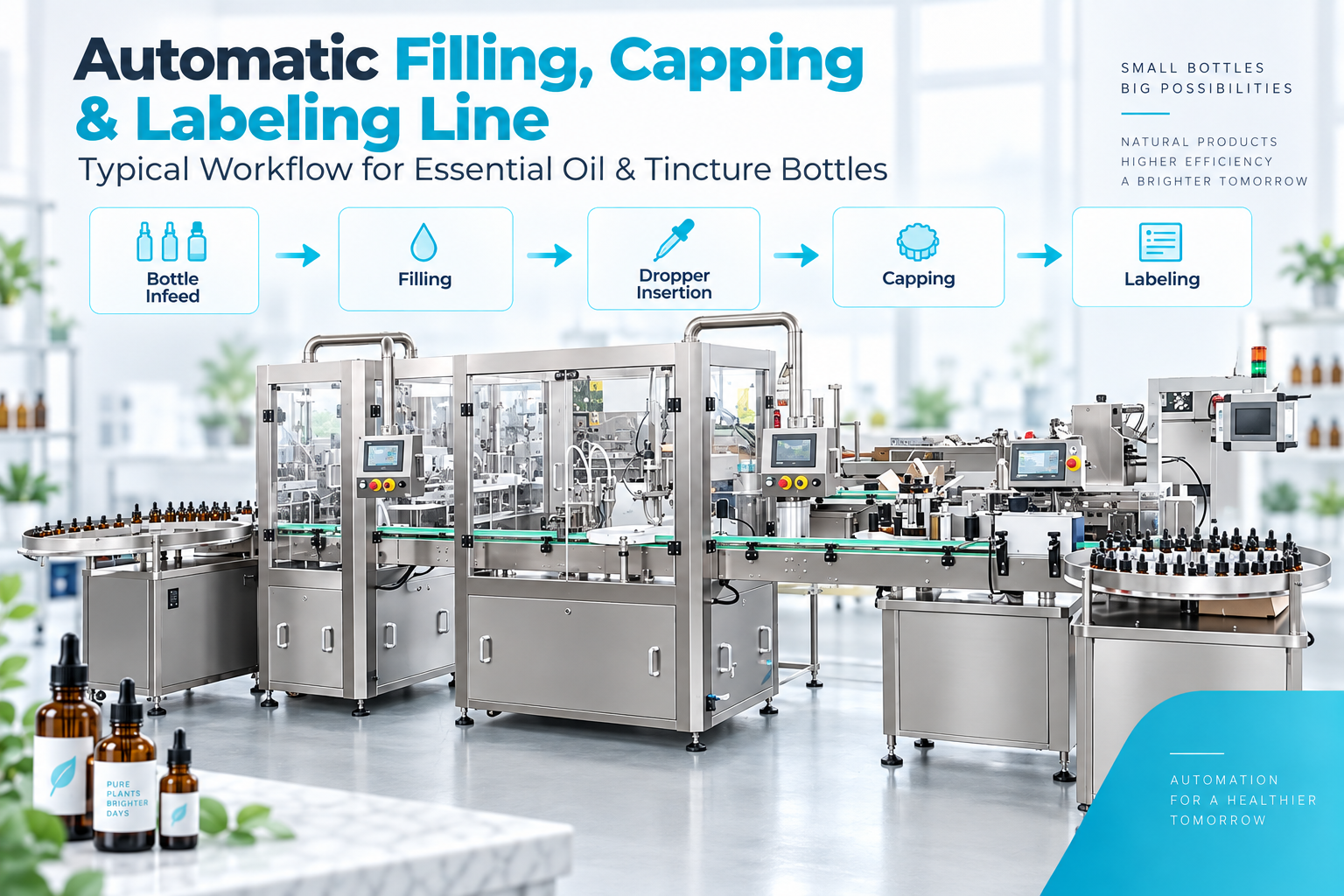
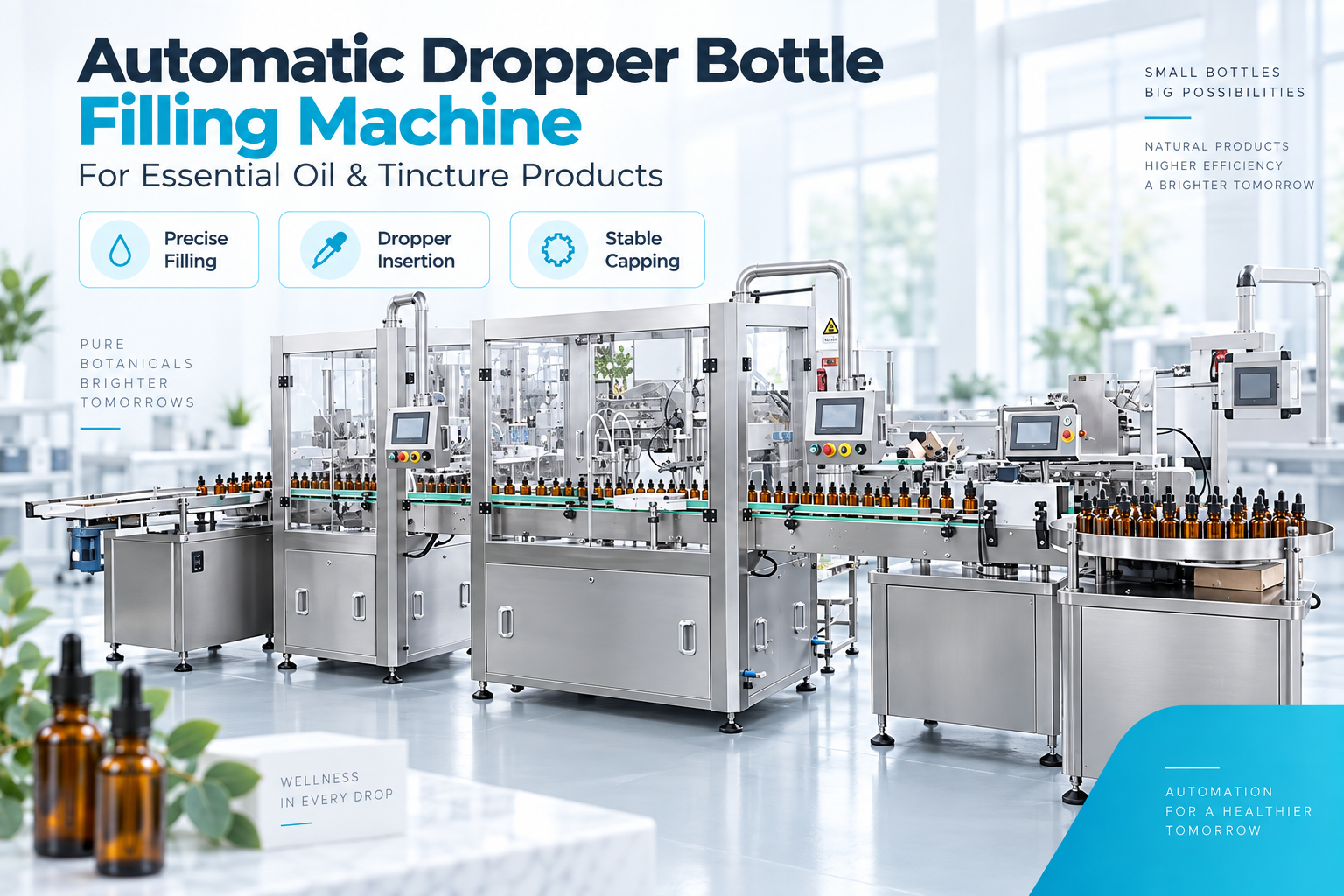
5. What Should a Complete Automatic Dropper Bottle Filling Line Include?

automatic-essential-oil-bottle-filling-line
Automatic essential oil bottle packaging line with enclosed stainless steel machinery and an illustrated filling, dropper insertion, capping and labeling workflow.

A standalone filler may be enough if your factory already has compatible capping and labeling equipment.

For a new production facility, an integrated automatic line can reduce manual handling between operations.

Typical production workflow

Illustrative configuration — actual stations depend on your packaging.

1.Bottle feeding  2.Precision liquid filling  3.Dropper insertion  4.Cap feeding and tightening  5.Labeling and batch coding  6.Inspection and packing

Optional equipment may include bottle washing, inspection systems, cartoning and secondary packaging.

For compact factories, a monoblock configuration can combine several operations within a smaller footprint.

An inline system may offer greater flexibility when equipment needs to be expanded or replaced independently.

Compare the complete process rather than purchasing each machine without checking how the stations communicate.
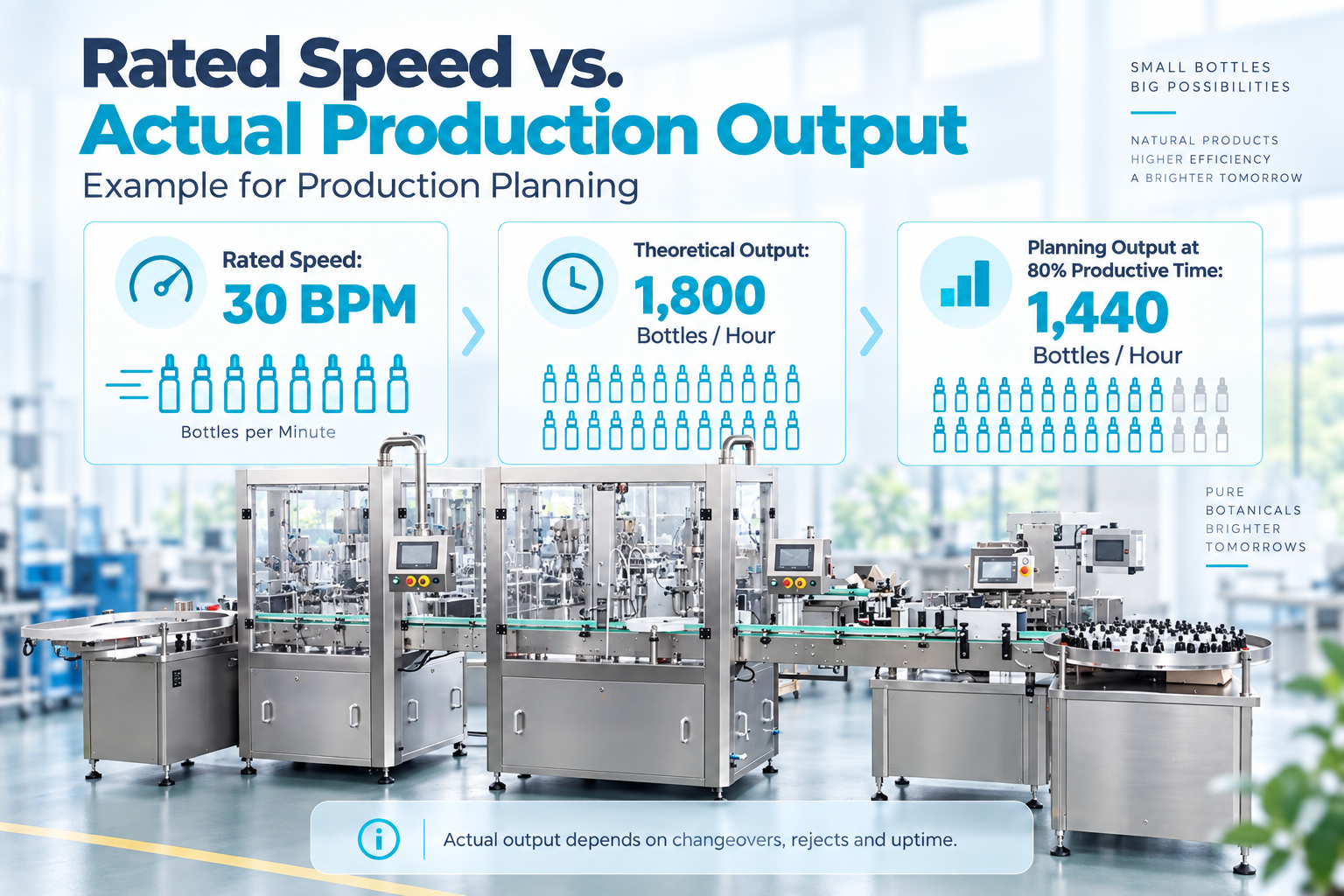
6. How Fast Should Your Filling Machine Run?

dropper-bottle-filling-machine-capacity
Production planning infographic comparing a rated filling speed of 30 BPM, theoretical output of 1,800 bottles per hour and estimated output of 1,440 bottles per hour.

Machine suppliers often advertise output in bottles per minute (BPM).

However, maximum speed is not the same as actual production output.

Consider an illustrative example:

Production capacity example

Assumptions for planning, not measured machine performance.

Rated speed:30 BPM

Theoretical hourly output:1,800

Planning assumption: 80% productive running time:1,440 bottles/hour

Actual saleable output will also depend on rejects, changeovers and other downtime.

Ask the supplier to specify the stable output for your actual bottle, filling volume and closure.

The capping station, dropper feeding system or labeling machine may become the bottleneck.

For reference, Shanghai Honest Machinery’s published US small-bottle project describes a 30ml glass dropper line with a rated output of 30–40 BPM. This is a company-reported project specification, not a guarantee for a different application.
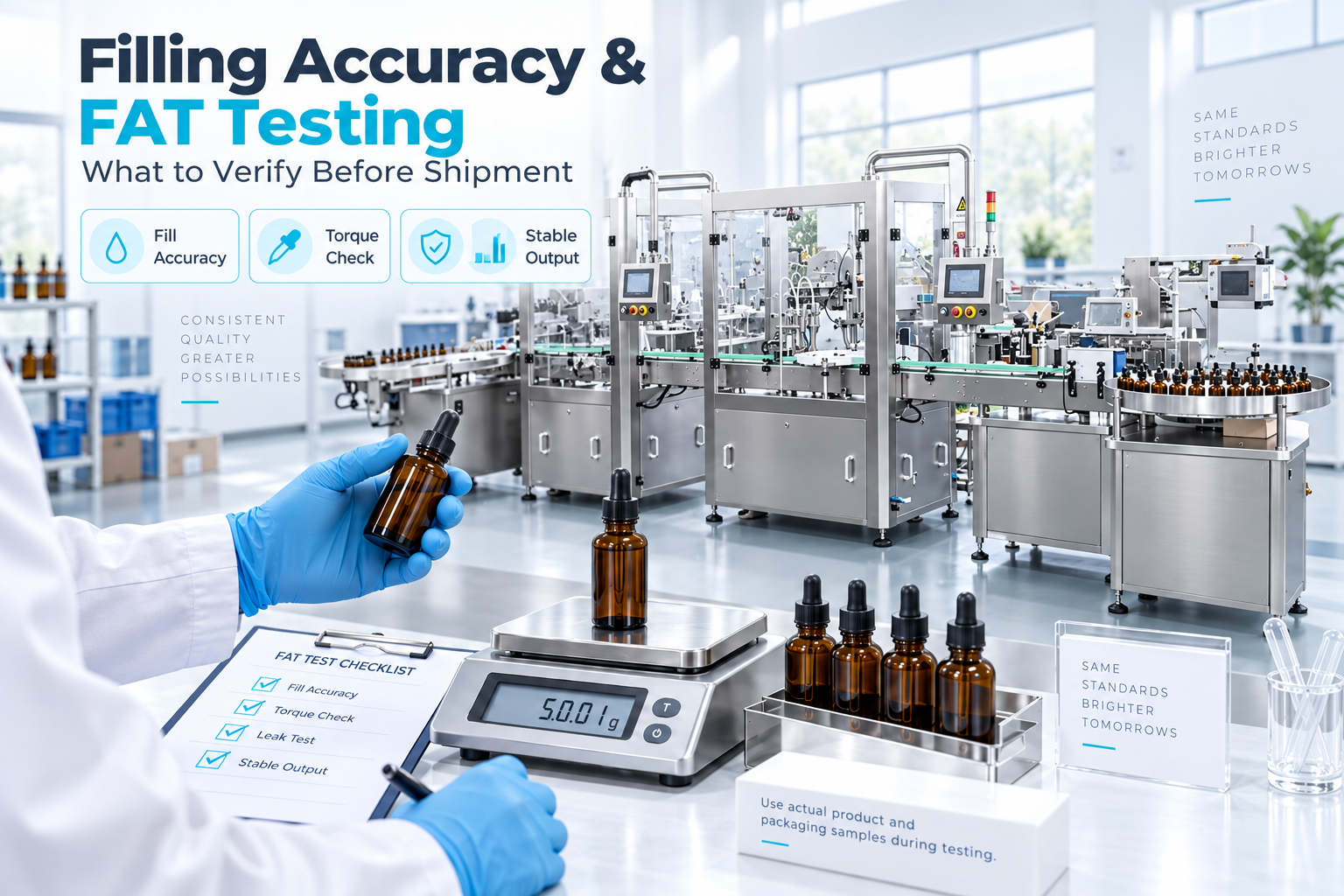
7. Filling Accuracy: What Should You Actually Test?

dropper-bottle-filling-machine-fat-testing
Illustration of dropper bottle filling machine factory acceptance testing with a digital scale, amber bottles, inspection checklist and quality control procedures.

A supplier may advertise an accuracy of ±0.5% or ±1%.

Those figures are meaningful only when the testing conditions are clear.

Ask whether the specification refers to the target volume, actual dispensed quantity or another measurement method.

Also confirm whether the result was measured using water or your actual product.

A Practical Accuracy Test

For a 10ml filling application:

  1. Define the acceptable fill-volume tolerance.

  2. Calibrate the measuring equipment.

  3. Collect consecutive samples during stable production.

  4. Check average fill quantity and individual variation.

  5. Repeat at startup and after a speed change.

If measurements are taken by weight, use the formulation’s measured density at the test temperature to convert between weight and volume.

Do not assume one accuracy result applies equally to 5ml, 10ml and 100ml bottles.

A qualified supplier should be willing to document the test conditions and acceptance criteria.
8. Cleaning, Material Compatibility and Safety Requirements

Product changeover can become expensive when your factory produces several essential oil fragrances in small batches.

Before purchasing, ask the supplier to demonstrate:

  • How the filling circuit is drained and cleaned.

  • Which components require replacement between formulations.

  • How much liquid remains inside the system.

  • Whether hoses, seals and gaskets are compatible with your products.

Stainless steel alone does not guarantee compatibility. Even an SS316L filling system may contain tubing and sealing components made from other materials.

Special Considerations for Alcohol-Based Tinctures

If your tincture contains ethanol or another flammable solvent, provide its Safety Data Sheet (SDS) before equipment selection.

The machine and installation may require suitable ventilation, grounding, ignition-source control and appropriately rated electrical equipment.

For US facilities, OSHA’s Flammable Liquids Standard, 29 CFR 1910.106  provides relevant requirements. Final equipment and facility requirements depend on the actual substance, process and applicable local regulations.

Product classification also matters. The FDA’s aromatherapy guidance  explains that an essential-oil product’s regulatory category depends on its intended use and marketing claims. Products intended for therapeutic purposes may be regulated as drugs rather than ordinary cosmetics.

Confirm the applicable requirements before finalizing equipment specifications.

9. How Much Does a Dropper Bottle Filling Machine Cost?

There is no reliable single price for every dropper bottle filling application.

A basic filling unit and a complete automatic line with dropper insertion, capping and labeling have different equipment requirements.

The quotation will depend on:

Cost Factor

Why It Matters

Filling technology

Different pumps and controls have different costs

Automation level

Integrated lines require additional stations

Bottle and cap design

Special components may need custom tooling

Required output

Higher throughput can require more filling heads

Safety requirements

Flammable liquids may require special configurations

After-sales service

Installation, training and spare parts affect ownership costs

Compare the complete quotation, not just the machine’s purchase price.

Ask whether the supplier includes change parts, factory testing, electrical documentation, operator training and a recommended spare-parts package.

A cheaper machine may cost more over time if it wastes expensive oil or needs frequent manual adjustment.

10. What Should You Check During Factory Acceptance Testing?

Factory Acceptance Testing (FAT) is one of the most useful steps before purchasing customized filling equipment.

Instead of relying on a short demonstration using standard bottles, agree on a test plan before placing the order.

Your FAT checklist should cover:

Test Item

Acceptance Criteria

Filling accuracy

Agreed tolerance at each selected volume

Stable output

Agreed number of acceptable bottles per hour

Bottle handling

No unacceptable tipping or damage

Dropper insertion

Correct positioning and assembly

Capping

Agreed torque range and sealing performance

Leakage

No leakage under the agreed test method

Changeover

Demonstrated using the agreed bottle formats

Cleaning

Procedure and product-loss results documented

The supplier should record results and address any failed acceptance criteria before shipment.

For example, if you plan to manufacture both 10ml essential oil bottles and 30ml tincture bottles, test both formats.

Include your most difficult closure, not just the easiest bottle.

Ask for a continuous production video and a documented FAT report.

A useful purchasing rule: A successful filling test is not a successful packaging-line test until the bottles have also been correctly assembled, capped and inspected.

11. Final Buying Checklist: What to Send Your Machine Supplier

A complete RFQ helps the supplier recommend equipment accurately and reduces unnecessary quotation revisions.

Prepare the following information:

  • Product type, viscosity and SDS where applicable.

  • Bottle sizes, dimensions and photographs.

  • Complete dropper, pipette and cap samples.

  • Required filling volumes and acceptable tolerance.

  • Target output in finished bottles per hour.

  • Number of different products and bottle formats.

  • Factory layout, power supply and cleaning requirements.

  • Required labeling, coding and secondary packaging functions.

If possible, provide several complete sets of each bottle and closure.

A customized machine proposal should be based on these details rather than a general catalogue specification.

People Also Ask / FAQ:

Yes, if the filling range, bottle guides and closure equipment are designed for both formats. Different bottle heights, neck sizes or caps may require change parts. Ask the supplier to demonstrate the changeover during FAT.

A peristaltic pump is often suitable for low-viscosity essential oils and frequent fragrance changes. Thicker formulations may benefit from piston filling. The final selection should follow product testing, chemical compatibility checks and your accuracy requirements.

Yes. Automatic systems can be configured for pipette placement and capping. However, pipette length, bulb material, collar dimensions and assembly consistency must be evaluated using actual packaging samples.

Start with compatible bottle and closure components. Verify dropper positioning, sealing surfaces and capping torque, then perform suitable leakage and transportation tests. Increasing capping torque alone is not a reliable solution.

It may be possible, but pump materials, cleaning procedures and safety requirements must be evaluated separately. An alcohol-based formulation may require additional controls that are unnecessary for a nonflammable oil.

Get a Dropper Bottle Filling Solution Built Around Your Product

The right dropper bottle filling machine should fit your liquid, packaging and production goals—not force you to redesign your product around the equipment.

At Shanghai Honest Machinery, we develop customized automatic filling, dropper insertion, capping and labeling solutions for small-bottle applications.

Tell us what you are planning to produce, and our team can evaluate your requirements and prepare a suitable equipment configuration.

Send us your product information, bottle photos, dropper and cap samples, filling volume and required bottles per hour.

We can then discuss the filling method, line layout, acceptance criteria and quotation for your project.

Contact Us For A Customized Solution:

Leave a Comment

Your email address will not be published. Required fields are marked *

"Reach out for a quote! We'll reply with specifics within 24 hours."

Let's have a chat