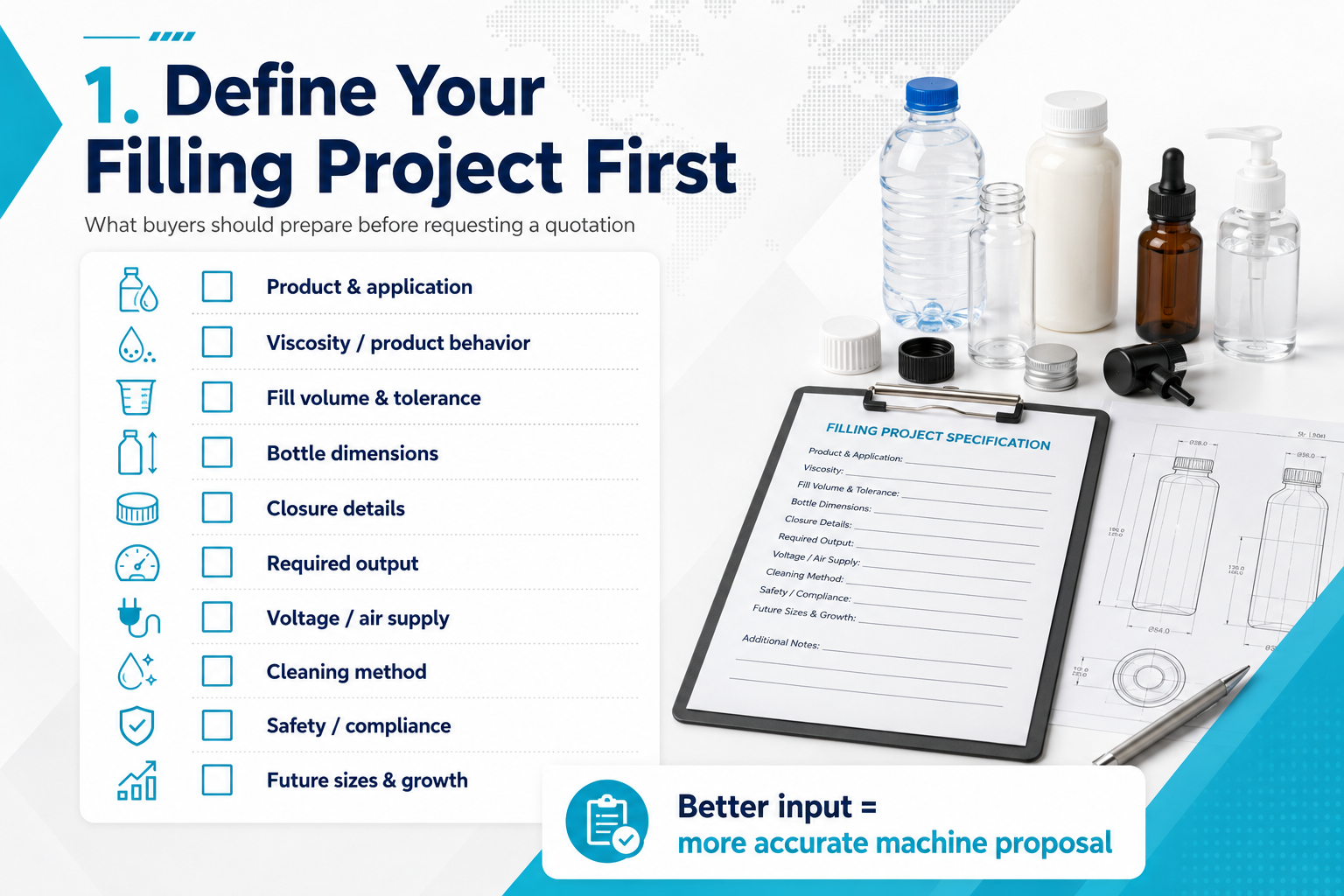
A reliable manufacturer cannot recommend the correct machine from a product name alone. “Shampoo,” “honey” or “chemical liquid” does not provide enough engineering information.
Prepare the following details before requesting a quotation:
- Product name and application
- Viscosity range at the actual filling temperature
- Whether the product foams, drips, crystallizes or contains particles
- Fill volume and acceptable filling tolerance
- Bottle dimensions, material, shape and neck diameter
- Cap, pump, trigger, dropper or spray-head details
- Required output in bottles per minute or hour
- Available voltage, frequency and compressed air
- Required cleaning method
- Local safety and compliance requirements
- Future bottle sizes and expected production growth
Send drawings, photographs and physical samples whenever possible. For a customized line, the bottle, cap and product should be treated as part of the machine design—not as details to be confirmed after production begins.
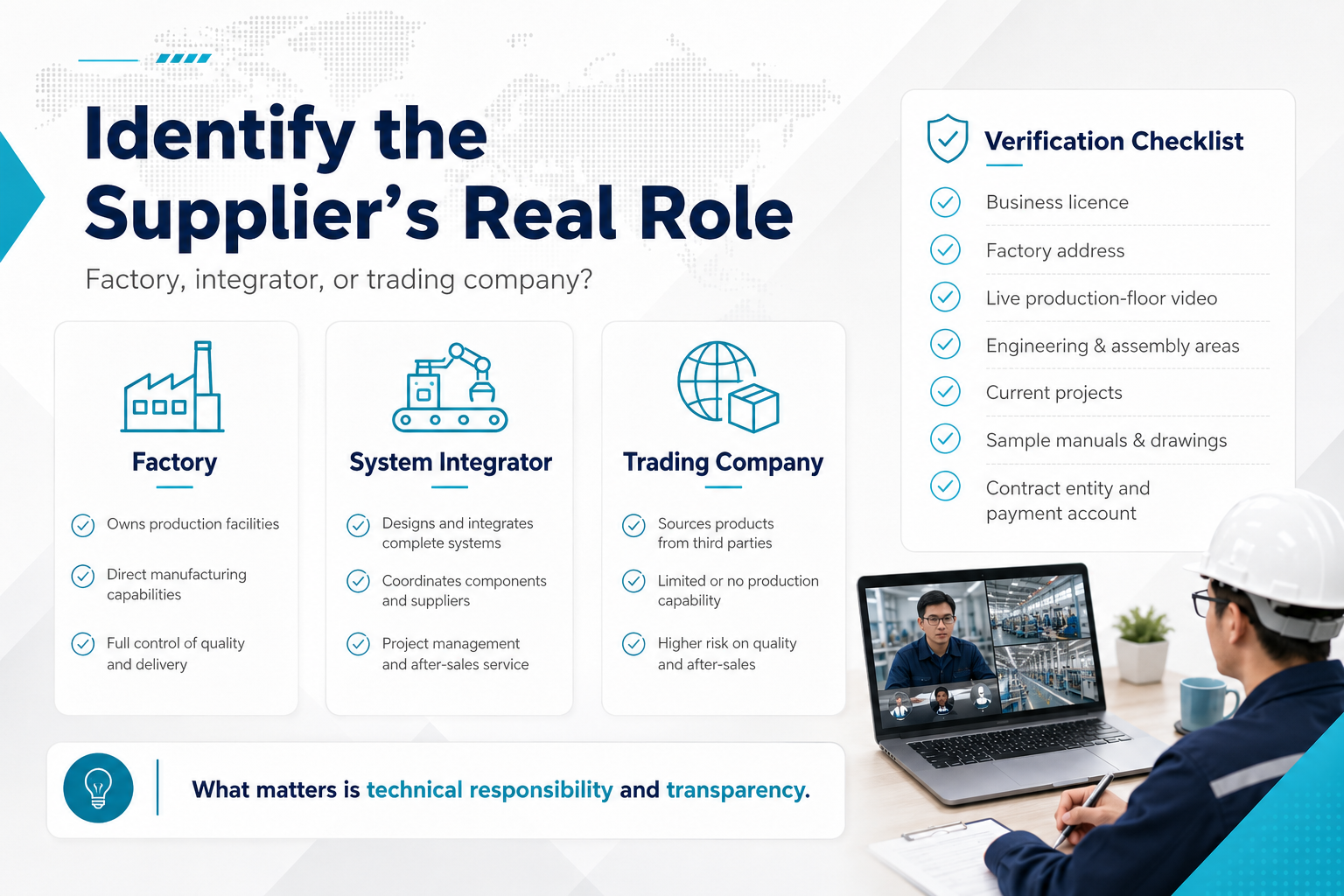
Not every company advertising filling equipment is the original manufacturer. The supplier may be a factory, a production-line integrator or a trading company.
A system integrator is not necessarily a poor choice. Integrators can be valuable when a project includes bottle unscrambling, filling, capping, labeling, coding and case packing. What matters is whether the supplier clearly explains which machines it manufactures, which parts are outsourced and who is responsible for commissioning the complete line.
Ask for:
- The company’s Chinese business licence
- Factory address and production-floor video
- Engineering and assembly areas shown during a live video call
- Photographs of current projects under construction
- Electrical drawings and sample manuals from similar machines
- References for comparable products and containers
- The name of the company that will appear on the contract and receive payment
The beneficiary name on the bank account should be consistent with the contracting entity unless a legitimate payment arrangement is documented.
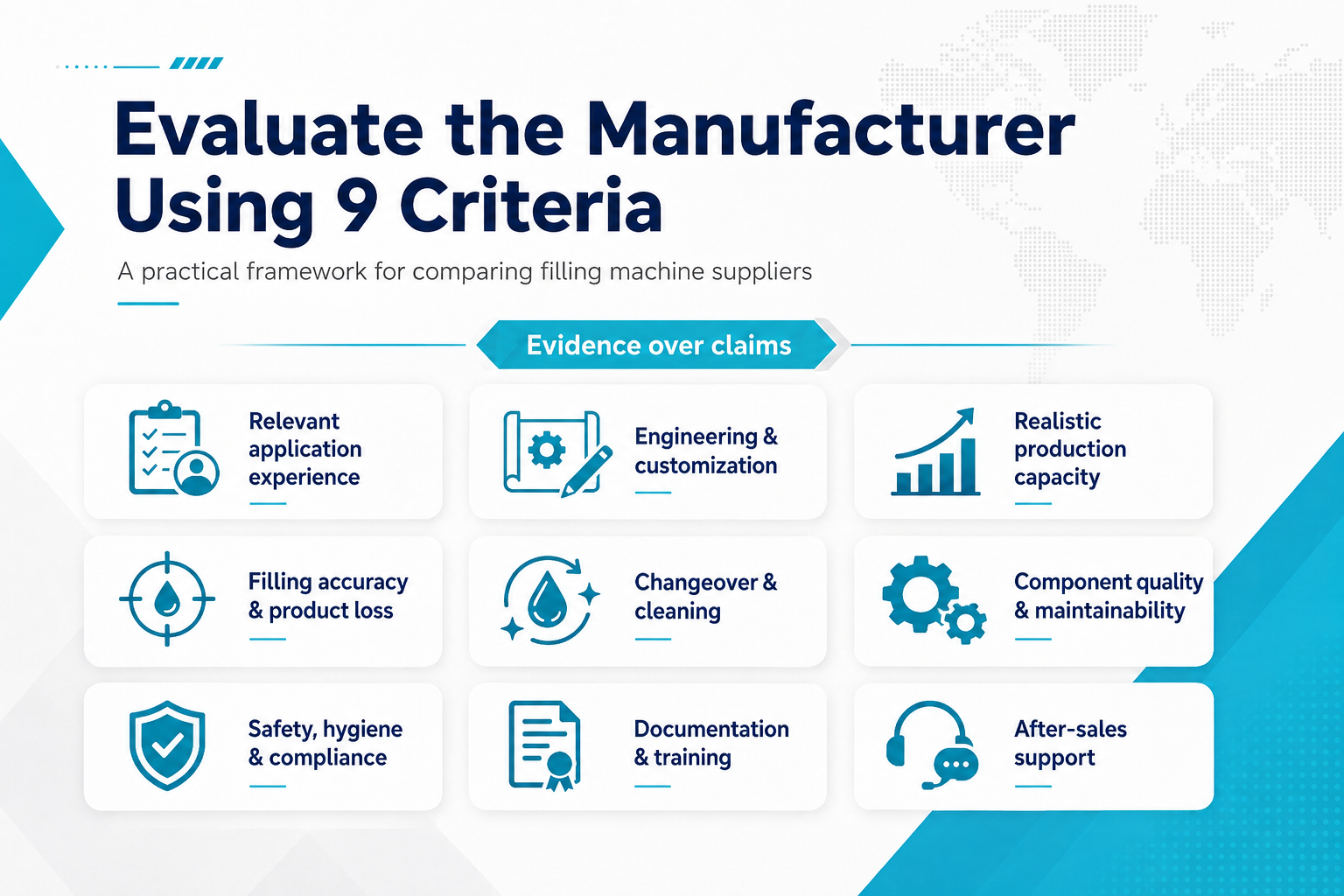
3.1 Relevant Application Experience
General experience is less important than experience with your application. A manufacturer may be strong in water bottling but have limited knowledge of foaming detergent, abrasive paste or pharmaceutical liquids.
Request videos and project records involving products with similar:
- Viscosity
- Chemical properties
- Fill volume
- Bottle opening
- Closure type
- Accuracy requirement
- Production speed
A relevant reference project is more valuable than a long list of unrelated machines.
3.2 Engineering and Customization Capability
A genuine custom filling machine manufacturer should explain why a particular filling principle is suitable.
The proposal should identify:
- Filling method and pump type
- Number of filling heads
- Product-contact materials
- Nozzle diameter and diving movement, if required
- Hopper or feed-tank design
- Cleaning and drainage method
- Cap-feeding and tightening system
- Sensors, PLC, motors and pneumatic components
- Safety guarding and emergency-stop arrangement
- Change parts required for each bottle
Be cautious if several suppliers offer almost identical configurations without first studying your samples.
3.3 Realistic Production Capacity
“Up to 60 bottles per minute” is not a sufficient performance commitment. Output depends on fill volume, viscosity, foaming, bottle stability, cap-feeding performance and downstream operations.
Ask the supplier to state:
Minimum sustained output using the buyer’s actual product, bottle and closure, measured over an agreed continuous test period.
This distinction between nominal speed and sustained saleable output is often missing from general buying guides. It prevents a machine from technically reaching the advertised speed for several minutes while failing to maintain it in normal production.
3.4 Filling Accuracy and Product Loss
Filling accuracy should be defined by a measurement method rather than a promotional percentage.
Confirm:
- Whether accuracy is measured by weight or volume
- The tested fill range
- Product temperature during the test
- Sample size
- Permitted deviation per container
- Treatment of start-up and shutdown bottles
- Dripping, foaming and product left inside pipes
For expensive products such as perfume, essential oils, reagents and cosmetic serum, reducing giveaway and residual product can be more important than increasing speed.
3.5 Changeover and Cleaning
If you produce several SKUs, ask the manufacturer to demonstrate a complete format change.
Measure:
- Time from the last acceptable bottle of SKU A to the first acceptable bottle of SKU B
- Number of tools required
- Number and weight of change parts
- Recipe storage in the PLC
- Cleaning time and water or solvent consumption
- Product remaining in the hopper, pump and pipework
A machine that runs quickly but requires several hours for cleaning and changeover may have lower daily output than a slower, more flexible system.
3.6 Component Quality and Maintainability
The brand of the PLC alone does not determine machine quality. Inspect the whole system, including sensors, drives, bearings, valves, cylinders, relays, seals and electrical cabinet construction.
Ask these practical questions:
- Are replacement components available in your country?
- Are component model numbers listed in the documentation?
- Can standard seals and hoses be purchased locally?
- Can the operator access pumps and nozzles without dismantling the line?
- Does the machine provide clear alarm messages?
- Can the manufacturer support remote troubleshooting?
Specify critical component brands in the contract instead of relying on “or equivalent” language without approval criteria.
3.7 Safety, Hygiene and Compliance
For the European market, a CE logo or a one-page certificate is not enough. EU guidance states that the manufacturer is responsible for conformity assessment, the technical file, the EU Declaration of Conformity and correct CE marking. European Commission: CE marking requirements
Request the applicable standards list, risk-assessment records, wiring diagrams, safety instructions and Declaration of Conformity. ISO 12100 provides principles for machinery risk assessment and risk reduction.
For pharmaceutical applications, equipment should be designed for its intended use, cleaning and maintenance, and product-contact surfaces must not adversely affect product quality, as explained in the FDA’s CGMP equipment guidance.
Compliance requirements vary by country and application. The buyer should have the final configuration reviewed by a qualified local compliance specialist.
3.8 Documentation and Training
Confirm the language and delivery format of:
- Operation manual
- Electrical schematic
- Pneumatic diagram
- PLC and HMI backup
- Component list
- Preventive-maintenance schedule
- Lubrication instructions
- Spare-parts list
- Troubleshooting guide
- Installation checklist
- Training records
- Test reports
Documentation should be part of the purchase scope, not an informal promise after shipment.
3.9 After-Sales Support
Ask how service works when the machine is already in your factory:
- Who responds to technical questions?
- What is the normal response time?
- Is remote PLC diagnosis available?
- Are installation and operator training included?
- Who pays for flights, hotels and local transport?
- Which parts are excluded from warranty?
- How quickly can spare parts be dispatched?
- Is support available after the warranty expires?
A two-year warranty has limited value if responsibility, response time and spare-part availability are not defined.
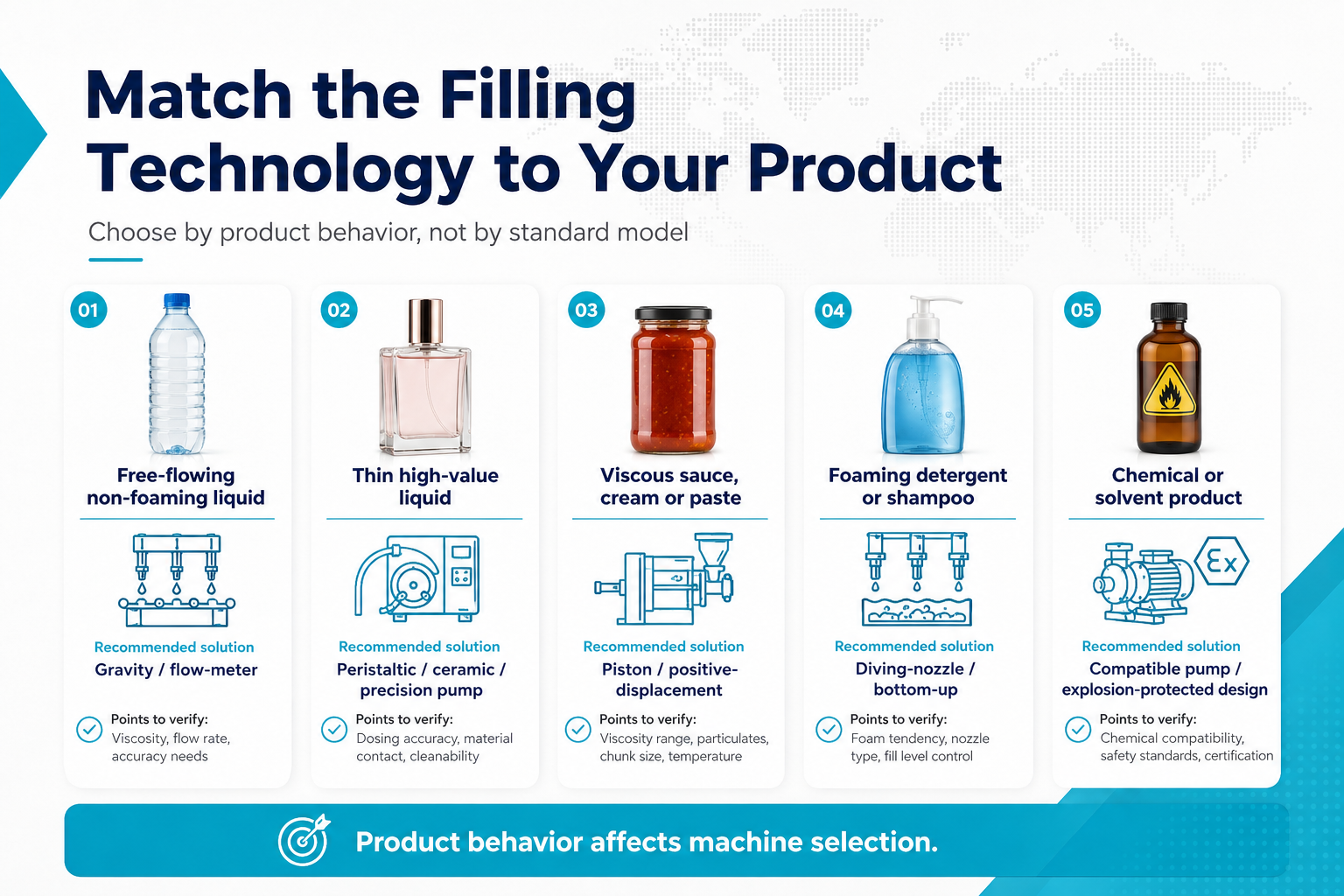
A manufacturer should recommend equipment according to product behavior, not simply according to its standard model range.
| Product characteristics | Common filling solution | Points to verify |
|---|---|---|
| Free-flowing, non-foaming liquid | Gravity or flow-meter filling | Pressure stability and shut-off accuracy |
| Thin, high-value liquid | Peristaltic, ceramic or precision pump | Product contact path and calibration |
| Viscous sauce, cream or paste | Piston or positive-displacement filling | Hopper feeding, heating and cleanability |
| Foaming detergent or shampoo | Diving-nozzle or bottom-up filling | Foam control and nozzle speed |
| Chemical or solvent product | Compatible pump or explosion-protected design | Seal compatibility, ventilation and electrical classification |
| Product containing particles | Large-port piston or suitable pump | Particle size, valve clearance and blockage risk |
Product characteristics can change during pumping. PMMI’s filling-machine guidance notes that pipes, bends, pumps and high operating speeds may affect viscosity or sensitive ingredients. PMMI ProSource: liquid filling machine buying tips
Buyers handling small bottles can review our small bottle filling machine solutions. Projects involving spray pumps and crimping can also refer to this spray bottle perfume filling machine configuration.
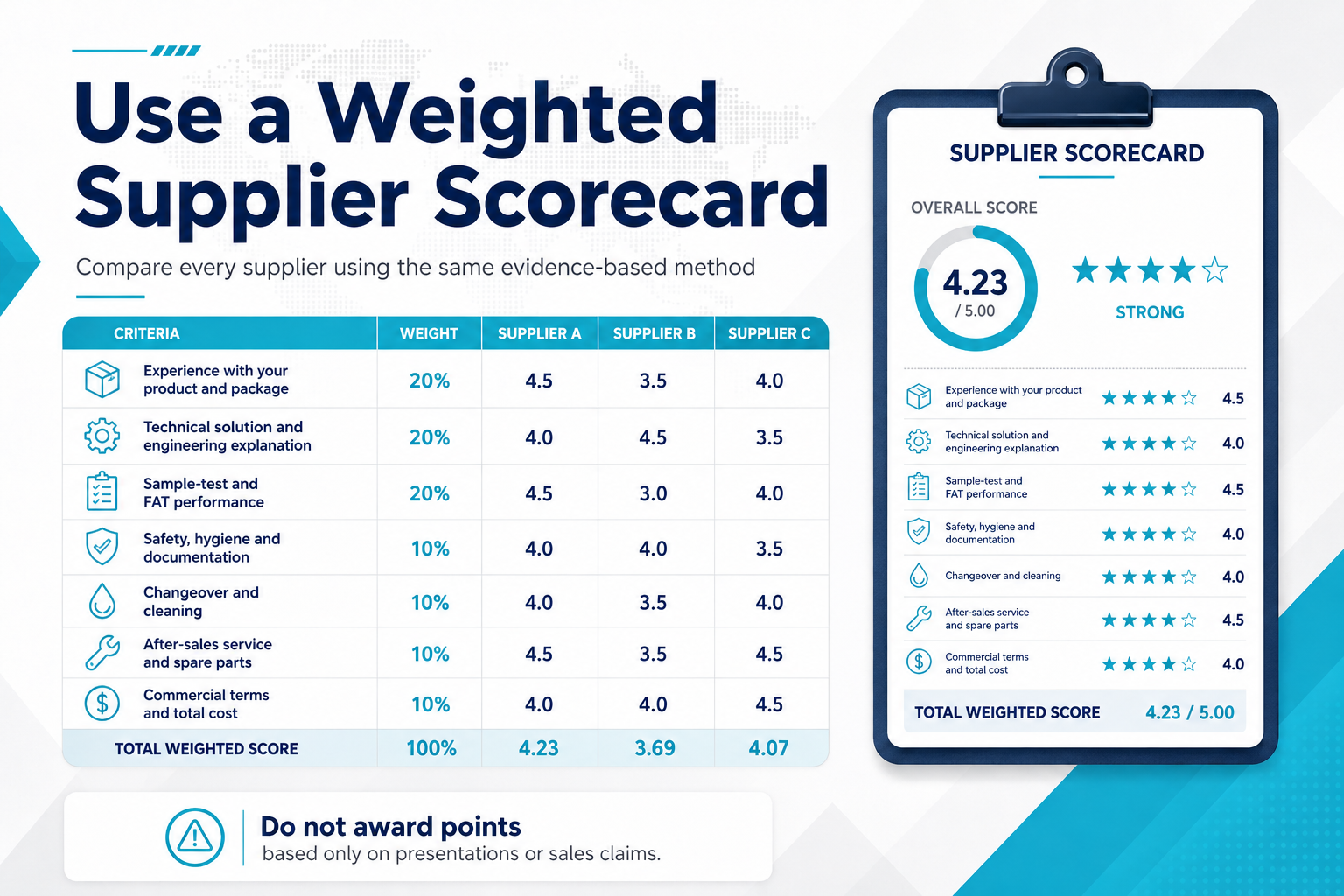
Use the same scoring method for every filling machine supplier in China.
| Evaluation item | Suggested weight |
|---|---|
| Experience with your product and package | 20% |
| Technical solution and engineering explanation | 20% |
| Sample-test and FAT performance | 20% |
| Safety, hygiene and documentation | 10% |
| Changeover and cleaning | 10% |
| After-sales service and spare parts | 10% |
| Commercial terms and total cost | 10% |
Score each category from 1 to 5, multiply it by its weighting and record the evidence supporting the score. Do not award points based only on presentations or sales claims.
A supplier that is 10% more expensive but proves stable operation with your samples may represent a lower purchasing risk than the cheapest bidder.
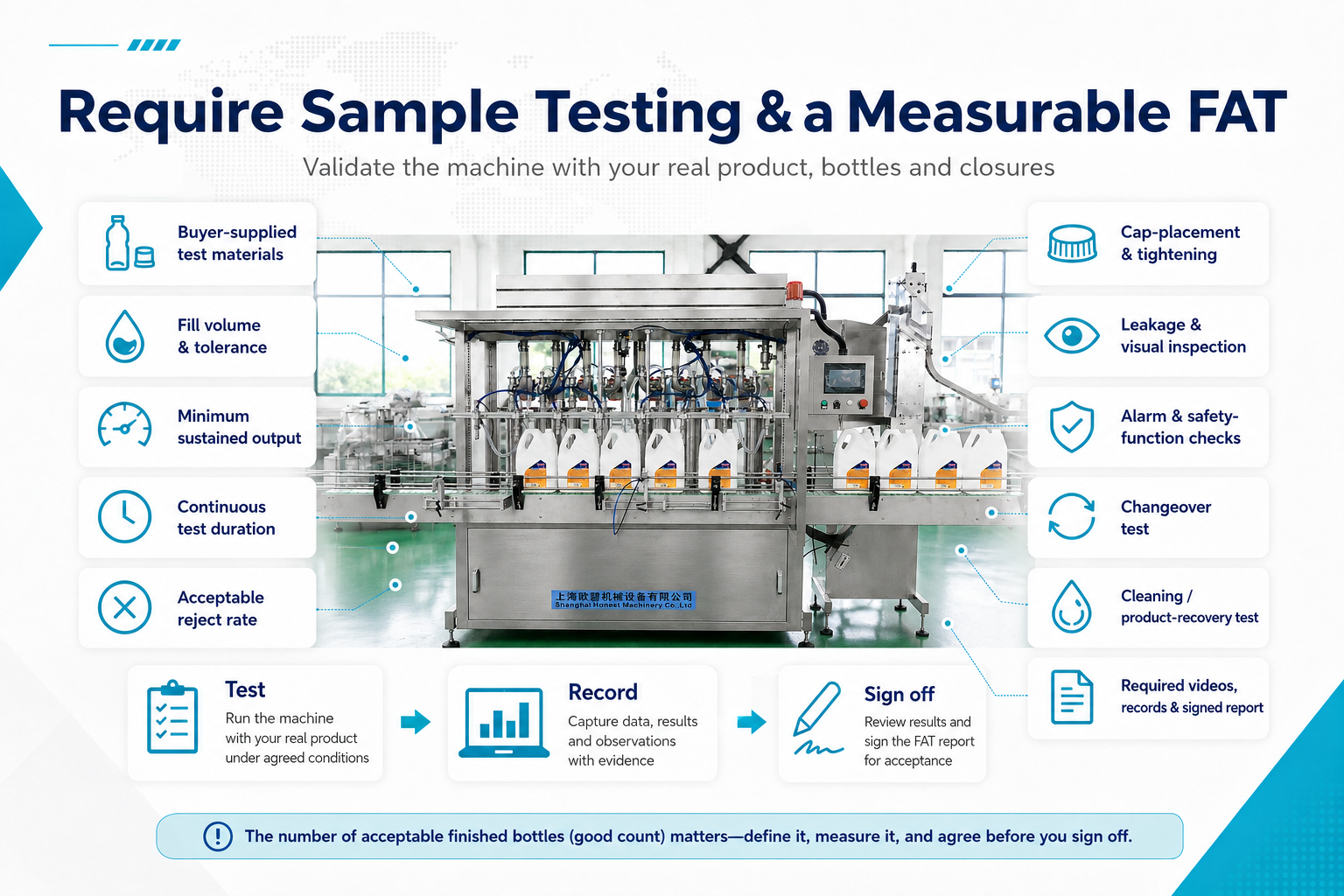
Send enough product, bottles, caps and labels for testing before final machine approval. Testing with water or an empty conveyor does not validate a system intended for honey, shampoo, adhesive or solvent.
Your Factory Acceptance Test should define:
- Test materials supplied by the buyer
- Target fill volume and tolerance
- Minimum sustained output
- Continuous test duration
- Acceptable reject rate
- Cap-placement and tightening requirements
- Leakage and visual inspection standards
- Alarm and safety-function checks
- Changeover test
- Cleaning or product-recovery test
- Required videos, records and signed report
Record the number of acceptable finished bottles—not just the number entering the machine.
For larger projects, consider hiring an independent inspection company to verify the machine, nameplate, components, accessories, documents and packing before the balance payment.
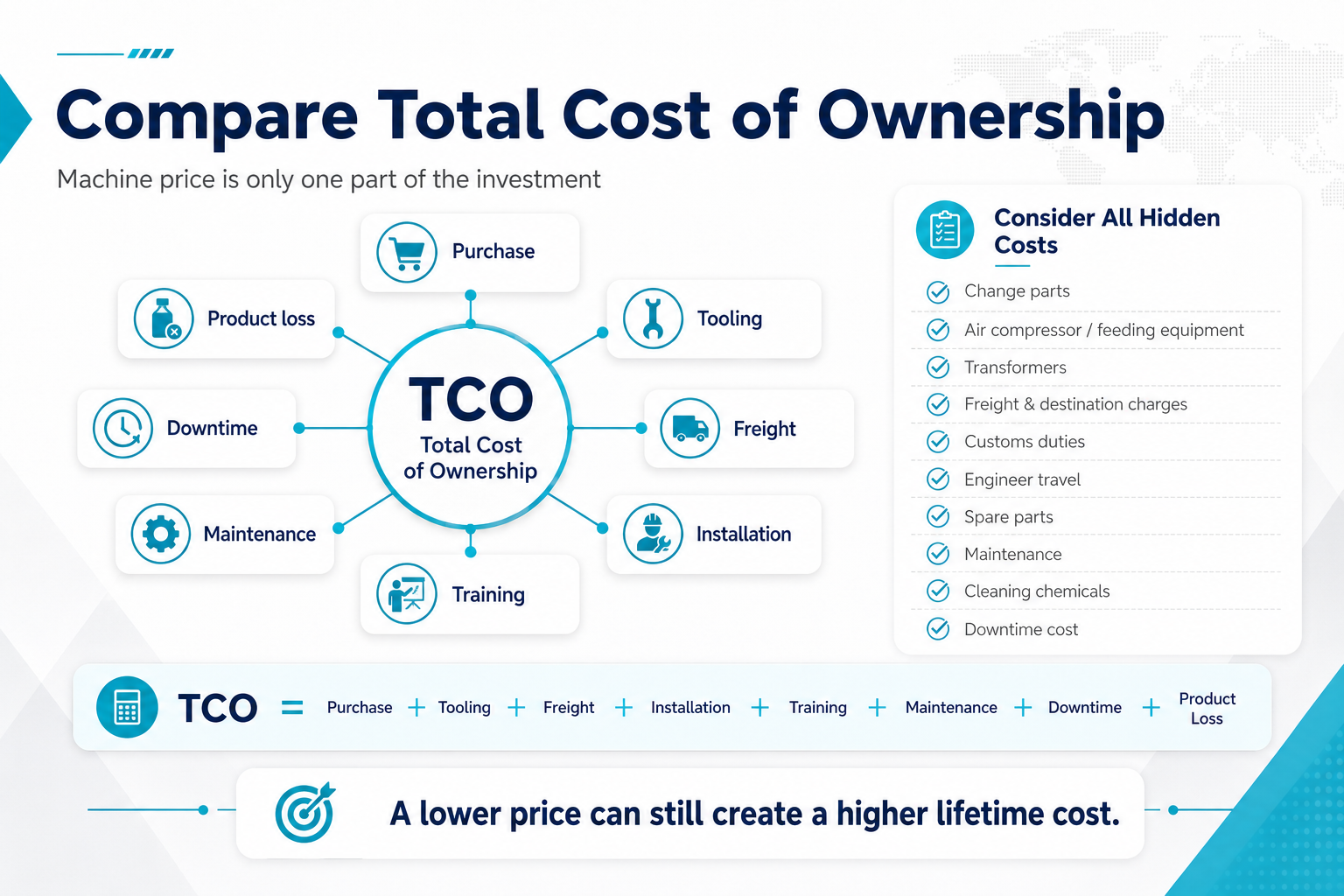
Machine price is only one part of the investment.
Calculate:
TCO=Purchase+Tooling+Freight+Installation+Training+Maintenance+Downtime+Product Loss
Include:
- Change parts for every bottle
- Air compressor or product-feeding equipment
- Voltage transformers
- Freight and destination charges
- Customs duties and taxes
- Installation and engineer travel
- Recommended spare parts
- Preventive-maintenance costs
- Expected product giveaway
- Cleaning chemicals and labour
- Estimated downtime cost
Also state the chosen Incoterm and named place in the contract. Incoterms define how transport tasks, costs and risks are divided between seller and buyer. ICC Incoterms® 2020
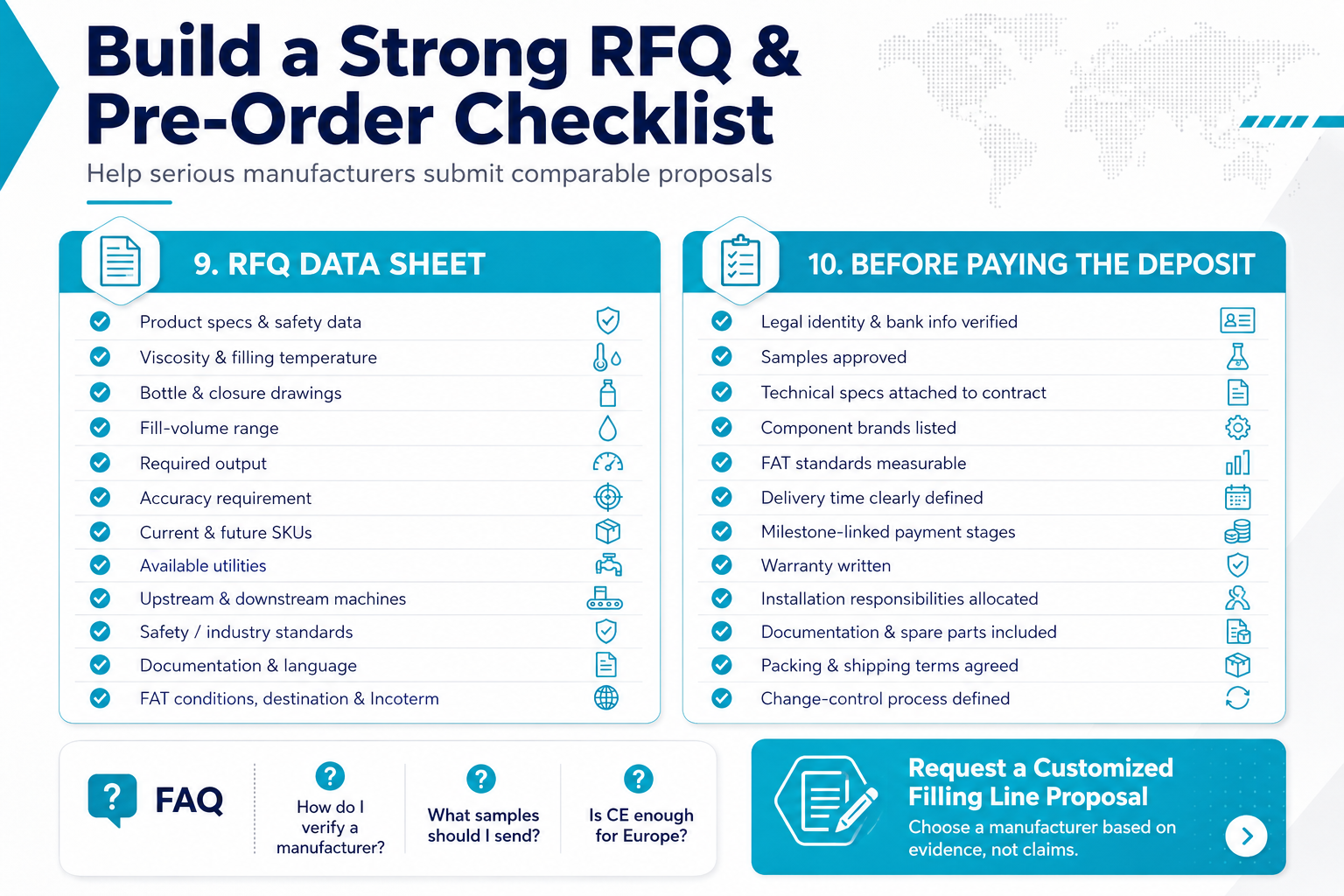
A strong RFQ helps serious manufacturers submit comparable proposals. Attach a project data sheet containing:
- Product specifications and safety data, where applicable
- Product viscosity and filling temperature
- Bottle and closure drawings
- Fill-volume range
- Required output
- Accuracy requirement
- Current and future SKUs
- Available factory utilities
- Required upstream and downstream machines
- Applicable safety or industry standards
- Required documentation and language
- FAT conditions, delivery destination and requested Incoterm
For a complete project, review the available automatic filling line solutions before deciding whether you need only a filler or an integrated filling, capping and labeling line.
The best filling machine manufacturer in China is not necessarily the largest factory or the lowest bidder. It is the supplier that understands your product, proves the proposed solution with real samples, accepts measurable performance criteria and supports the machine after installation.
Shanghai Honest Machinery provides customized automatic filling, capping, labeling and packaging solutions for small bottles, food and sauce products, cosmetics, pharmaceuticals and chemical applications. Send us your product information, bottle and closure samples, fill range and required output. Our engineering team will review the application and prepare a configuration based on your actual production conditions.
Request a Customized Filling Line Proposal