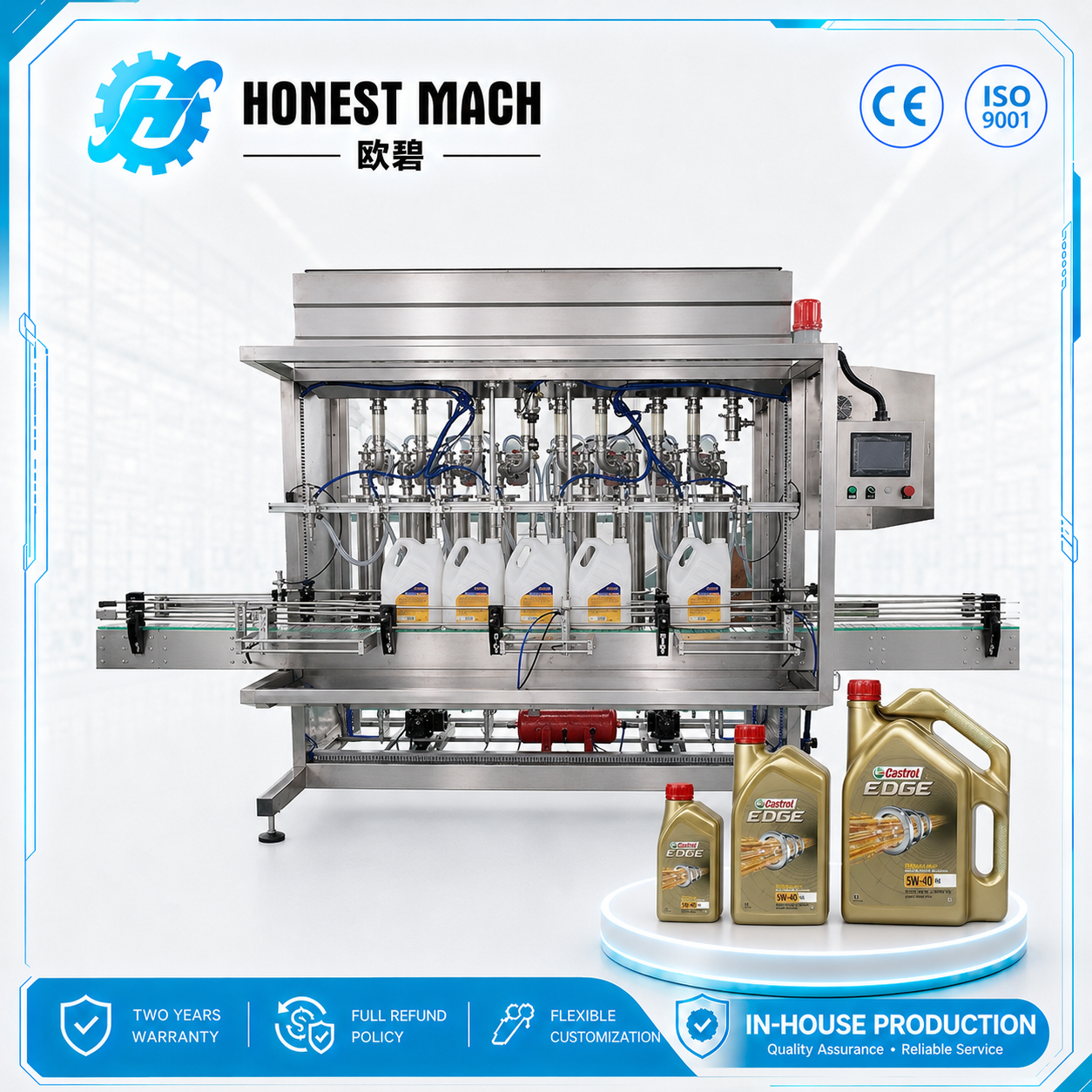
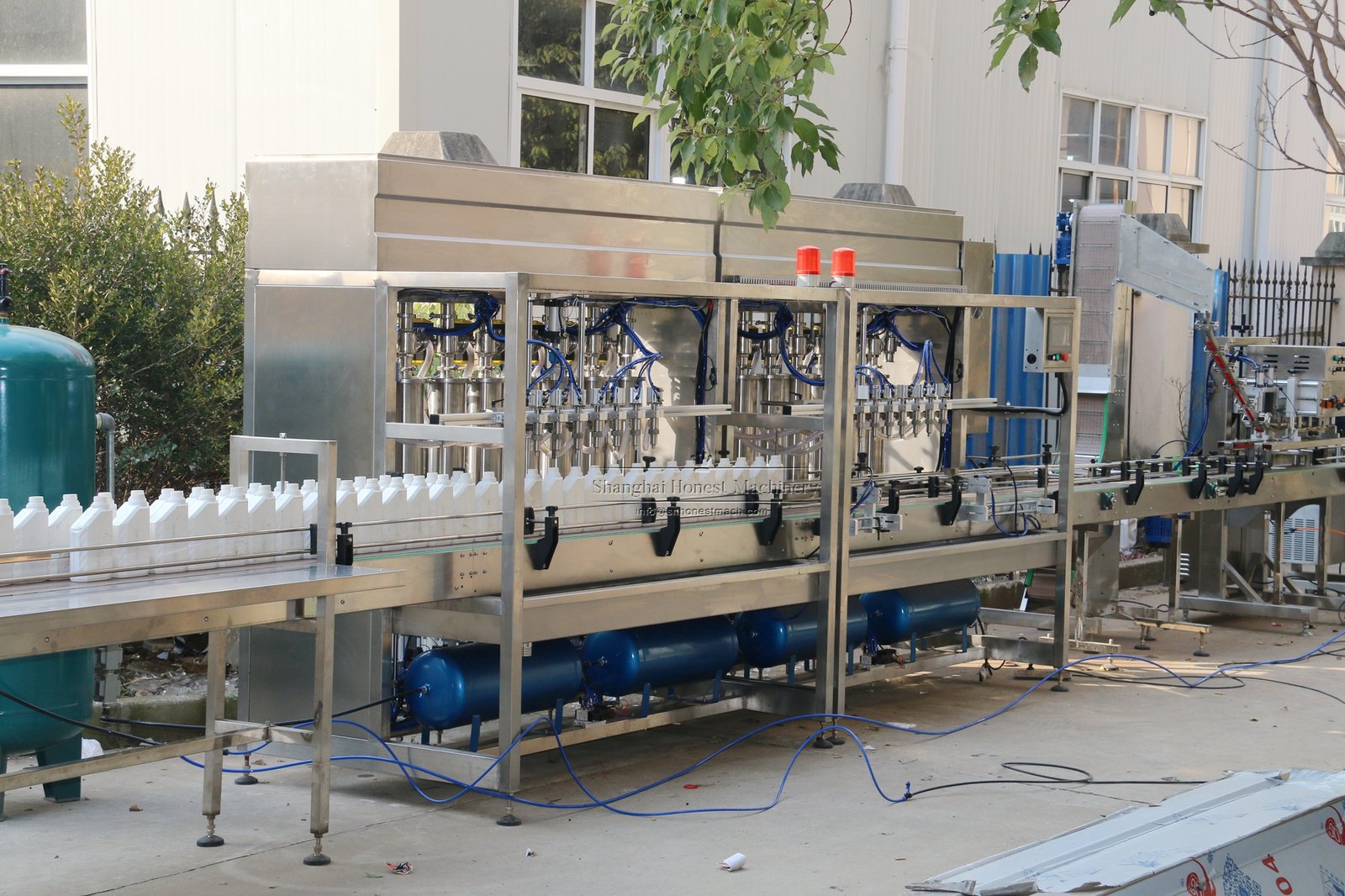
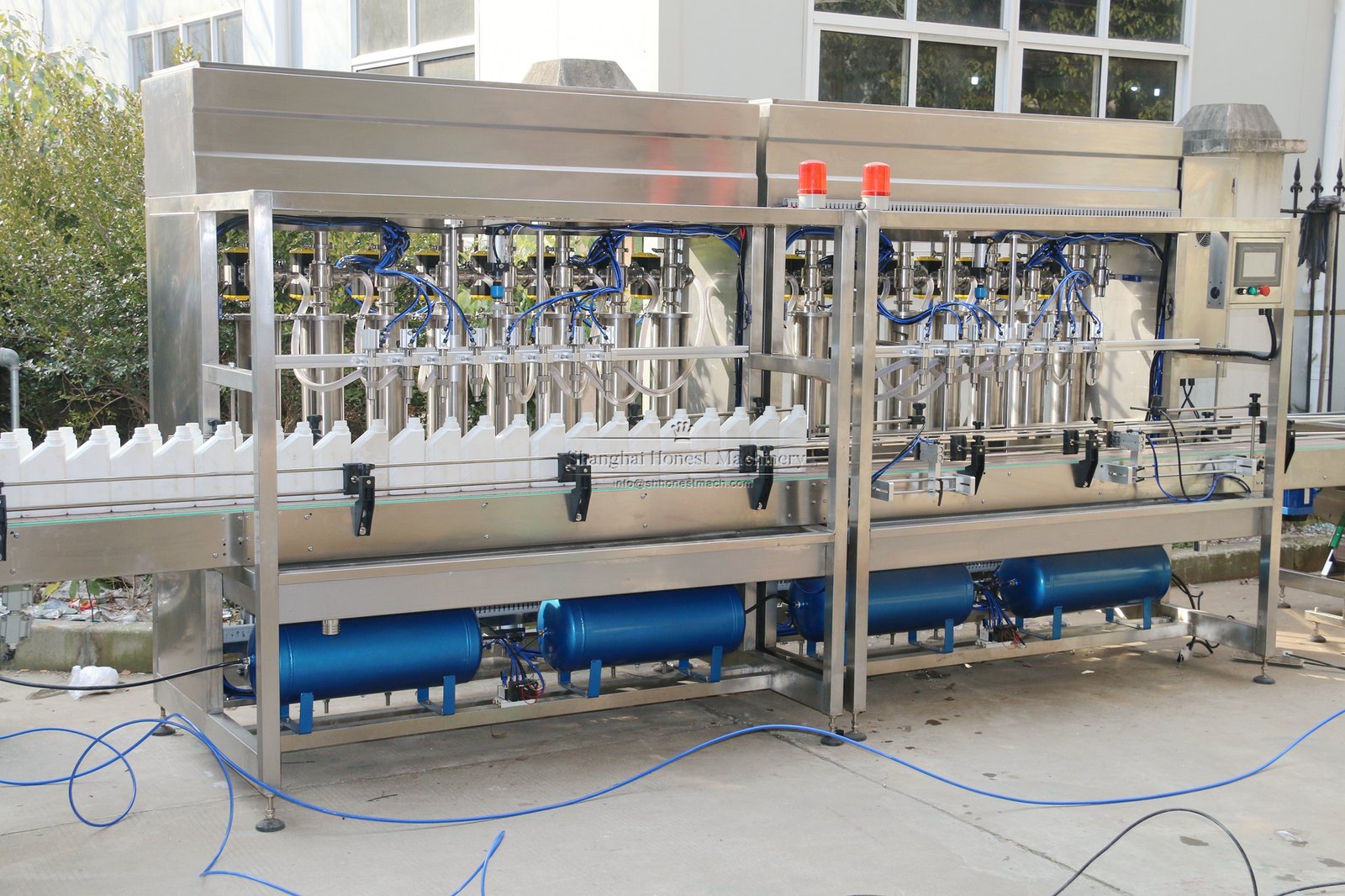
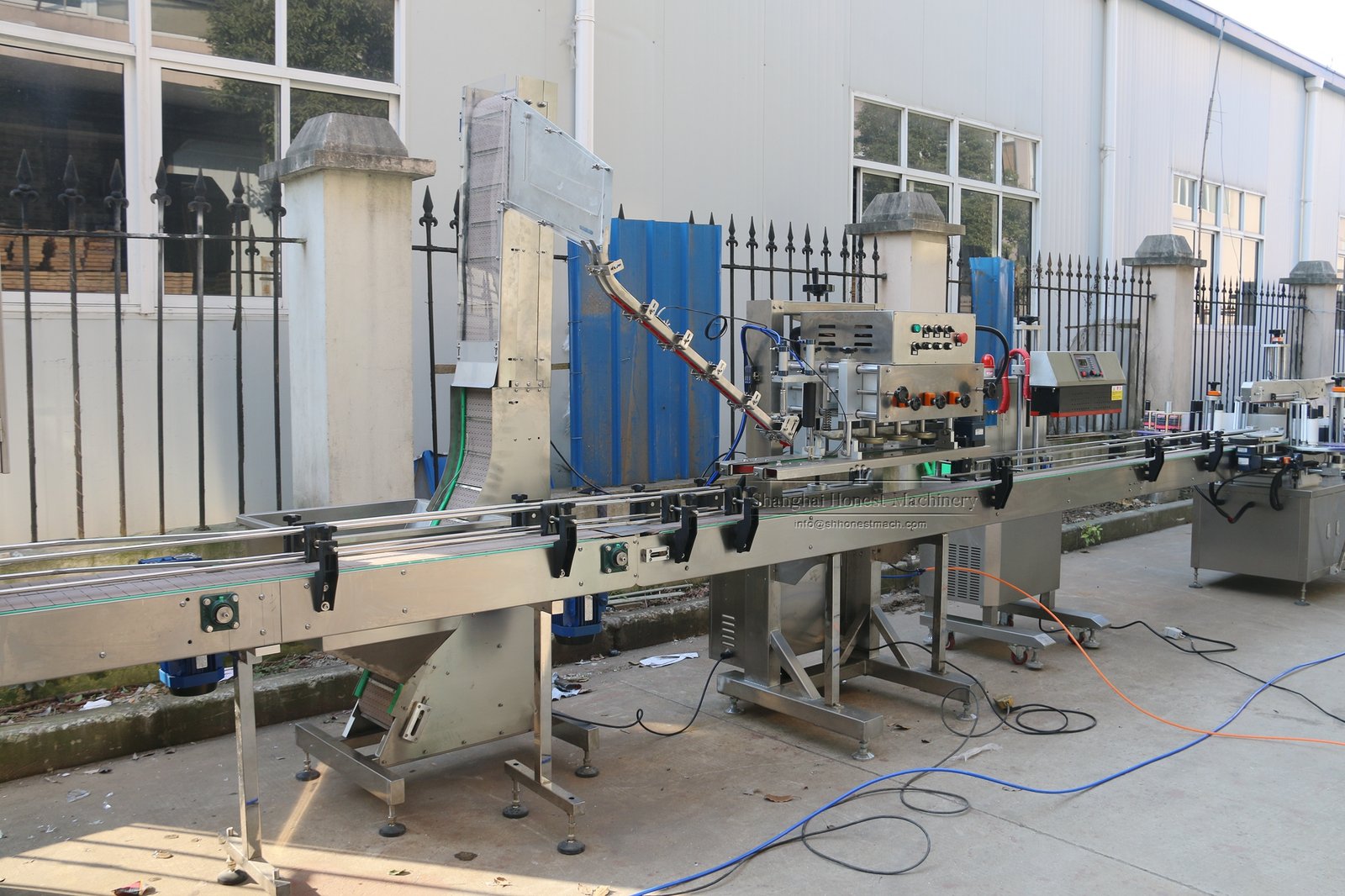
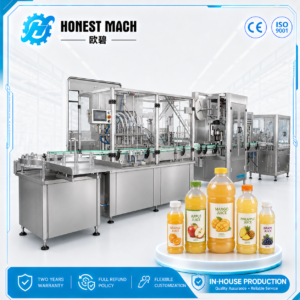
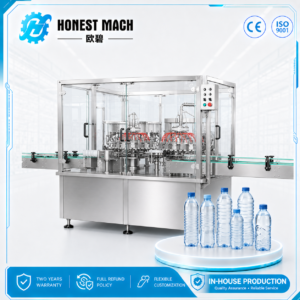
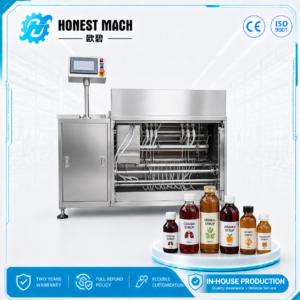
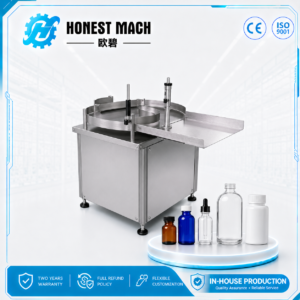
Lubricant oil filling machine
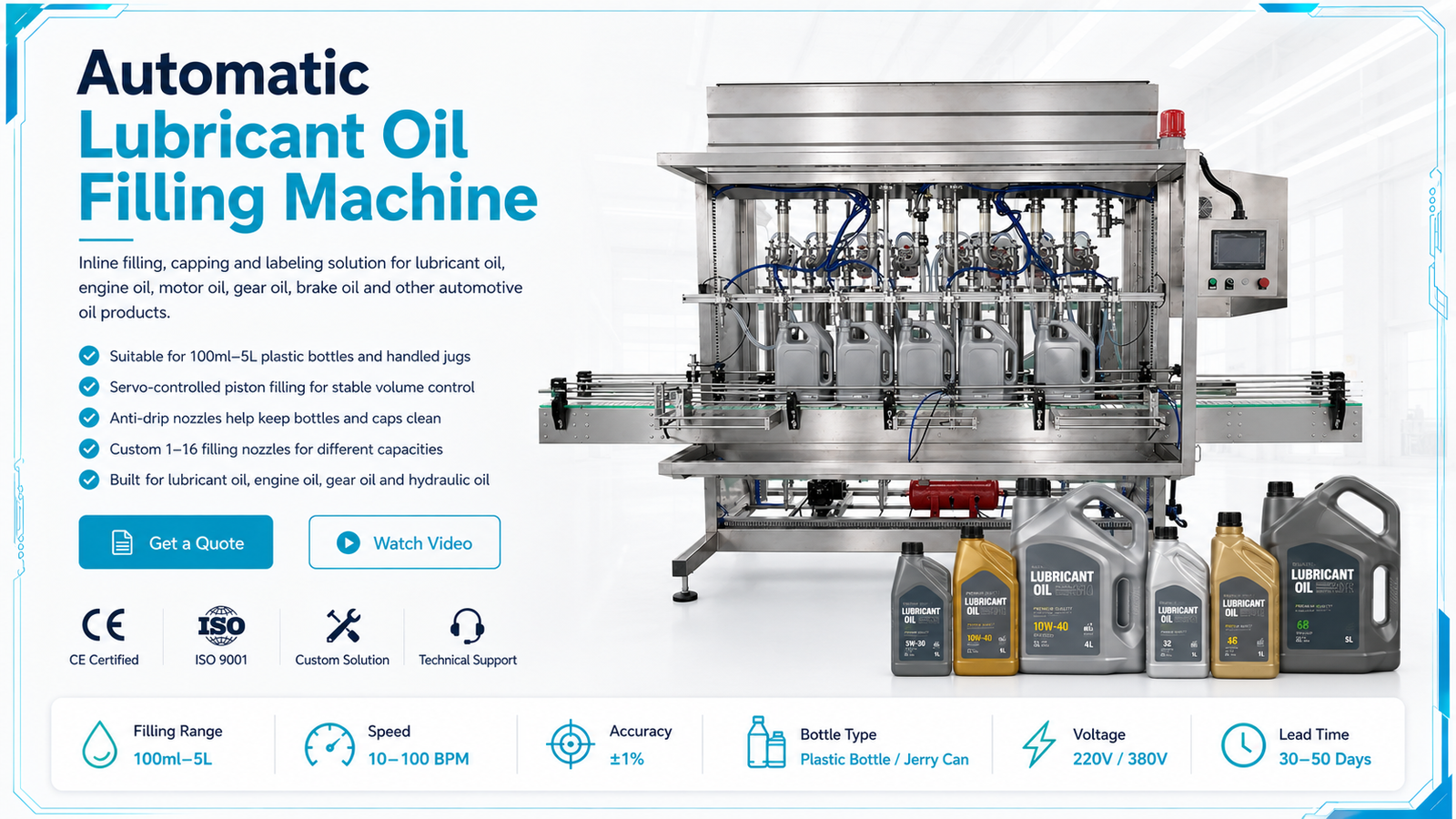
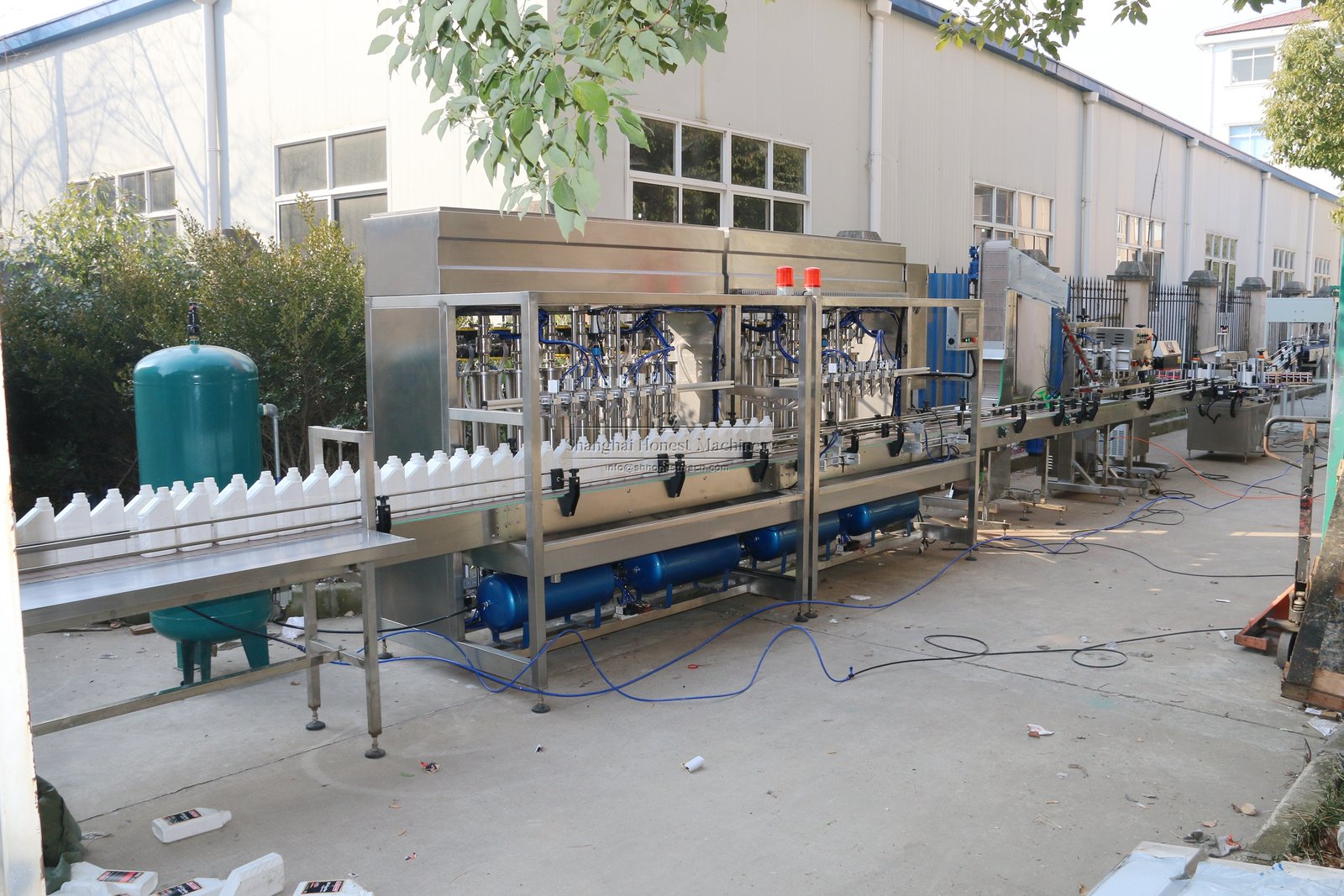
Inline filling, capping and labeling solution for lubricant oil, engine oil, motor oil, gear oil, brake oil and other automotive oil products.
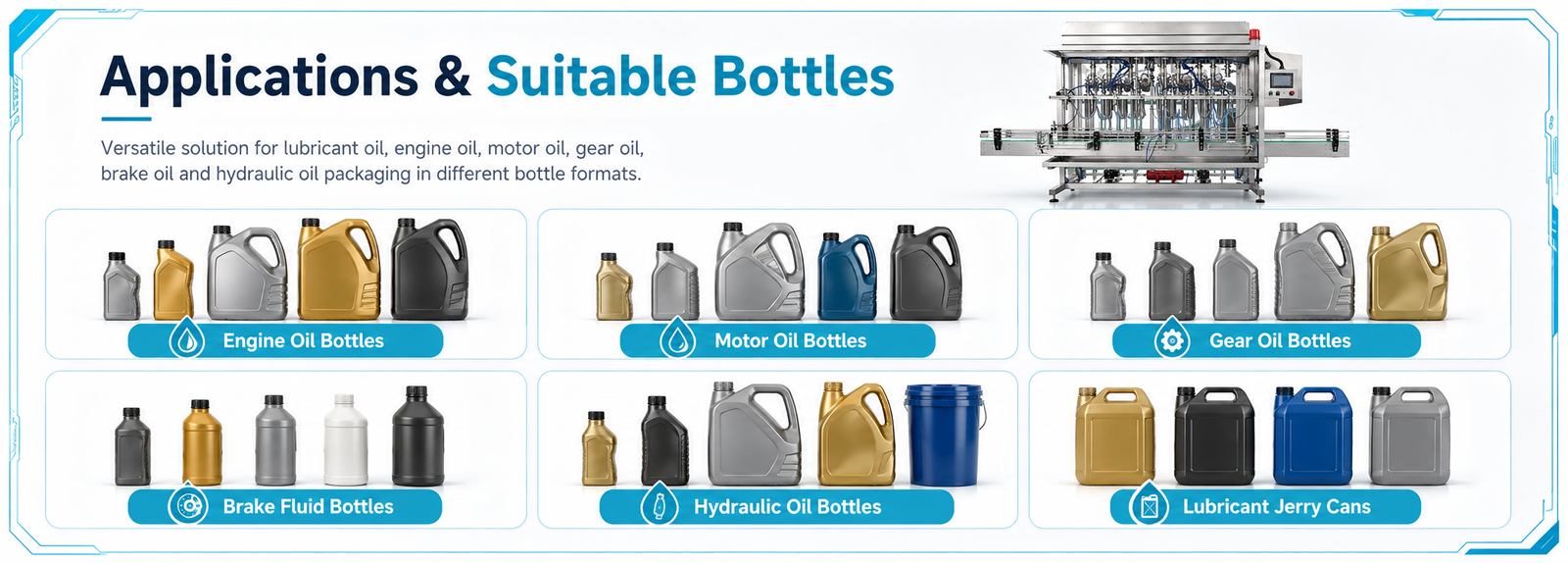
Our automatic lubricant oil filling machine is designed for filling lubricant oil, engine oil, motor oil, gear oil, brake oil, hydraulic oil, transmission oil and other automotive or industrial oil products into 0.5L, 1L, 2L, 4L and 5L plastic bottles or handled jugs.
This inline lubricant oil filling machine can be customized according to your bottle volume, oil viscosity, cap type, filling accuracy requirement and target production capacity. For lubricant oil and engine oil products, flow meter filling, piston filling or net weight filling can be selected to achieve stable filling volume and reliable production performance.
Key Features:
- Suitable for automotive oils such as lubricant oil, engine oil, motor oil, gear oil, brake oil, hydraulic oil and transmission oil.
- Custom filling system with flow meter, piston or net weight filling according to oil viscosity and accuracy requirements.
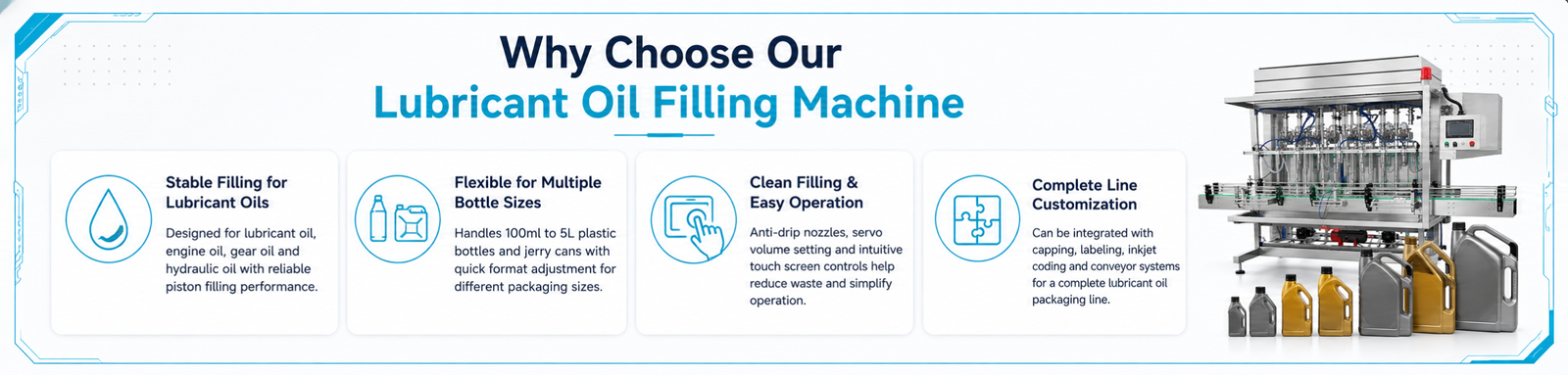
- Anti-drip filling nozzles help reduce oil leakage and keep bottle mouths clean before capping.
Tell us your oil type, bottle size, oil viscosity, cap style and target capacity. We will recommend a suitable lubricant oil filling and bottling solution for your production.
What we can offer you?
-
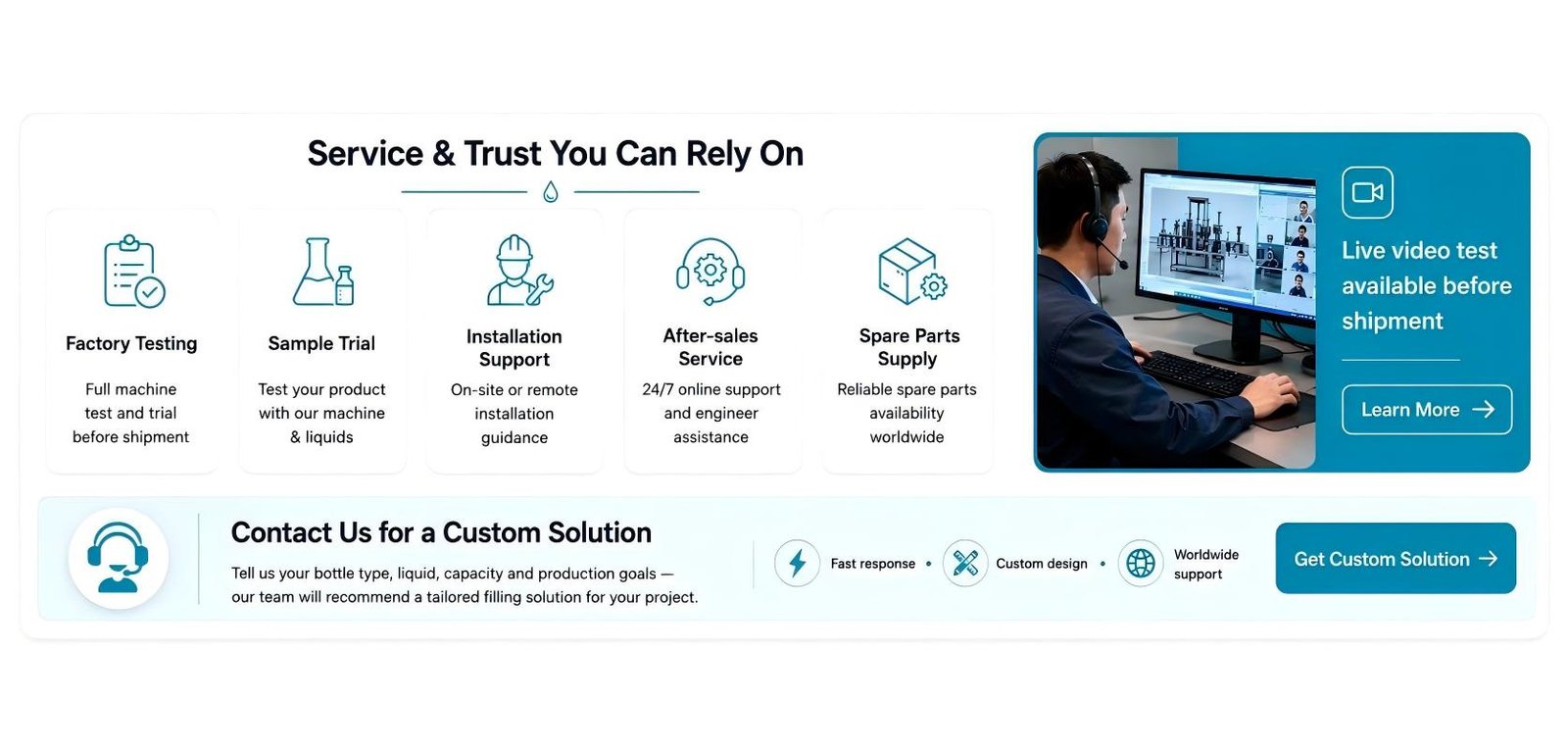
100% Refund Policy
If the quality is poor or it can’t run your product, we guarantee a 100% full refund for your peace of mind
-
Two years warranty
Any equipment purchased from us comes with a two-year warranty.we provide free replacements and cover shipping for parts under 10kg damaged due to quality issues, not deliberate damage
-
Attentive after-sales service
We promise: all equipment purchased from us is backed by comprehensive after-sales service and lifetime benefits.
-
Timely production and delivery
We oversee the entire process from receiving samples to design and production, providing timely photos and videos to showcase the entire process to ensure the efficiency of equipment production and timely delivery
Parameter:
- Model: Automatic lubricant oil filling machine
- Filling volume: 100ml-5L(customized)
- Filling nozzles: 1-16 nozzles for your optional(customized)
- Filling speed: 10-100BPM for your optional(customized)
- Filling method: Piston pump for filling with servo motor control
- Filling accuracy: ±1%(according to product)
- Capping rate: ≥99.99%
- Power supply: Single phase 110V/220V,50/60Hz or three phase 380V/440V 50/60Hz(customized)
- Total dimension: 2300mm*1650mm*2250mm(customized)
Highlight:
1.It use piston pumps for filling, suitable for materials of different viscosities.
2.With servo motor control, it can automatically adjust the filling volume, making it convenient for customer operation and use
1.All connections adopt quick release joint,easy to dismantle and maintain,reduce the cost of the use and maintenance,save the time
What you can get with our automatic lubricant oil filling machine
Related Products:
FAQ:
This becomes important when the same line produces products such as 5W-30 engine oil, 10W-40 motor oil, gear oil and hydraulic oil, because even a small amount of the previous batch may affect the next product’s formulation or color.
A suitable changeover procedure should consider the complete product-contact path, including the:
- holding tank,
- filling cylinders or pumps,
- hoses and piping,
- valves,
- and filling nozzles.
For frequent grade changes, the machine can be designed with quick-release connections to make product-contact parts easier to dismantle and clean. Your current lubricant oil filler already uses quick-release joints for easier maintenance and cleaning.
For customers producing many lubricant SKUs every day, we recommend defining the acceptable residual carryover between grades before machine design. This helps determine whether normal flushing is sufficient or whether dedicated product-contact components are more appropriate.
Yes. Lubricants are not simply base oil. Different formulations may contain detergents, dispersants, anti-wear additives, viscosity modifiers or other chemical packages that can affect elastomers differently over long-term use.
Therefore, machine selection should consider more than viscosity alone.
For a new project, it is useful to provide:
- oil type,
- viscosity range,
- SDS or relevant chemical information,
- operating temperature,
- and any known material restrictions.
Lubricant filling equipment manufacturers commonly offer different sealing materials such as Viton, PTFE or other chemically resistant options depending on the oil formulation and service conditions.
This is especially important when one machine will handle several specialty industrial lubricants instead of only standard automotive engine oil.
Air entrained in lubricant can create an overlooked filling problem.
If the oil reaches the filler immediately after aggressive mixing or high-speed pumping, trapped air may change the apparent product volume and cause unstable fill results even when the filling machine itself is repeating correctly.
In these cases, the solution is not always to recalibrate the filler. The upstream process may need to provide:
- more stable product supply,
- sufficient settling time,
- lower-turbulence transfer,
- or an appropriately sized buffer tank.
Industry troubleshooting guidance for engine-oil filling specifically identifies aeration, temperature and supply conditions as variables that can affect dose consistency.
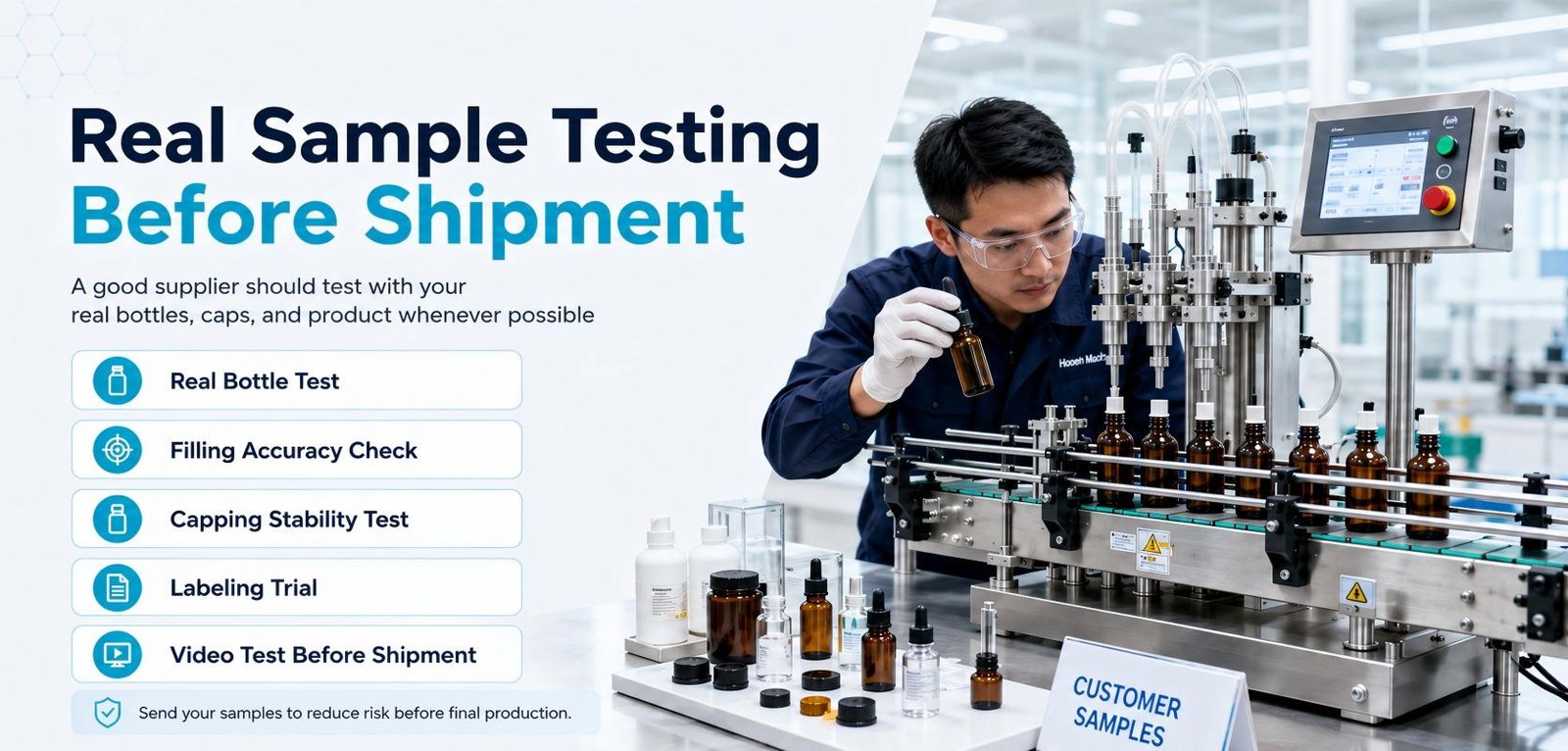
For FAT, we therefore recommend testing the machine using oil that represents the real production condition rather than only a perfectly settled laboratory sample.
Because machine output is determined by more than the number of filling nozzles.
A 5L lubricant jug takes significantly longer to fill than a 1L bottle. Large handled containers may also require slower conveyor movement and more time for:
- bottle positioning,
- filling,
- cap feeding,
- capping,
- and downstream labeling.
Your current machine can be configured with 1–16 filling nozzles and approximately 10–100 BPM, but the final output depends on the actual filling volume, oil properties and packaging configuration.
Other lubricant-equipment suppliers likewise specify capacity according to both nozzle quantity and filling volume rather than giving one universal speed for every container.
So when comparing quotations, buyers should ask for the guaranteed output using the actual bottle volume, for example:
1L @ required BPH
versus
4L/5L @ required BPH
rather than comparing only the headline maximum speed.
Yes. These packaging steps can be integrated into the lubricant oil line depending on your bottle and closure design.
For automotive lubricants, the finished package may require more than filling and ordinary capping. A complete project can include:
Filling → Cap Feeding → Capping → Induction Sealing → Labeling → Batch/Lot Coding → Carton Packing
Tamper-evident closures or induction foil sealing are particularly useful when the brand needs stronger leak protection, product integrity or visible evidence that the package has not been opened.
Current lubricant filling lines from major suppliers are commonly designed to integrate filling with capping, sealing, labeling, coding and downstream packaging rather than operating the filler as an isolated machine.
For accurate machine design, we recommend sending the actual bottle, cap, inner seal or foil specification together, because the capping and sealing sections need to match the real packaging components.

Let’s start this journey together!
Revolutionize your production with our bottling machines!Share your needs and we’ll be in touch with a tailored quote within 48 hours.
SEND BELOW INQUIRY